

You don’t need to be fit to start. You need to start to get fit.

If you’re new to exercise and want to lose belly fat, the amount of conflicting advice out there is overwhelming. Do HIIT. Lift weights. Run. Do a hundred crunches. Try yoga. Try everything.
The truth is simpler than the noise suggests: the best exercises for beginners to lose belly fat are the ones you can actually do consistently, that don’t require equipment or a gym membership, and that address both calorie burn and body composition simultaneously.
This guide cuts straight to what works — with clear explanations of why each exercise helps, how to do it correctly, and how to build it into a routine that produces real results.
First: Why Crunches Won’t Lose Your Belly Fat
Let’s address this upfront because it’s one of the most persistent myths in fitness.
Crunches, sit-ups, and ab exercises build the muscles underneath your belly fat — but they don’t burn the fat itself. You cannot spot-reduce fat from a specific area by exercising that area. Your body decides where to pull fat from based on genetics, hormones, and overall energy balance — not which muscles are working.
The exercises that actually reduce belly fat do so by burning calories, improving insulin sensitivity, reducing cortisol, and building lean muscle that raises your resting metabolic rate. None of those things require crunches.
As we cover in our guide to how to get rid of belly fat, the combination of full-body strength training, cardio, and daily walking is what moves the needle — not isolated ab work.
The Beginner Exercise Framework
Before the exercises, here’s the structure that produces the best results for beginners:
3 days per week: Full-body strength training (bodyweight) Daily: Walking — 8,000–10,000 steps 1–2 days per week: Light cardio or HIIT (added after the first 2–3 weeks) Rest: At least one full rest day per week
This framework covers all the bases — building muscle to raise metabolism, burning calories through cardio, and accumulating daily movement through walking. It takes roughly 90–120 minutes of structured exercise per week and produces meaningful results within 4–6 weeks of consistency.
Part 1: The Best Beginner Cardio Exercises for Belly Fat
1. Walking
Walking is the single best starting exercise for beginners — and one of the most underrated fat loss tools at any level.
It burns calories without spiking cortisol (which would promote belly fat storage), improves insulin sensitivity, is safe for almost everyone regardless of fitness level, requires no equipment, and can be done daily without recovery time.
Target: 8,000–10,000 steps per day. Start where you are and add 1,000 steps per week until you hit the target.
Why it specifically helps belly fat: Walking after meals is particularly effective — a 10–15 minute walk after eating reduces the post-meal blood sugar and insulin spike by 20–30%, directly reducing the insulin-driven fat storage that contributes to belly fat. As we cover in our article on does cardio actually burn belly fat, walking combined with strength training is one of the most effective fat loss pairings available.
How to progress: Increase pace, add incline, or extend duration as fitness improves.
2. Marching in Place
For complete beginners, marching in place is an accessible way to elevate heart rate without joint stress.
How to do it: Stand tall and march in place, bringing knees to hip height. Pump arms naturally. Start with 3 minutes and build to 10.
Calories burned: Roughly 200–300 per hour — modest but a genuine starting point for people who are very deconditioned.
Progress to: High knees (faster marching with knees higher) once comfortable.
3. HIIT for Beginners
High-intensity interval training is one of the most time-efficient fat loss tools available — and beginner versions are accessible even for people with low fitness levels.
Basic beginner HIIT structure:
- 20 seconds of moderate effort
- 40 seconds of rest
- Repeat 8–10 rounds
- Total time: ~10 minutes
Beginner-friendly HIIT exercises:
- Marching in place at a fast pace
- Step touches (side to side)
- Low-impact jumping jacks (step out instead of jump)
- Slow mountain climbers
As fitness improves over weeks, increase work period to 30 seconds, decrease rest to 30 seconds, and progress to higher-impact versions.
Why it helps belly fat specifically: HIIT improves insulin sensitivity significantly and produces an afterburn effect (EPOC) that continues burning calories for hours after the workout — both of which specifically target visceral fat reduction.
Part 2: The Best Beginner Strength Exercises for Belly Fat
This is where most beginners underinvest — and it’s arguably more important than cardio for belly fat loss. Strength training builds lean muscle that raises resting metabolic rate and improves insulin sensitivity, addressing the root hormonal drivers of belly fat accumulation.
You don’t need a gym. These exercises use only your bodyweight and produce genuine results.
4. Bodyweight Squats
Muscles worked: Quads, hamstrings, glutes, core Reps: 3 sets of 10–15
How to do it: Stand with feet shoulder-width apart, toes slightly turned out. Lower your hips as if sitting back into a chair, keeping chest up and knees tracking over toes. Lower until thighs are parallel to the floor (or as low as comfortable). Press through heels to return to standing.
Why it helps belly fat: Squats recruit the largest muscle groups in the body — more muscle activation means more calories burned and greater insulin sensitivity improvement per exercise than any isolation movement.
Beginner modification: Squat to a chair or bench to reduce range of motion until strength and mobility improve.
Progression: Add a pause at the bottom, slow the descent, or progress to jump squats as fitness improves.
5. Push-Ups
Muscles worked: Chest, shoulders, triceps, core Reps: 3 sets of 8–12 (or as many as possible with good form)
How to do it: Start in a plank position — hands slightly wider than shoulder-width, body in a straight line from head to heels. Lower chest toward the floor keeping elbows at roughly 45 degrees from your body. Press back to start.
Beginner modification: Perform on knees until upper body strength develops for full push-ups. This is completely valid and produces real strength gains.
Why it helps belly fat: Push-ups build upper body muscle that contributes to overall metabolic rate, and the core engagement required throughout the movement trains abdominal stability without the compressive forces of crunches.
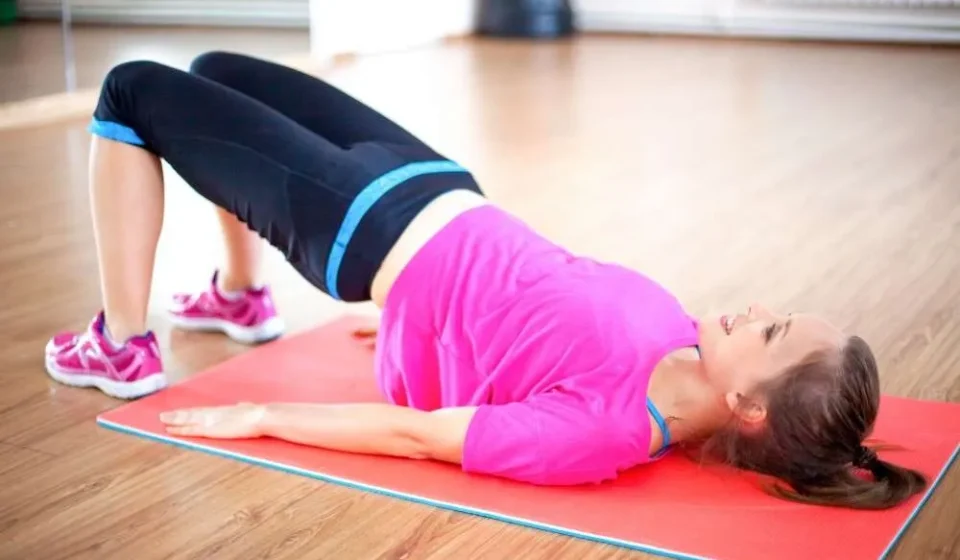
6. Glute Bridges
Muscles worked: Glutes, hamstrings, lower back, core Reps: 3 sets of 15–20
How to do it: Lie on your back with knees bent and feet flat on the floor, hip-width apart. Press through heels and squeeze glutes to lift hips toward the ceiling until body forms a straight line from knees to shoulders. Hold briefly at the top, then lower slowly.
Why it helps belly fat: Glutes are the largest muscle group in the body. Strengthening them contributes significantly to overall metabolic rate and improves the posterior chain strength needed for more demanding exercises.
Progression: Progress to single-leg glute bridges (one foot lifted) as strength improves.
7. Reverse Lunges
Muscles worked: Quads, glutes, hamstrings, core Reps: 3 sets of 10 per leg
How to do it: Stand tall with feet together. Step one foot back and lower the back knee toward the floor until both knees are at roughly 90 degrees. Front knee should stay above the ankle, not pushing forward over the toes. Push through the front heel to return to standing.
Why reverse lunges over forward lunges for beginners: Reverse lunges place less stress on the knee joint and are easier to balance for beginners while still recruiting the same muscle groups effectively.
Progression: Add a knee drive at the top (bringing back knee up to hip height) or hold light weights.
8. Dumbbell or Resistance Band Rows (or Bent-Over Rows)
Muscles worked: Back, biceps, rear shoulders, core Reps: 3 sets of 12 per arm
How to do it (without equipment): Place one hand and same-side knee on a chair or sturdy surface for support. With the opposite hand, reach down and mimic pulling a heavy object up toward your hip — focusing on squeezing the back muscle rather than using the arm.
With a resistance band: Stand on the band, hinge forward slightly, and pull both ends up toward your hips.
Why it helps belly fat: Rows train the back — one of the largest muscle groups in the upper body — which significantly contributes to overall metabolic rate. Most beginners neglect back training entirely, leaving significant fat loss benefit on the table.
9. Dead Bug
Muscles worked: Deep core, transverse abdominis, lower back Reps: 3 sets of 8–10 per side
How to do it: Lie on your back with arms extended toward the ceiling and knees bent at 90 degrees (like a table-top position). Press lower back into the floor. Slowly lower opposite arm and leg toward the floor simultaneously — keeping lower back pressed down throughout. Return to start and repeat on the other side.
Why this instead of crunches: Dead bugs train the deep core muscles that actually support posture, stabilize the spine, and reduce lower back pain — without the spinal flexion of crunches that can worsen lower back issues. They’re also safe for people with diastasis recti, unlike crunches.
10. Plank (Modified)
Muscles worked: Full core, shoulders, glutes Duration: 3 sets of 20–30 seconds, building to 60 seconds
How to do it: Start on forearms and knees (modified) or forearms and toes (full). Body should form a straight line from head to knees or heels. Engage core, squeeze glutes, and breathe. Don’t let hips sag or rise.
Beginner modification: Start on knees and forearms. Progress to full plank as core strength develops.
Why it helps belly fat: Planks build core endurance that supports all other exercises, improves posture, and builds the functional core strength that transfers to daily movement and more demanding workouts.
The Beginner Workout Plan
Here’s how to put it all together into a complete three-day weekly program:
Workout A (Monday)
- Bodyweight squats — 3 x 12
- Push-ups (modified if needed) — 3 x 8
- Glute bridges — 3 x 15
- Dead bug — 3 x 8 per side
- Plank (modified) — 3 x 20 seconds
Rest 60–90 seconds between sets. Total time: ~25 minutes.
Workout B (Wednesday)
- Reverse lunges — 3 x 10 per leg
- Rows — 3 x 12 per arm
- Push-ups — 3 x 8
- Glute bridges — 3 x 15
- Plank — 3 x 25 seconds
Workout C (Friday)
- Bodyweight squats — 3 x 15
- Push-ups — 3 x 10
- Reverse lunges — 3 x 12 per leg
- Rows — 3 x 12
- Dead bug — 3 x 10 per side
- Plank — 3 x 30 seconds
Daily: Walk 8,000+ steps, with particular focus on a post-meal walk after dinner.
Week 3 and beyond: Add one beginner HIIT session per week (10–15 minutes) on a non-strength day.
How to Progress Over Time
The first 4–6 weeks are about building the habit and learning the movements. After that, progression is important — your body adapts quickly and needs increasing challenge to continue improving.
Ways to progress without equipment:
- Increase reps gradually (from 12 to 15 to 20)
- Slow down the tempo — a 3-second lowering phase doubles the difficulty of any bodyweight exercise
- Add pauses at the hardest point of the movement
- Progress to harder variations (knee push-ups → full push-ups → decline push-ups)
- Reduce rest periods between sets
Signs you’re ready to progress: You can complete all prescribed reps with good form and feel like you could do more. If the last two reps of each set are genuinely challenging, the weight (or difficulty) is right.
What to Expect and When
Weeks 1–2: Learning movements, mild soreness (DOMS), building the habit. Don’t expect dramatic visual changes.
Weeks 3–4: Movements feel more natural, strength improving noticeably, energy levels improving. Possible small scale changes.
Weeks 5–8: Body composition starting to shift, clothes fitting differently, waist measurements decreasing even if scale is slow.
Weeks 8–12: Real, visible changes in body composition. Strength significantly improved from baseline. The foundation is built for more demanding training if desired.
Belly fat takes time to shift visually — but the underlying changes happening from the first week (improved insulin sensitivity, reduced cortisol from regular exercise, increased muscle mass) are real and accumulating even before you can see them in the mirror.
For the complete picture of everything that drives belly fat loss beyond exercise — including diet, sleep, and stress — our guide on why you’re not losing belly fat covers the full framework.
The Bottom Line
The best exercises for beginners to lose belly fat are not the most complicated or intense ones — they’re the ones you can do consistently, that build real muscle, and that fit into your life without requiring a gym membership or specialized equipment.
Walk daily. Strength train three times a week with compound bodyweight movements. Add a short HIIT session once you’ve built the foundation. Be consistent for 12 weeks before judging results.
That’s it. No crunches required.
Are you just starting out with exercise? Share where you’re beginning and what feels most manageable — encouragement from the community makes a real difference when you’re getting started.