
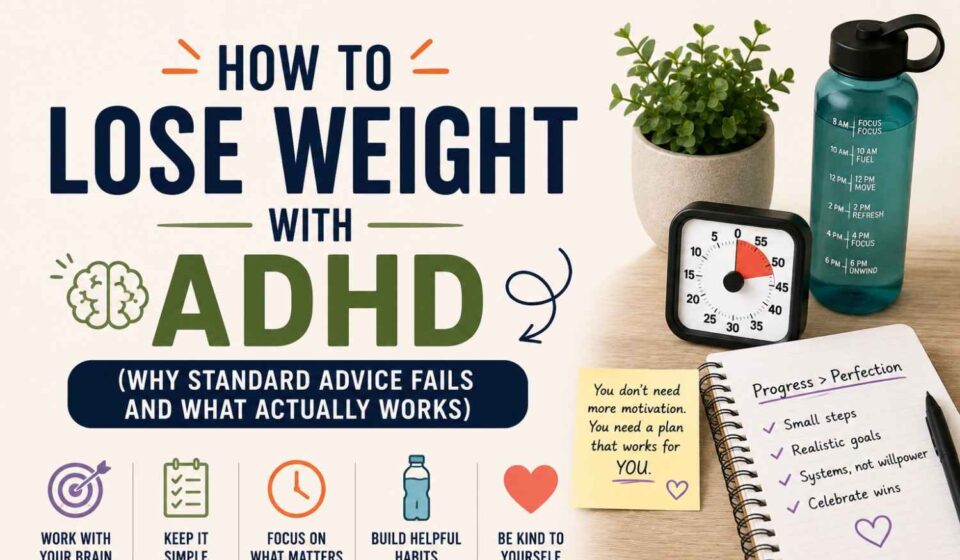
How to Lose Weight With ADHD (Why Standard Advice Fails and What Actually Works)

ADHD affects appetite, impulsivity, executive function, and consistency — here’s an approach that accounts for all of it
Standard weight loss advice might as well be written for a different species when you have ADHD.
“Track your calories consistently.” Requires sustained attention and working memory that ADHD makes genuinely difficult.

“Plan your meals in advance.” Demands the executive function — planning, organization, initiation — that ADHD directly impairs.
“Exercise at the same time every day.” Relies on routine maintenance that many people with ADHD find almost impossible to sustain.
“Just have more willpower.” Completely misunderstands how ADHD works.
People with ADHD aren’t lazy or undisciplined — their brains are wired differently, and those differences affect weight management in specific, well-understood ways. Understanding them is the first step to finding approaches that actually work.
How ADHD Affects Weight and Fat Loss
Impulsive Eating
One of the most direct ADHD-weight connections: impulsivity. ADHD involves impaired inhibitory control — the ability to pause before acting on an impulse. Applied to food, this means:
- Eating without thinking about it
- Grabbing whatever is immediately available rather than making a deliberate choice
- Finishing a bag of chips without noticing
- Ordering the larger option impulsively at a restaurant
- Eating in response to seeing or smelling food rather than from actual hunger
Hyperfocus and Forgetting to Eat
ADHD doesn’t always mean under-eating. But many people with ADHD experience the opposite of impulsive eating — becoming so hyperfocused on a task that they forget to eat for hours, then arriving at extreme hunger that drives impulsive, poor-quality eating choices.
This hunger-then-binge pattern is different from intentional intermittent fasting — it’s dysregulated eating driven by attention problems rather than deliberate strategy.
Dopamine-Seeking and Food
ADHD involves dopamine dysregulation — the brain’s reward pathways function differently, seeking higher-dopamine experiences and having difficulty with activities that provide delayed rather than immediate reward.
Food — particularly high-sugar, high-fat, and high-salt processed food — provides immediate, strong dopamine hits. For people with ADHD whose brains are chronically seeking dopamine, these foods are particularly compelling.
This partly explains why people with ADHD tend toward more impulsive, pleasure-driven food choices than people without — it’s a neurological pull, not a character flaw.
Executive Function and Planning
Eating well requires significant executive function:
- Planning meals in advance
- Making a shopping list and executing it
- Initiating cooking even when it’s not immediately motivating
- Remembering to defrost protein in the morning
- Tracking calories consistently over weeks
ADHD directly impairs all of these functions. The planning that makes healthy eating automatic for neurotypical people is genuinely effortful — and often inconsistent — for people with ADHD.
Emotional Dysregulation and Emotional Eating
ADHD is closely associated with emotional dysregulation — difficulty managing intense emotions, rejection sensitivity, frustration intolerance. As covered in our article on how to lose weight with emotional eating, emotional eating is using food to manage emotional states — and ADHD’s emotional dysregulation makes this pattern more common and more intense.
Sleep Disruption
ADHD and sleep problems are strongly correlated — delayed sleep phase, difficulty falling asleep, and non-restorative sleep are common. As covered in our article on why sleep is the most underrated weight loss tool, sleep deprivation worsens every aspect of weight management — and it’s endemic to ADHD.
Medication Effects on Appetite
ADHD stimulant medications (Adderall, Ritalin, Vyvanse) suppress appetite significantly — often dramatically during the medication’s active period. This can cause under-eating during the day followed by excessive hunger and eating in the evening when medication wears off.
Non-stimulant ADHD medications have variable appetite effects.
The ADHD-Specific Weight Loss Approach
The standard weight loss toolkit needs significant modification for ADHD. The goal: strategies that work with ADHD brain functioning rather than requiring neurotypical executive function.
Principle 1: Design the Environment, Not Willpower
People with ADHD have less behavioral inhibition available — meaning they rely more heavily on environmental cues and less on deliberate decision-making than neurotypical people.
This makes environmental design more important — and more effective — for ADHD weight management than for the general population.
Remove impulsive eating triggers:
- Don’t keep ultra-processed, high-dopamine foods in the home. If they’re not there, the impulsive grab can’t happen.
- Keep healthy, portable protein snacks visible and accessible — Greek yogurt at eye level in the fridge, fruit on the counter, protein bars in the bag.
- Portion snacks into individual serving containers so the “mindless bag finishing” pattern is broken by a physical stopping point.
Make healthy eating the path of least resistance:
- The food that requires zero effort to access and prepare is the food you’ll eat when executive function is depleted. Make that food nutritious.
- Pre-portioned snack boxes assembled on Sunday reduce the decision load of eating throughout the week.
Principle 2: Simplify Aggressively
Complex meal plans fail for ADHD. Meal plans with twelve different recipes, exotic ingredients, and elaborate preparation requirements are abandonment waiting to happen.

The rotation approach: Identify 5–7 meals you genuinely enjoy that are nutritious and relatively simple. Rotate through only those meals. Reduce the decision-making to near-zero. Boring? Possibly. Sustainable? Yes.
Template meals: Rather than specific recipes, use templates:
- Breakfast: protein (eggs/yogurt/cottage cheese) + fruit
- Lunch: protein (chicken/tuna/legumes) + vegetables + grain
- Dinner: protein + vegetables + any carbohydrate
Within these templates, the specific choices can vary based on what’s available and appealing — but the structure is consistent.
Principle 3: Batch and Automate
ADHD makes consistent initiation of tasks genuinely difficult — “task initiation deficit” is one of the most common ADHD executive function impairments. The solution: reduce the number of initiation events required by batching.
Sunday batch cooking: One batch cooking session per week prepares protein and other components for multiple meals. The hard part — initiating cooking — happens once rather than every day.
As covered in our meal prep article, even one or two batch-cooked items transforms the week’s eating. For ADHD, this automation is not optional efficiency — it’s the difference between eating well three days per week and eating well most of the week.
Automatic grocery ordering: Setting up a recurring online grocery order for the same core items eliminates the weekly initiation of planning a grocery list and executing a shopping trip.
Principle 4: Use Timers and External Reminders for Meals
Many people with ADHD don’t feel hunger normally — hyperfocus suppresses the hunger signal, and the first awareness of hunger may be at extreme hunger levels that drive impulsive eating.
Setting phone alarms for meal times replaces the internal hunger cue that ADHD disrupts. Eating at consistent times regardless of perceived hunger prevents the extreme hunger that produces poor food choices.
Principle 5: ADHD-Friendly Calorie Management
Full calorie tracking is genuinely difficult for ADHD — it requires sustained attention, working memory, and consistent initiation that many people with ADHD can’t reliably maintain.
More ADHD-compatible alternatives:
Protein-only tracking: Track only protein intake (simpler, one number, higher impact) rather than full calorie counting. Hitting protein targets naturally structures eating in a way that supports fat loss without requiring full tracking.
Photo tracking: Take a photo of everything you eat rather than logging it. Review photos once daily. Lower cognitive demand than database searches and gram entries.
Visual plate method: Half plate vegetables, quarter protein, quarter carbs. Zero math required. As covered in our portion control article, this visual method approximates a good caloric deficit without tracking for many people.
Intermittent fasting: A compressed eating window (12–16 hours fasting) can reduce total eating opportunities, simplifying the management challenge. Some people with ADHD find the clear “in window / out of window” rule easier to follow than continuous calorie awareness. As covered in our article on whether intermittent fasting is worth it, this works well for some people and not others — try it and assess.
Principle 6: Exercise That Works for ADHD
Conventional exercise advice (same activity, same time, same place every day) often fails for ADHD because:
- Routine maintenance is difficult
- Boredom tolerance is lower
- Motivation for delayed-reward activities is impaired
Exercise approaches that work better for ADHD:
Activities with immediate stimulation: Competitive sports, group fitness classes, partner workouts — these provide the immediate engagement that ADHD brains respond to. Running alone on a treadmill offers less engagement; a pickup basketball game or spin class with music offers more.
Exercise that doubles as something interesting: Hiking new trails, trying new workout types, fitness video games (Ring Fit Adventure, Beat Saber), dancing — novelty maintains ADHD engagement where routine loses it.
Short, intense sessions: HIIT provides more stimulus and requires less sustained attention than long steady-state cardio. 20 minutes of varied intervals is often more manageable than 45 minutes of running at the same pace.
Body doubling: Working out with another person — or even just near another person in a gym or park — provides the social accountability that helps ADHD executive function significantly.
Walking as the lowest-barrier daily activity: Even if other exercise fails, daily walking can be maintained with minimal executive function demands. As covered in our guide to how to lose weight by walking, consistent walking produces meaningful fat loss over time.
Principle 7: Manage Medication Timing and Eating
For people on stimulant ADHD medication:
Eat before morning medication if possible. Stimulant medication significantly suppresses appetite — eating a protein-rich breakfast before taking medication ensures adequate morning nutrition.
Plan specifically for the rebound hunger. The hours when stimulant medication wears off (typically late afternoon/early evening) produce significant appetite return. Having a planned, protein-rich meal or snack ready for this time prevents the impulsive, high-calorie eating that often fills this hunger window.
Discuss medication timing with your prescriber if the appetite suppression/rebound pattern is significantly affecting eating — sometimes timing adjustments help.
Principle 8: Use ADHD Medication as a Tool, Not a Crutch
ADHD medication improves executive function, reduces impulsivity, and can improve the eating-related challenges of ADHD — but it’s not a weight loss medication and it’s not a substitute for the environmental and behavioral strategies above.
The appetite suppression of stimulant medication is also not a reliable weight loss mechanism — it typically suppresses daytime eating and transfers caloric intake to evenings when medication has worn off, often producing no net caloric reduction.
Sleep for ADHD Weight Management
Improving sleep with ADHD is genuinely challenging — delayed sleep phase and racing thoughts at bedtime are common. But sleep improvement produces meaningful dividends for both ADHD symptoms and weight management.
ADHD-specific sleep strategies:
- Blue light blocking glasses in the evening (reduces stimulation that delays ADHD sleep onset)
- A consistent, structured wind-down routine (external structure helps where internal regulation is difficult)
- White noise or ambient sound to reduce distraction during sleep onset
- Consistent wake time even on weekends (anchors the circadian rhythm)
- Discuss with your prescriber whether medication timing affects sleep — stimulants taken too late disrupt sleep significantly
Professional Support
For people with ADHD struggling with weight:
ADHD coaching can specifically address the executive function challenges affecting eating and exercise — more relevant than general willpower-based weight loss support.
Therapists specializing in ADHD can address the emotional dysregulation and emotional eating patterns that frequently co-occur.
Registered dietitians familiar with ADHD can create dietary approaches specifically adapted to ADHD brain functioning rather than neurotypical assumption-based plans.
The Bottom Line
ADHD affects weight management through impulsivity, dopamine-seeking, executive function impairment, emotional dysregulation, and sleep disruption — all of which require specific adaptations to the standard weight loss approach.
The ADHD-specific approach that works:
- Environmental design over willpower — remove impulsive eating triggers, make healthy food the path of least resistance
- Aggressive simplification — rotation of 5–7 meals, template-based eating
- Batch cooking to reduce initiation events
- External meal timers instead of relying on hunger cues
- ADHD-compatible calorie management (protein tracking, visual plate method, photo tracking)
- Engaging, varied exercise rather than repetitive routine
- Specific management of medication timing and eating patterns
For the foundational fat loss framework that applies alongside ADHD-specific adaptations, our guide to how to get rid of belly fat covers everything in one place.
Do you have ADHD and have found specific strategies that work for weight management that neurotypical advice completely misses? Share in the comments — this community needs ADHD-specific practical wisdom.
Stop Wondering What to Eat This Week
Get my free 7-Day High-Protein Weight Loss Meal Plan delivered straight to your inbox — a simple week of satisfying, protein-focused meals designed to make healthy eating easier without complicated calorie tracking.
- 7 full days of breakfast, lunch, dinner & snacks
- One complete shopping list for the whole week
- A quick high-protein food cheat sheet
- Simple daily tips to help you stay on track
Free PDF • Delivered by email • Unsubscribe anytime
Check your inbox 💜
Your free 7-day high-protein meal plan is on its way.