
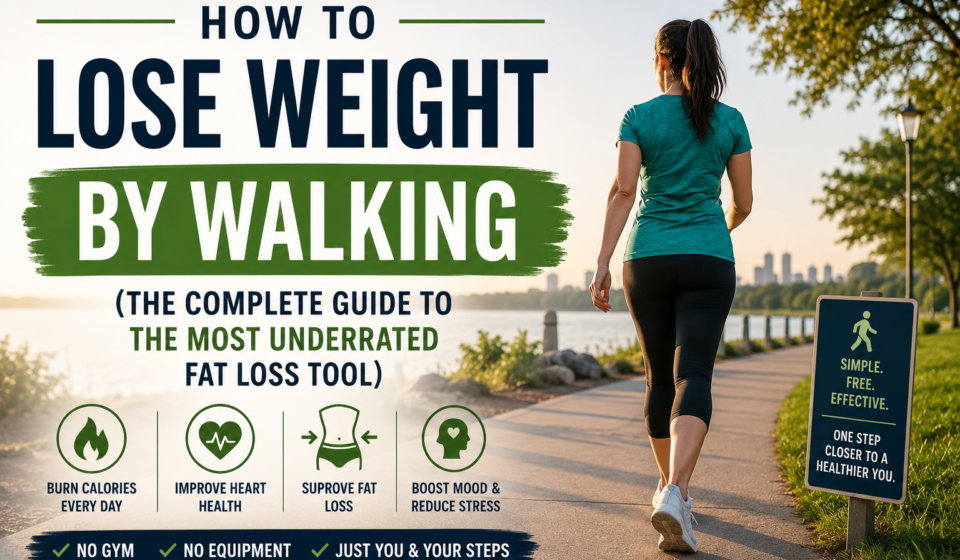
How to Lose Weight by Walking (The Complete Guide to the Most Underrated Fat Loss Tool)

You already know how to do it. Here’s how to make it actually work for weight loss.
Walking is the most accessible, most sustainable, most underrated fat loss exercise available. It requires no equipment, no gym membership, no skill, no recovery time, and almost no barrier to entry. You already know how to do it.
And yet most people who “just walk for exercise” don’t lose meaningful weight — because they’re not walking with intention or structure.

This guide covers everything: how much to walk, how fast, what variations produce the most fat loss, how to build a walking habit that sticks, and what to combine it with to maximize results.
Why Walking Works for Fat Loss
It Burns More Calories Than People Realize
Walking gets dismissed as “too easy” to produce real fat loss. The numbers tell a different story:
Approximate calorie burn per hour of walking (160 lb person):
- Slow walk (2.0 mph): 180–220 calories
- Moderate walk (3.0 mph): 240–280 calories
- Brisk walk (3.5 mph): 280–320 calories
- Fast walk (4.0 mph): 330–380 calories
- Incline walk (3.5 mph, 10% incline): 400–480 calories
10,000 steps per day burns approximately 400–500 extra calories compared to a sedentary baseline. Over a week that’s 2,800–3,500 extra calories — roughly 0.8–1 lb of additional fat loss per week from walking alone, without changing diet.
Over a year of consistent 10,000-step days: 40–52 lbs of potential fat loss from walking alone. The math is compelling.
It Doesn’t Spike Cortisol
This is one of walking’s most significant and least discussed advantages for fat loss.
High-intensity exercise — HIIT, running, intense cardio — is a physiological stressor that elevates cortisol during and after sessions. For people who are already stressed, sleep-deprived, or carrying significant life pressure, this additional cortisol burden can actually impair fat loss.
Walking at moderate pace doesn’t spike cortisol — it reduces it. A 20–30 minute walk demonstrably lowers cortisol levels, reduces anxiety, and improves mood. This makes walking a fat loss exercise that improves the hormonal environment for fat loss rather than stressing it further.
As we cover in our guide to how to get rid of belly fat, cortisol is one of the primary drivers of visceral belly fat accumulation. Any exercise that reduces cortisol while burning calories is particularly valuable for this area.
It Can Be Done Daily Without Recovery
Unlike running, HIIT, or strength training — all of which require recovery days between sessions — walking can be done every single day without overtraining risk. This means the calorie-burning and cortisol-reducing benefits compound daily rather than being limited to 3–4 sessions per week.
It Fits Into Life Without Dedicated Workout Time
Walking can be layered into existing daily activities — commuting, taking calls, doing errands, socializing — in ways that no other exercise can. This means the “time cost” of walking is often zero or close to zero.
Post-Meal Blood Sugar Management
A 10–15 minute walk after meals significantly reduces the post-meal blood sugar spike — by 20–30% in most research. This directly reduces insulin elevation, which reduces fat storage from that meal and improves insulin sensitivity over time.
For people with visceral belly fat — which is strongly driven by insulin resistance — post-meal walking is one of the most targeted and accessible interventions available.
How Many Steps Do You Actually Need?
The “10,000 steps” target has become cultural shorthand for adequate daily movement — but where did it come from and is it actually the right number?
The 10,000-step target originated from a Japanese marketing campaign for a pedometer in 1965, not from scientific research. The actual evidence on step counts is more nuanced:
What the research shows:
- Under 5,000 steps/day: Associated with sedentary lifestyle and higher health and weight risks
- 7,500 steps/day: Significant health benefits, meaningful fat loss contribution
- 10,000 steps/day: Strong health outcomes, optimal for most fat loss goals
- Over 12,500 steps/day: Additional benefits that plateau for most people
The practical target: 8,000–10,000 steps per day is well-supported for fat loss. Getting to 7,500 steps produces most of the benefit. Going beyond 12,000 produces diminishing additional returns.
Starting where you are: If you currently average 3,000 steps, jumping to 10,000 immediately is unsustainable. Add 1,000 steps per week until you reach your target — the gradual increase is sustainable and prevents the injury that can come from dramatic increases in walking volume.
How Fast Should You Walk?
Pace matters more than most people realize for fat loss:
Slow walking (under 2.5 mph): Burns calories but provides minimal cardiovascular benefit. Fine for accumulating steps but not optimal for fat loss.
Moderate walking (3.0–3.5 mph): The sweet spot for most people — calorie burn is meaningful, pace is sustainable for long durations, and the gentle cardiovascular challenge provides fitness benefits over time.
Brisk walking (3.5–4.0 mph): Noticeable cardiovascular challenge, significantly higher calorie burn than slow walking. The gold standard pace for fat loss walking — fast enough to elevate heart rate to zone 2 (60–70% of maximum) for many people.
Power walking (4.0+ mph): Very high calorie burn for walking, significant cardiovascular challenge. Difficult to sustain for long periods but excellent for shorter, more intense sessions.
A simple pace test: You should be breathing noticeably at your walking pace but still able to hold a full conversation. If you can sing, you’re probably too slow. If you can’t speak in sentences, you’re probably better served by jogging.
Walking Variations That Maximize Fat Loss
Incline Walking
Adding incline — either on a treadmill or on outdoor hills — multiplies calorie burn dramatically without requiring faster pace:
- 0% incline, 3.5 mph: ~280 calories/hour
- 5% incline, 3.5 mph: ~380 calories/hour
- 10% incline, 3.5 mph: ~460 calories/hour
- 15% incline, 3.5 mph: ~540 calories/hour
Outdoor hill walking, stair climbing, and the treadmill incline walk all provide this benefit. Even modest inclines (3–5%) meaningfully increase the fat loss value of a walking session.
Interval Walking
Alternating between fast and easy walking pace — interval walking — produces higher calorie burn than steady-pace walking and provides cardiovascular challenge:
- 2 minutes fast pace (4.0+ mph)
- 1 minute easy pace (3.0 mph)
- Repeat for 30–45 minutes
This produces calorie burn comparable to jogging for many people while remaining genuinely low-impact.
Weighted Walking
Walking with a weighted vest (5–20% of body weight) increases calorie burn by 10–15% without changing pace. It also adds a bone density benefit from the additional load.
Avoid ankle weights — they alter gait mechanics and increase injury risk.
Nordic Walking
Walking with poles (Nordic walking) increases calorie burn by 20–45% compared to regular walking by engaging the upper body throughout the stride. It’s particularly popular in Scandinavia and increasingly available as a class format.
How to Build Your Daily Step Count
Most people who start a walking habit for weight loss start strong and fade after a few weeks. These strategies build the habit durability that produces results:
Find Your Natural Walking Opportunities
Before adding dedicated walking time, identify the existing opportunities in your day that you’re currently not using:
- Commute: Walk to public transport, park further away, get off one stop early
- Lunch break: A 20-minute lunchtime walk adds ~2,000 steps daily
- Phone calls: Walk during every phone call instead of sitting
- Coffee: Walk to a coffee shop rather than using the one in your building
- Evenings: A 20-minute post-dinner walk adds ~2,000 steps and improves blood sugar control
Many people find they can add 3,000–5,000 daily steps through these changes alone — without any dedicated “walk for exercise” time.
Schedule One Dedicated Walk Per Day
Beyond accumulated steps, one intentional walk per day — even 20–30 minutes — provides the cortisol-reducing, mood-improving, cardiovascular benefits that scattered steps don’t.
Morning walks have the additional benefit of natural light exposure that regulates circadian rhythm, improves sleep quality, and provides vitamin D — all of which support fat loss. As covered in our article on why sleep is the most underrated weight loss tool, morning light is one of the most underutilized sleep optimization tools available.
Evening walks after dinner are excellent for blood sugar management — the post-meal walk that blunts insulin spikes and improves fat metabolism over time.
Use a Fitness Tracker
Seeing your step count in real time dramatically increases daily movement. Research consistently shows that people with step counters walk significantly more than those without — the awareness drives behavior change without requiring willpower.
Most smartphones have built-in step counting — no additional device required. A dedicated fitness tracker (Fitbit, Apple Watch, Garmin) provides more accurate counts and additional motivation through streaks and goals.
Make It Enjoyable
Walking is uniquely compatible with other enjoyable activities:
- Podcasts: Dedicated “walking podcasts” you only listen to while walking create a Pavlovian motivation to walk more
- Audiobooks: Saving an enjoyable book exclusively for walks makes walking the activity you look forward to
- Music: A specifically curated walking playlist at the right BPM (120–130 for brisk walking) maintains pace and enjoyment
- Social walking: Walking with a friend or partner converts exercise into social time — dramatically improving consistency
The most important thing for fat loss isn’t the optimal walking protocol — it’s the one you’ll actually do daily for months and years.
Walking and Weight Loss: What the Research Shows
Multiple large studies have examined walking specifically for weight loss:
A systematic review of walking interventions found average weight loss of 1.5 kg (3.3 lbs) from walking programs — modest in absolute terms but significant given that no dietary changes were involved.
Studies specifically examining step count increases found that each additional 2,000 steps per day (above baseline) was associated with approximately 0.5 lbs of additional weight loss per month.
Research on post-meal walking found significant improvements in visceral fat and insulin sensitivity with consistent 10–15 minute post-meal walks over 12 weeks — even without changes to diet or other exercise.
The consistent finding: walking produces modest but real and sustainable fat loss that compounds significantly over time.
How to Maximize Walking’s Fat Loss Effect
Walking alone produces modest results. Combined with the right additional strategies, those results multiply:
Add strength training 3x per week. Walking burns calories but doesn’t build muscle. Strength training builds the lean muscle that raises resting metabolic rate — and the combination of both produces far better body composition than either alone. As covered in our article on best exercises to lose belly fat for beginners, strength training is the most important exercise addition for body composition.
Optimize diet. Walking creates a calorie deficit. Diet determines the quality of that deficit and whether it actually produces fat loss. High protein intake, reduced added sugar, and adequate fiber work synergistically with walking to produce results that walking alone can’t.
Prioritize sleep. Poor sleep undermines fat loss from any exercise — and walking’s cortisol-reducing benefits compound with good sleep quality to create an excellent hormonal environment for fat loss.
Walk after meals specifically. Three 10–15 minute post-meal walks per day produces metabolic benefits that exceed one 30–45 minute walk in terms of blood sugar management and insulin sensitivity.
A Sample Walking Fat Loss Week
Monday: 25-minute morning walk + post-dinner walk (15 min) + accumulated daily steps = ~8,000 steps Tuesday: 30-minute lunchtime brisk walk + accumulated steps = ~9,000 steps Wednesday: 25-minute morning walk + post-dinner walk = ~8,000 steps Thursday: 40-minute incline walk (treadmill or hills) + accumulated steps = ~10,000 steps Friday: 25-minute morning walk + post-dinner walk = ~8,000 steps Saturday: 60-minute outdoor walk or hike = ~12,000 steps Sunday: Easy walking throughout the day = ~7,000 steps
Weekly total: ~62,000 steps (~31 miles) Estimated additional calorie burn: ~2,500–3,500 calories above sedentary baseline Potential additional fat loss: ~0.7–1 lb per week from walking alone
What to Expect: Realistic Walking Fat Loss Results
Walking only (no diet changes): 0.5–1 lb per month. Meaningful but slow.
Walking + dietary improvement (calorie deficit, high protein): 1–1.5 lbs per week. Significant and sustainable.
Walking + dietary improvement + strength training: 1–2 lbs per week with better body composition quality. The optimal combination.
The honest message: walking is not a fast path to dramatic fat loss on its own. But it’s an extraordinarily sustainable, cortisol-reducing, insulin-improving foundation that compounds over months and years into genuinely significant results — particularly when combined with the other strategies covered throughout this blog.
For the complete fat loss framework that walking supports most effectively, our guide to how to get rid of belly fat covers everything in one place.
How many steps are you currently averaging per day — and what’s your biggest challenge getting more? Share in the comments.
Stop Wondering What to Eat This Week
Get my free 7-Day High-Protein Weight Loss Meal Plan delivered straight to your inbox — a simple week of satisfying, protein-focused meals designed to make healthy eating easier without complicated calorie tracking.
- 7 full days of breakfast, lunch, dinner & snacks
- One complete shopping list for the whole week
- A quick high-protein food cheat sheet
- Simple daily tips to help you stay on track
Free PDF • Delivered by email • Unsubscribe anytime
Check your inbox 💜
Your free 7-day high-protein meal plan is on its way.