
The fitness industry has been lying to you. Here’s the science that sets the record straight.
Weight loss advice is drowning in myths — ideas that sound logical, get repeated constantly, and are either completely wrong or so oversimplified they do more harm than good.
Some of these myths keep people stuck in ineffective approaches for years. Others make weight loss seem harder and more restrictive than it actually needs to be. All of them deserve to be put to rest.
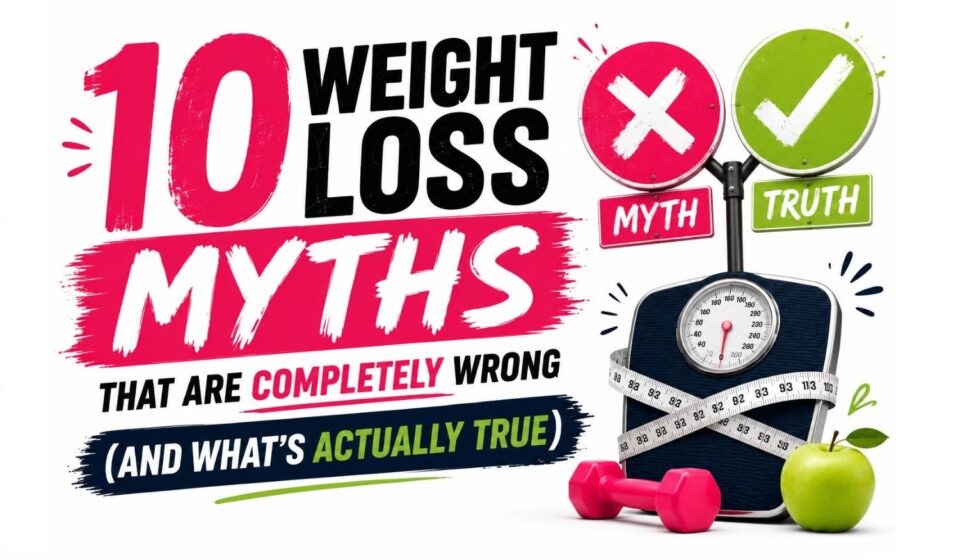
Here are 10 of the most persistent weight loss myths — and what the science actually says.
Myth 1: Eating Fat Makes You Fat
The myth: Dietary fat contains 9 calories per gram (versus 4 for protein and carbohydrates), so eating fat is what makes you fat.
The truth: Fat storage is driven by calorie surplus — not by eating fat specifically. Dietary fat consumed within a calorie deficit doesn’t become body fat any more than dietary protein or carbohydrates do.
In fact, dietary fat is essential for hormone production, brain function, fat-soluble vitamin absorption, and cell membrane integrity. Eliminating fat from the diet produces significant health consequences.
The low-fat diet craze of the 1980s and 1990s — driven by this myth — coincided with dramatic increases in obesity rates, largely because reduced-fat products replaced fat with sugar to maintain palatability.
What’s actually true: Total calorie intake drives fat storage. Healthy fats (olive oil, avocado, nuts, fatty fish) support both health and satiety, making the calorie deficit easier to maintain. As covered in our guide to how to lose weight with Mediterranean diet, a dietary pattern high in healthy fats and low in refined carbohydrates produces excellent fat loss results.
Myth 2: You Need to Do Cardio to Lose Weight
The myth: Running, cycling, and other cardio exercise is required for weight loss.
The truth: Diet drives 70–80% of fat loss. Cardio is beneficial but not required. Strength training produces comparable or better fat loss outcomes than cardio in most studies — through building muscle that raises resting metabolic rate.
Many people have lost significant weight through diet alone without any exercise. Many others have lost weight primarily through strength training and walking without traditional cardio.
What’s actually true: Any calorie deficit produces fat loss. The most important exercise for body composition is strength training, not cardio. Daily walking is the most sustainable and effective movement habit. Cardio is one tool among many — not a requirement.
As covered in our guide to cardio vs. weights for fat loss, the combination of strength training and daily walking outperforms cardio-only approaches for most people’s actual goals.
Myth 3: Eating After 8pm Causes Weight Gain
The myth: Your metabolism slows at night so food eaten late gets stored as fat.
The truth: Your body doesn’t switch into fat-storage mode at a specific hour. Total calorie intake over 24 hours drives fat storage — not when within that 24 hours the calories are consumed.
Multiple controlled studies have compared identical diets eaten at different times and found minimal difference in fat storage when total calories are equivalent.
What’s actually true: Late-night eating causes weight gain in practice — not because of the timing, but because it typically adds extra calories to an already complete day, involves calorie-dense low-satiety foods, and is often driven by habit or boredom rather than hunger.
As covered in our article on does eating late at night cause weight gain, the issue is the extra calories, not the clock.
Myth 4: Carbs Are the Enemy
The myth: Carbohydrates cause fat gain and must be eliminated to lose weight.
The truth: Carbohydrates don’t inherently cause fat gain. Calorie surplus causes fat gain. Many of the world’s leanest populations eat high-carbohydrate diets (traditional Japanese, Mediterranean populations, rural Asians).
Low-carbohydrate diets work — but primarily because they reduce overall calorie intake by eliminating a major food group, improve insulin sensitivity in insulin-resistant people, and reduce appetite for some people. Not because carbohydrates are inherently fattening.
What’s actually true: Carbohydrate quality matters enormously. Refined carbohydrates (white bread, white rice, sugary food) spike insulin and drive hunger in ways that whole food carbohydrates (oats, lentils, sweet potato) don’t. Reducing refined carbohydrates and replacing them with protein and whole food carbohydrates produces excellent fat loss — not because “carbs are bad” but because it reduces insulin spikes and increases satiety.
Myth 5: You Need to Eat 6 Small Meals a Day to “Keep Your Metabolism Fired Up”
The myth: Eating frequently keeps your metabolism elevated and prevents it from slowing down. Going longer than 3 hours without eating puts your body in “starvation mode.”
The truth: Meal frequency has minimal effect on total daily calorie burn. The “metabolism fired up” idea was based on the thermic effect of food — but the thermic effect of 6 small meals is identical to that of 3 larger meals containing the same total calories.

The body does not enter “starvation mode” after 3 hours without eating. Significant metabolic adaptation requires weeks of significant restriction — not hours without food.
What’s actually true: Meal frequency is a personal preference, not a metabolic requirement. Some people do better with 3 meals, others with 2, others with 5. Whichever pattern makes it easiest to maintain adequate protein and stay within your calorie target is the right pattern for you.
Myth 6: Muscle Turns Into Fat When You Stop Training
The myth: If you build muscle then stop exercising, the muscle turns into fat.
The truth: Muscle and fat are completely different tissues. One cannot convert into the other — any more than bone can turn into skin.
What actually happens when you stop training: muscle mass decreases (atrophy) due to reduced stimulus. Separately, if activity decreases but calorie intake doesn’t, fat mass increases. These two processes occurring simultaneously create the impression of muscle “turning into” fat — but they’re independent processes.
What’s actually true: When you stop strength training, you lose muscle over weeks to months. If you also maintain the same calorie intake with less activity, you gain fat. The solution: if you stop training temporarily, reduce calories slightly to match reduced activity.
Myth 7: The Scale Is the Best Way to Measure Progress
The myth: If the scale isn’t going down, you’re not making progress.
The truth: The scale measures total body weight — fat, muscle, water, bone, food, and everything else. It cannot distinguish between these components and produces wildly different readings based on hydration, sodium intake, digestive contents, hormonal cycles, and timing.
Someone who has lost 3 lbs of fat and gained 2 lbs of muscle has dramatically improved their body composition while losing only 1 lb on the scale. Someone who lost 3 lbs of water weight by dehydrating has made zero health improvement despite a promising scale reading.
What’s actually true: Body composition — the ratio of fat to muscle — is a more meaningful measure than scale weight. Progress measurements (waist, hips, arms), progress photos, strength benchmarks, and how clothes fit all provide more useful information about actual fat loss than the scale alone.
As covered in our article on why you weigh more at night than in the morning, daily weight fluctuations of 2–5 lbs are completely normal and don’t represent fat changes.
Myth 8: Detox Diets and Cleanses Remove Toxins and Jumpstart Weight Loss
The myth: The body accumulates toxins that need to be periodically “flushed” with juice cleanses, detox diets, or special supplements. This removes toxins and produces fat loss.
The truth: The human body has highly sophisticated detoxification systems — the liver, kidneys, lymphatic system, and digestive tract process and eliminate waste products continuously and effectively. No juice cleanse or supplement enhances these processes.
“Toxins” in this context is a marketing term — proponents of detox products rarely name specific toxins, because the claim doesn’t hold up to scrutiny.
What’s actually true: Juice cleanses produce rapid weight loss from fluid and glycogen depletion — which returns immediately when normal eating resumes. They don’t remove toxins, they don’t “reset” metabolism, and they don’t produce lasting fat loss. The best support for the body’s actual detoxification systems: adequate hydration, fiber-rich whole foods, minimal alcohol, and quality sleep.
Myth 9: You Can Target Fat Loss in Specific Areas (Spot Reduction)
The myth: Doing crunches reduces belly fat. Doing leg exercises reduces thigh fat.
The truth: Spot reduction — losing fat from a specific area by exercising that area — is not physiologically possible. Fat is mobilized from throughout the body in response to hormonal signals (primarily adrenaline and other lipolytic hormones) — not from the specific muscles being worked.
Doing 500 crunches works the abdominal muscles but draws fat from wherever the body’s hormonal environment currently prefers to mobilize it — which is rarely the belly specifically.
What’s actually true: Overall fat loss through calorie deficit reduces fat proportionally throughout the body, with genetically and hormonally determined regional patterns. The areas that store fat first tend to lose it last. Exercise that builds muscle in specific areas improves the appearance of those areas, but through muscle development — not spot fat reduction.
Myth 10: Eating Healthy Is Too Expensive
The myth: Eating well for weight loss requires expensive superfoods, organic produce, and specialty health foods that most people can’t afford.
The truth: Some of the most nutritious, highest-protein, most satiety-producing foods available are among the cheapest per calorie:
- Eggs: ~$0.25 each, 6g protein
- Lentils: ~$0.10 per serving, 18g protein
- Canned tuna: ~$1 per can, 25g protein
- Oats: ~$0.15 per serving, 5g protein + high fiber
- Frozen vegetables: ~$0.50 per serving, high nutrition
- Bananas: ~$0.20 each
A week of genuinely nutritious eating — built around eggs, lentils, canned fish, oats, and frozen vegetables — costs less than a week of fast food.
What’s actually true: The most expensive foods in the typical diet are processed convenience foods, takeout, alcohol, and sweetened beverages — not whole foods. As covered in our guide to how to lose weight on a budget, eating for fat loss can be done on a very modest food budget with the right knowledge.
The Bottom Line
Weight loss is simpler and less restrictive than the myth-laden fitness industry suggests:
- Fat doesn’t make you fat — calorie surplus does
- Cardio isn’t required — strength training and walking produce excellent results
- Late-night eating isn’t inherently problematic — extra calories are
- Carbs aren’t the enemy — refined carbs and sugar are worth reducing
- Meal frequency is a preference, not a metabolism requirement
- Muscle doesn’t turn into fat — they’re completely different tissues
- The scale is one tool, not the only measure of progress
- Detox cleanses don’t work — your liver does
- Spot reduction doesn’t exist — but overall fat loss does
- Healthy eating doesn’t require expensive superfoods
Most of these myths make weight loss seem harder, more restrictive, or more expensive than it actually needs to be. The truth is more liberating — and more effective.
For the complete evidence-based fat loss framework that ignores the myths and focuses on what actually works, our guide to how to get rid of belly fat covers everything in one place.
Which of these myths did you believe for years before learning the truth? Share in the comments — you might save someone else years of following bad advice.
Stop Wondering What to Eat This Week
Get my free 7-Day High-Protein Weight Loss Meal Plan delivered straight to your inbox — a simple week of satisfying, protein-focused meals designed to make healthy eating easier without complicated calorie tracking.
- 7 full days of breakfast, lunch, dinner & snacks
- One complete shopping list for the whole week
- A quick high-protein food cheat sheet
- Simple daily tips to help you stay on track
Free PDF • Delivered by email • Unsubscribe anytime
Check your inbox 💜
Your free 7-day high-protein meal plan is on its way.