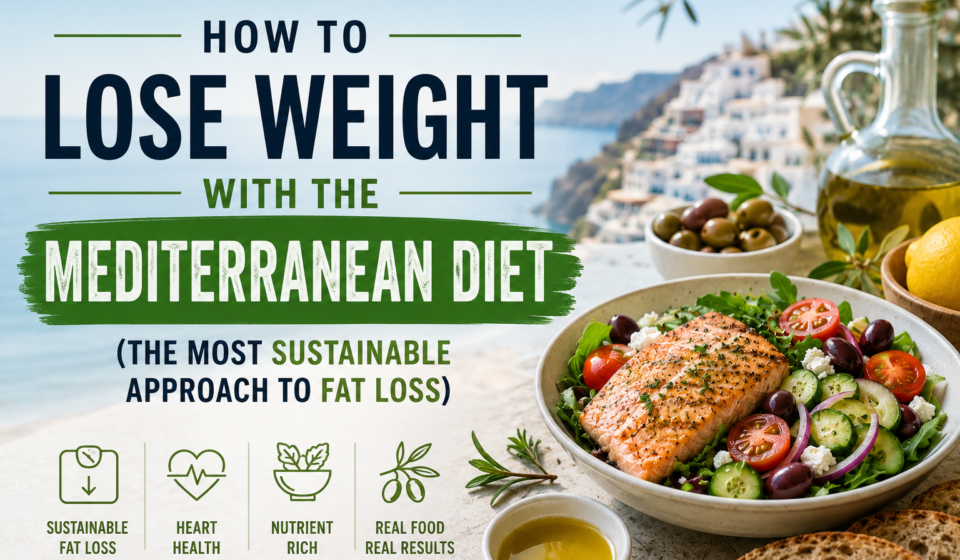
How to Lose Weight With the Mediterranean Diet (The Most Sustainable Approach to Fat Loss)

Consistently ranked the world’s best overall diet — here’s how to actually use it for weight loss
The Mediterranean diet has been ranked the best overall diet by US News & World Report for seven consecutive years — and for good reason. Of all the dietary approaches studied for long-term health and weight management, it has some of the most robust, consistent evidence behind it.
But “Mediterranean diet” is often misunderstood as simply eating pasta and olive oil. The reality is a specific, evidence-backed eating pattern with clear principles that drive both fat loss and extraordinary long-term health outcomes — with a sustainability that keto, low carb, and calorie counting rarely match.
Here’s how it actually works and how to use it effectively for weight loss.
What the Mediterranean Diet Actually Is
The Mediterranean diet is based on the traditional eating patterns of people living in Mediterranean countries — particularly Greece, southern Italy, and Spain — in the mid-20th century, before Western processed food became dominant.
It’s not a rigid diet with precise macro targets. It’s a food pattern characterized by:
Abundant: Vegetables, fruits, whole grains, legumes, nuts, seeds, olive oil, herbs and spices
Moderate: Fish and seafood (at least twice per week), poultry, eggs, dairy (mainly yogurt and cheese)
Limited: Red meat (a few times per month), added sugar, processed food, refined grains
Occasional: Red wine (in the traditional pattern — optional and not a requirement)
The distinguishing features:
- Olive oil as the primary fat source — replacing butter, vegetable oils, and processed fat
- Heavy emphasis on plant foods — vegetables, legumes, and whole grains form the foundation
- Fish over meat — seafood is the primary animal protein, with red meat minimized
- Whole foods over processed — the traditional Mediterranean diet contains essentially no ultra-processed food
Why the Mediterranean Diet Works for Weight Loss
It’s Not Primarily a Weight Loss Diet — But It Works
This is actually a feature, not a bug. The Mediterranean diet wasn’t designed for weight loss — it’s a whole-food dietary pattern designed around traditional eating. The weight loss benefits come from the quality of the foods and the natural calorie control that comes from eating satisfying, nutrient-dense whole foods.
People who follow the Mediterranean diet tend to eat fewer total calories without counting — because the high fiber, healthy fat, and protein content of Mediterranean foods produces strong satiety.
High Fiber Drives Satiety
The Mediterranean diet is extraordinarily high in fiber — from vegetables, legumes, whole grains, nuts, and fruit. As covered in our article on why you’re always hungry, adequate fiber is one of the two most powerful dietary tools for managing hunger naturally.
Most Western eaters consume 10–15g of fiber per day. A well-constructed Mediterranean diet easily provides 35–45g per day — nearly triple the typical intake.
Healthy Fats Extend Satiety
Olive oil, avocados, nuts, and fatty fish provide monounsaturated and omega-3 fats that slow gastric emptying and extend the feeling of fullness after meals. The Mediterranean diet’s relatively high fat content (primarily healthy fat) is a feature rather than a flaw — it’s why Mediterranean meals are genuinely satisfying despite being nutritionally excellent.
Reduced Processed Food Naturally Reduces Calorie Density
Ultra-processed foods — engineered for palatability and caloric density — dominate the Western diet and drive overconsumption. The Mediterranean diet’s emphasis on whole foods naturally reduces calorie density without restriction, as whole foods are more filling per calorie than processed alternatives.
Anti-Inflammatory Effects Support Metabolic Health
Chronic inflammation impairs insulin sensitivity, promotes fat storage, and makes losing weight harder. The Mediterranean diet is one of the most anti-inflammatory dietary patterns ever studied — olive oil polyphenols, omega-3 fatty acids from fish, and the broad spectrum of plant compounds in vegetables and legumes all reduce inflammatory markers significantly.
Lower inflammation means better insulin sensitivity, better hormonal balance, and a metabolic environment more conducive to fat loss.
Excellent Long-Term Sustainability
This is the Mediterranean diet’s most important weight loss feature: people actually stick to it.
Unlike keto and strict calorie counting — which produce excellent results when followed but are abandoned by the majority of people within 6–12 months — the Mediterranean diet is genuinely enjoyable. The food is delicious, varied, compatible with social eating and restaurant dining, and aligned with how humans have eaten for millennia.
Weight loss maintained for years produces better outcomes than dramatic weight loss followed by rebound — and sustainability is the Mediterranean diet’s strongest suit.
The Evidence for Mediterranean Diet and Weight Loss
The PREDIMED Trial
The landmark PREDIMED (Prevention with Mediterranean Diet) trial enrolled 7,447 people at cardiovascular risk and found that Mediterranean diet adherence significantly reduced major cardiovascular events — but also produced meaningful improvements in body weight and abdominal obesity compared to a low-fat control diet.
Mediterranean Diet vs Other Approaches
Multiple systematic reviews and meta-analyses have compared Mediterranean diet to other dietary patterns:
- vs Low-fat diet: Mediterranean diet consistently produces comparable or superior weight loss, with significantly better cardiometabolic outcomes
- vs Low-carb/keto: Similar weight loss at 6 and 12 months when adherence is matched; Mediterranean diet has significantly higher long-term adherence
- vs Standard dietary advice: Consistently superior outcomes across multiple health markers including weight
The consistent finding: the Mediterranean diet produces weight loss comparable to more restrictive approaches, with dramatically better long-term adherence and superior health outcomes beyond just weight.

How to Actually Follow the Mediterranean Diet for Weight Loss
Build Your Plate Around Vegetables
The foundation of every Mediterranean meal is vegetables — at least half the plate. Not as a reluctant side dish but as the centerpiece.
Mediterranean cooking transforms vegetables into genuinely craveable food: roasted with olive oil and herbs, slow-cooked in tomato-based sauces, grilled with lemon and garlic. The goal is making vegetables so delicious that eating them abundantly is a pleasure rather than a discipline.
Vegetables to prioritize: Leafy greens, tomatoes, eggplant, zucchini, peppers, artichokes, cucumbers, onions, garlic, cauliflower, broccoli.
Make Olive Oil Your Primary Fat
Replace all other cooking oils with extra virgin olive oil. Use it generously for cooking, as salad dressing (with lemon or vinegar), and drizzled on finished dishes.
The polyphenols in quality extra virgin olive oil are among the most powerful anti-inflammatory compounds in the food supply — and the oleocanthal in EVOO has been found to inhibit the same inflammatory enzymes as ibuprofen.
Don’t use “light” olive oil — the health benefits come from the polyphenols in extra virgin, which are removed in refined olive oils.
Eat Fish and Seafood at Least Twice Per Week
Fatty fish — salmon, sardines, mackerel, anchovies — provide omega-3 fatty acids that reduce inflammation, improve insulin sensitivity, and specifically target visceral belly fat reduction as covered in our guide to the best foods to eat to lose weight fast.
White fish — cod, sea bass, tilapia — provide lean protein at very low calorie cost.
Shellfish — mussels, clams, prawns, squid — are high in protein, rich in minerals (particularly zinc and iron), and typically lower in calories than meat.
Make Legumes a Weekly Staple
Lentils, chickpeas, white beans, black beans, and fava beans are Mediterranean diet staples that deserve a place in 3–4 meals per week. They provide exceptional protein and fiber at very low calorie cost — one of the most nutritionally efficient foods available.
Mediterranean preparations make legumes genuinely delicious: hummus, lentil soup, chickpea stew with tomatoes and spinach, white bean salad with olive oil and herbs.
Eat Whole Grains in Moderate Portions
Whole grain bread, farro, bulgur, barley, and moderate amounts of whole wheat pasta feature in the Mediterranean diet — but in proportions significantly smaller than in Western eating. A side serving of whole grain, not a large plate of it.
The key is choosing whole grains over refined — the fiber and nutrient profile of whole grain bread is dramatically better than white bread for blood sugar stability and satiety.
Eat Nuts and Seeds Daily
A small handful of almonds, walnuts, pistachios, or seeds (chia, flax, pumpkin) daily provides healthy fat, protein, fiber, and a wide range of micronutrients that support metabolic health.
Portion matters — nuts are calorie-dense (170 calories per handful) and easy to overeat. A measured portion (approximately 28–30g) daily is the Mediterranean standard.
Minimize Red Meat
Traditional Mediterranean eating involves red meat perhaps 2–4 times per month — not daily or even weekly as in the Western diet. Poultry is a more frequent protein source; fish is more frequent still.
This doesn’t mean eliminating red meat — it means treating it as an occasional food rather than a daily staple.
Eliminate Ultra-Processed Food
This is the non-negotiable at the heart of the Mediterranean diet: if it comes in a package with more than 5 ingredients, most of which are unrecognizable, it probably doesn’t belong in a Mediterranean pattern.
Ultra-processed foods — packaged snacks, fast food, ready meals, sweetened beverages, most breakfast cereals — are completely absent from the traditional Mediterranean diet and should be minimized to the extent possible.
A Week of Mediterranean Eating for Weight Loss
Monday:
- Breakfast: Greek yogurt with honey, walnuts, and berries
- Lunch: Large Greek salad with chickpeas, feta, olives, and EVOO dressing
- Dinner: Baked salmon with roasted vegetables and lemon
Tuesday:
- Breakfast: Whole grain toast with avocado, tomato, and olive oil
- Lunch: Lentil soup with crusty whole grain bread
- Dinner: Grilled chicken with tabbouleh and roasted peppers
Wednesday:
- Breakfast: Scrambled eggs with spinach, tomatoes, and herbs
- Lunch: Hummus with vegetable crudités and whole grain pita
- Dinner: Sardines with roasted cauliflower and green salad
Thursday:
- Breakfast: Overnight oats with berries and almonds
- Lunch: Tuna with white beans, capers, and lemon EVOO dressing
- Dinner: Lamb chops (small portion) with roasted eggplant and tzatziki
Friday:
- Breakfast: Greek yogurt with fruit and chia seeds
- Lunch: Large salad with grilled prawns, avocado, and olive oil
- Dinner: Whole wheat pasta with tomato sauce, vegetables, and small amount of parmesan
Saturday:
- Breakfast: Vegetable omelette with feta and herbs
- Lunch: Chickpea and vegetable stew
- Dinner: Baked sea bass with Mediterranean vegetables and olive oil
Sunday:
- Breakfast: Whole grain bread with quality olive oil and tomatoes
- Lunch: Leftover stew with salad
- Dinner: Grilled chicken with roasted vegetables and hummus
Mediterranean Diet vs Keto and Low Carb for Weight Loss
This comparison comes up constantly — and the honest answer is:
For fastest initial weight loss: Keto and low carb typically produce faster early results (primarily from water/glycogen loss) and stronger appetite suppression in the short term.
For long-term weight loss and health: Mediterranean diet consistently shows comparable or superior outcomes at 12 months and beyond, with significantly better adherence, better cardiovascular outcomes, better gut health, and better overall quality of life.
The bottom line: If you want maximum short-term results and can tolerate strict restriction, keto or low carb. If you want a sustainable lifetime eating pattern that produces excellent weight loss alongside extraordinary health benefits, Mediterranean diet.
Both our keto article and low carb article — how to lose weight with keto and how to lose weight with low carb — are worth reading alongside this one if you’re deciding between approaches.
Maximizing Mediterranean Diet Weight Loss Results
The Mediterranean diet is a sustainable eating pattern — but “sustainable eating pattern” doesn’t automatically mean “calorie deficit.” To ensure fat loss, not just health improvement:
Prioritize protein — the Mediterranean diet can be relatively lower in protein than optimal for fat loss. Consciously building meals around fish, legumes, eggs, and Greek yogurt ensures adequate protein for muscle preservation. As covered in our guide to how much protein you actually need per day, 0.7–1g per pound of bodyweight is the target.
Control portions of calorie-dense foods — olive oil, nuts, cheese, and avocado are nutritious but calorie-dense. Using them as flavoring and enrichment rather than in unlimited amounts keeps calorie intake appropriate.
Minimize wine — the traditional Mediterranean pattern includes moderate red wine, but alcohol adds empty calories and impairs fat metabolism. For weight loss specifically, reducing or eliminating alcohol accelerates results.
Combine with daily walking — the traditional Mediterranean lifestyle involves significant daily walking — something modern life has largely eliminated. Aiming for 8,000–10,000 steps per day, as covered throughout this blog, complements the dietary pattern as it was originally practiced.
The Bottom Line
The Mediterranean diet is one of the most evidence-backed, sustainable, and genuinely enjoyable dietary approaches available — producing meaningful fat loss alongside exceptional cardiovascular, metabolic, and longevity outcomes that more restrictive diets simply don’t match.
Its strength is not maximum short-term restriction but optimal long-term sustainability — the eating pattern people actually maintain for years and decades, producing cumulative health and body composition benefits that brief, intense dieting never achieves.
For the complete fat loss framework that the Mediterranean diet supports most effectively — including exercise, sleep, and stress management alongside dietary quality — our guide to how to get rid of belly fat covers everything in one place.
Are you already following a Mediterranean-style diet or curious about starting? Share your experience in the comments — and any favorite Mediterranean recipes that have become staples in your routine.
Stop Wondering What to Eat This Week
Get my free 7-Day High-Protein Weight Loss Meal Plan delivered straight to your inbox — a simple week of satisfying, protein-focused meals designed to make healthy eating easier without complicated calorie tracking.
- 7 full days of breakfast, lunch, dinner & snacks
- One complete shopping list for the whole week
- A quick high-protein food cheat sheet
- Simple daily tips to help you stay on track
Free PDF • Delivered by email • Unsubscribe anytime
Check your inbox 💜
Your free 7-day high-protein meal plan is on its way.