
One of the most effective fat loss tools costs nothing and takes five minutes a day

Food journaling sounds old-fashioned in a world of calorie tracking apps and continuous glucose monitors. But research consistently shows it’s one of the most effective behavioral tools for weight loss — not because of the data it produces, but because of the awareness it creates.
Studies have found that people who track their food intake lose twice as much weight as those who don’t — and the more consistently they track, the better their results. Not because the act of writing something down burns calories, but because awareness changes behavior in ways that willpower and good intentions rarely can.
Here’s how to use a food journal effectively — including approaches that go far beyond just counting calories.
Why Food Journaling Works
Before getting into the how, it helps to understand why this simple habit produces such consistent results.
It closes the awareness gap. Research consistently shows that people underestimate their food intake by 20–40% — not from dishonesty, but from genuine unawareness. Portion sizes are larger than perceived, ingredients in meals are forgotten, snacks consumed while distracted don’t register, and liquid calories are consistently overlooked. Writing down what you eat closes this gap immediately.
It creates a pause between impulse and action. The act of deciding to write something down before or after eating introduces a brief moment of conscious awareness that interrupts automatic eating behavior. That pause is often enough to make a different choice — or at minimum, to make a conscious one.
It reveals patterns you can’t see otherwise. Most overeating isn’t random — it follows patterns linked to time of day, emotional states, social situations, stress levels, and sleep quality. These patterns are invisible until they’re written down and reviewed. Once you can see them, you can address them.
It provides accountability without external judgment. A food journal is private. There’s no one to impress or disappoint — just honest data that lets you make informed decisions about what to change.
It makes progress visible. Seeing weeks of consistent effort documented creates genuine motivation and pride that sustains behavior through low-motivation periods.
Types of Food Journals — Pick What Fits Your Goals
Not all food journaling looks the same. The right approach depends on what you’re trying to understand and change.
1. The Traditional Calorie and Macro Tracker
The most common approach — logging everything you eat with calories, protein, carbs, and fat. Apps like MyFitnessPal, Cronometer, and Lose It make this relatively fast once you’ve built the habit.
Best for: People who want precise data, are working toward specific macro targets, or have hit a plateau and need to understand exactly where their intake stands.
Limitation: Can become obsessive for some people, creates anxiety around food for others, and takes the most time of any approach. As we discuss in our guide to how to lose weight without counting calories, calorie tracking isn’t necessary for everyone — but for those who benefit from data, it’s powerful.
2. The Protein-First Journal
A simpler approach focused exclusively on protein intake — logging the protein content of every meal without tracking total calories or other macros.
Best for: People who find full calorie tracking too burdensome but want to ensure adequate protein intake, which is the single most important dietary variable for fat loss and muscle preservation.
Since high protein intake naturally improves satiety and reduces overall calorie intake, focusing on protein alone produces meaningful results for many people. Our guide to how much protein you actually need per day explains why this single focus is so effective.
3. The Hunger and Fullness Journal
Rather than tracking nutrients, this approach tracks your hunger level before eating (on a scale of 1–10) and fullness level after eating. No calories, no macros — just your body’s signals.
Best for: People reconnecting with intuitive eating, those recovering from restrictive eating patterns, or anyone who has lost touch with genuine hunger and fullness signals through years of dieting.
This approach rebuilds the awareness of physical hunger vs. emotional hunger that chronic dieting and distracted eating erode. It doesn’t produce precise calorie data but creates the mindful eating foundation that makes all other approaches more effective.
4. The Mood and Emotion Journal
Tracks what you eat alongside your emotional state, stress level, energy, and sleep quality — creating a map of the relationship between emotions and eating behavior.
Best for: People who suspect emotional eating is a significant factor in their weight, or anyone who has repeatedly followed good habits during the week and derailed on weekends or during stressful periods.
This approach often produces the most insight of any journaling method — revealing the specific emotional triggers, situations, and patterns that drive overeating in ways that pure calorie data never could. It connects directly to the strategies in our article on how to stop stress eating.
5. The Simple Food Log
Just a list of what you ate — no calories, no ratings, no emotional data. Breakfast: eggs and yogurt. Lunch: chicken salad. Snack: handful of nuts. Dinner: salmon and broccoli.
Best for: People who want awareness without the burden of detailed tracking, or those just starting out who want to build the habit before adding complexity.
Even this minimal version reveals patterns — how often processed food appears, whether protein is present at every meal, how frequently alcohol shows up, whether vegetables are actually eaten as often as assumed.
How to Start a Food Journal (Step by Step)
Step 1: Choose Your Format
Paper journal: A simple notebook works perfectly. Low friction, no battery required, completely private. Some people find the physical act of writing more mindful than typing.
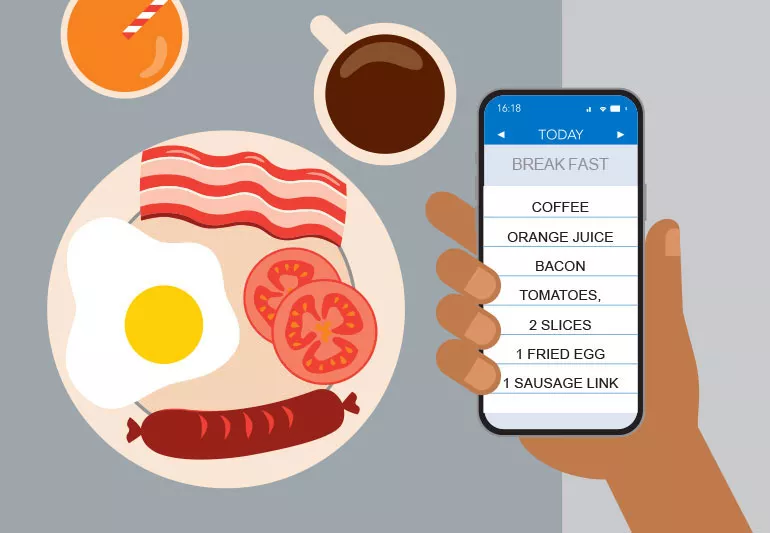
Notes app on your phone: Fast, always accessible, searchable. A simple daily note with meals listed works well for the simple food log approach.
Dedicated tracking app: MyFitnessPal, Cronometer, or Lose It for calorie and macro tracking. More setup time but powerful data over weeks.
Spreadsheet: For people who like data and customization — create columns for whatever you want to track.
The best format is the one you’ll actually use consistently. Don’t let perfect be the enemy of good — a basic notes app used every day beats a sophisticated app used three times then abandoned.
Step 2: Decide What to Track
Based on the type of journal above, decide what information you’re capturing. Start simple and add complexity only if you’re finding the simple version insufficient.
A good starting point for most people:
- What you ate (food and approximate portion)
- When you ate it
- Your hunger level before (1–10)
- One-line note on how you were feeling
This takes under two minutes per entry and captures the most important behavioral data.
Step 3: Log in Real Time, Not From Memory
The single most important journaling habit — log immediately, not at the end of the day.
Memory is unreliable for food intake. The snack while cooking dinner, the bite of your partner’s food, the second glass of wine — these vanish from memory by the time you reconstruct the day from scratch at 9pm. Logging immediately after eating (or even before) captures reality rather than a sanitized version of it.
If immediate logging feels too disruptive, set two reminders — after lunch and after dinner — to capture the day in two sessions rather than one end-of-day reconstruction.
Step 4: Be Honest — Including the “Bad” Days
A food journal only works if it’s accurate. Logging the days when eating is on track and skipping the days when it isn’t produces data that confirms your assumptions rather than challenges them.
The days when eating goes off plan are often the most informative — they reveal the triggers, situations, and patterns that standard good behavior doesn’t expose. Log them without judgment. No one is grading your journal.
Step 5: Review Weekly
The daily log is data collection. The weekly review is where the insight comes from.
Once a week — Sunday evening works well — look back at the week’s entries and ask:
- Where did I feel genuinely hungry vs. eating out of habit or emotion?
- Are there times of day when I consistently overate or made poor choices?
- How often did protein appear at every meal?
- How did sleep and stress correlate with eating quality?
- What patterns am I not seeing on a day-by-day basis?
The patterns that emerge from weekly review are often surprising and almost always actionable. This is where the real value of food journaling lives — not in the individual entries, but in the patterns across entries.
Common Food Journaling Mistakes
Only Tracking the Good Days
As mentioned above — logging selectively produces selective insight. Commit to logging every day for at least two weeks before drawing conclusions.
Logging From Memory at the End of the Day
Reconstructing a day from memory underestimates intake by 20–30% on average. Log in real time or as close to it as possible.
Treating It as a Test to Pass
A food journal isn’t a report card. If you approach it as a performance to be evaluated rather than data to be analyzed, you’ll log what you think you should be eating rather than what you actually ate — which defeats the entire purpose.
Tracking Calories and Nothing Else
Pure calorie tracking misses the behavioral and emotional context that drives eating behavior. Adding even a brief note about hunger level or emotional state transforms a calorie log into a genuine behavioral tool.
Giving Up After a Bad Week
The weeks where eating goes poorly are the weeks that produce the most useful data. If a bad week makes you want to stop journaling, that’s precisely when continuing is most valuable.
Using It as a Restriction Tool That Causes Anxiety
If food journaling is making you anxious, obsessive, or overly rigid about food — stop the calorie-tracking approach and switch to the hunger/fullness or simple food log method instead. Food journaling should create awareness and insight, not distress.
What to Do With the Insights
The journal is a diagnostic tool. The value is in acting on what it reveals.
If you discover you’re under-eating protein: Build meals around protein sources first. Our guide to the best foods to eat to lose weight fast covers the highest-protein, most practical options.
If you discover emotional eating patterns: Use the triggers you’ve identified to build specific alternative responses. Our article on how to stop stress eating provides the framework.
If you discover liquid calories are significant: Eliminate them — it’s one of the fastest, easiest calorie reductions available and requires no complex behavioral change.
If you discover weekend consistency is the problem: Plan specifically for weekends — pre-decide meals, keep the protein-first habit, maintain sleep schedule. As we note in our article on how to break a weight loss plateau, weekend inconsistency is one of the most common hidden causes of stalled progress.
If you discover portion sizes are larger than assumed: Use smaller plates, pre-portion snacks, and cook measured quantities until your perception recalibrates.
Digital vs. Paper: Which Is Better?
Both work. The research doesn’t strongly favor either — consistency matters more than format.
Paper advantages: More mindful, no phone distraction, completely private, no setup, never runs out of battery.
Digital advantages: Searchable, easy to review patterns over time, can calculate nutrition automatically, accessible anywhere.
Many people find a hybrid works well — a simple notes app for daily logging and a monthly review in a paper journal where they write reflections and patterns in more depth.
How Long Should You Keep a Food Journal?
This depends on your goals and what you’re getting from it.
Two to four weeks is the minimum to reveal meaningful patterns — short-term journaling is often the most revealing because the initial honest data is fresh.
Three months with consistent journaling builds habits and awareness that often persist long after you stop formal tracking.
Indefinitely works well for some people who find ongoing tracking motivating rather than burdensome.
Many people find that after several months of consistent journaling they’ve internalized the awareness enough that they no longer need to write it down — they’ve rebuilt the intuitive eating connection that years of distracted eating eroded.
Others keep a journal indefinitely because they find it useful and sustainable. Both are valid approaches.
The Bottom Line
A food journal is one of the most evidence-backed, accessible, and free tools available for weight loss — and one of the most underused.
It works not by restricting what you eat but by illuminating what you actually eat — closing the awareness gap that silently undermines the best intentions of almost everyone who has tried and struggled to lose weight.
Start simple. Log honestly. Review weekly. Act on what you find.
The insights a few weeks of honest journaling produce are worth more than months of effort directed at the wrong problems.
For the complete framework of what to do with those insights — the dietary, exercise, sleep, and stress strategies that actually drive fat loss — our guide to how to get rid of belly fat pulls everything together.
Have you tried food journaling before? Did it help or did you find it too burdensome? Share your experience in the comments.