
The official recommendations are too low. Here’s what the research actually supports — and why protein is the most important dietary lever most people are ignoring.
Most people who think they eat enough protein don’t. And that single gap is quietly undermining fat loss, muscle preservation, energy levels, and appetite control — without them ever realizing it.
Protein is everywhere in the conversation right now — on every food label, in every fitness influencer’s content, debated endlessly online. But the debate misses the most important point: the official daily recommendation is not a target. It’s a floor. And building your diet around the floor is why so many people struggle with results despite genuine effort.
Here’s what the research actually says — and exactly how to apply it.
Why Protein Matters More Than Most People Realize
Most people associate protein with gym culture and muscle building. But protein does far more than support muscle — especially when it comes to fat loss and body composition.
It’s the Most Satiating Macronutrient
Protein suppresses ghrelin (the hunger hormone) and boosts peptide YY (the fullness hormone) more powerfully than carbohydrates or fat. Eating adequate protein means eating less overall — not through willpower, but through genuine satiety. This single effect is responsible for much of the calorie reduction people experience on high-protein diets.
It Burns Calories Through Digestion
Protein has a thermic effect of approximately 25-30% — your body burns roughly 25-30 calories digesting every 100 calories of protein you eat. Carbohydrates burn 5-10%, fat burns 0-3%. Simply eating more protein slightly increases your total daily calorie burn without any additional effort.
It Preserves Muscle During Weight Loss
When you’re in a calorie deficit — from dieting, medication, or both — your body looks for energy wherever it can find it, including muscle tissue. Adequate protein is the primary dietary signal that tells your body to preserve muscle and burn fat preferentially.
Without it, a significant proportion of the weight lost is muscle rather than fat — producing worse body composition, lower metabolic rate, and greater difficulty maintaining the weight loss long-term.
As covered in our guide to weight loss injections and muscle loss — this muscle preservation function of protein is particularly critical for people on GLP-1 medications, where dramatic appetite suppression can make adequate protein intake challenging.
It Directly Targets Belly Fat
Higher protein diets are consistently associated with less visceral fat — the dangerous abdominal fat that drives metabolic disease. The combination of better appetite control, muscle preservation, and metabolic boost makes protein one of the most powerful dietary tools specifically for belly fat reduction. As covered in our complete guide to how to get rid of belly fat — protein is the dietary non-negotiable for meaningful abdominal fat loss.
Why the Official Recommendation Is Misleading
The standard dietary recommendation for protein is 0.8g per kilogram of bodyweight — approximately 0.36g per pound. For a 150-lb person, that’s roughly 54g daily.
This sounds reasonable until you understand what it actually represents:
The minimum amount required to prevent deficiency in sedentary adults.
It’s the amount needed to not rapidly lose muscle. Not the amount needed to thrive, lose fat effectively, build strength, or maintain a healthy metabolism as you age.
For anyone who exercises, is trying to lose fat, is over 40, or simply wants to feel and perform well — the evidence points to a significantly higher intake.
What the Research Actually Recommends
Sports nutrition and metabolic research is remarkably consistent on this. For active people and those trying to lose fat — the optimal range is:
0.7-1g of protein per pound of bodyweight per day (or 1.6-2.2g per kilogram for those who prefer metric)
For a 150-lb person — that’s 105-150g of protein daily. Roughly double the official recommendation.
For people in a significant calorie deficit trying to maximize muscle preservation during fat loss — some research supports going even higher, up to 1.2g per pound — particularly for leaner individuals where the risk of muscle loss is greater.
How Much Protein Do YOU Need?
The simple calculation:
- Take your bodyweight in pounds
- Multiply by 0.7 for a conservative target or 1.0 for an aggressive target
- That’s your daily protein goal in grams
| Bodyweight | Conservative (0.7g/lb) | Aggressive (1g/lb) |
|---|---|---|
| 130 lbs | 91g | 130g |
| 150 lbs | 105g | 150g |
| 175 lbs | 122g | 175g |
| 200 lbs | 140g | 200g |
| 225 lbs | 157g | 225g |
| 250 lbs | 175g | 250g |
Important note for people significantly above their goal weight: Use your goal bodyweight rather than current weight to avoid an unrealistically high target. Someone who weighs 280 lbs and wants to reach 180 lbs should target protein based on 180 lbs — not 280 lbs.
Protein on GLP-1 Medications — Why It Matters Even More
This section didn’t exist in earlier versions of this guide — but given how many people are now using semaglutide, tirzepatide, and other GLP-1 medications, it’s essential.
GLP-1 medications suppress appetite so dramatically that many people find their food intake drops to 800-1,200 calories daily without deliberate effort. This creates a specific protein problem:
When total food intake drops significantly — protein is the first nutrient to suffer.
People eating 900 calories of mixed food often consume only 50-70g of protein — far below what’s needed for muscle preservation during the significant weight loss these medications produce.
The consequence: a meaningful proportion of the weight lost is muscle rather than fat. This reduces metabolic rate, worsens body composition, increases regain risk when medication stops, and produces the “skinny fat” outcome that many GLP-1 users experience without understanding why.
The solution on GLP-1 medications:
- Eat protein FIRST at every meal — before anything else
- Prioritize high-protein, low-volume foods (Greek yogurt, cottage cheese, eggs, canned fish) when appetite is very low
- Use protein shakes as insurance on days when solid food is difficult
- Target the same 0.8-1g/lb goal even at very low total calorie intake
As covered in our guide to the best diet to follow on weight loss injections — protein priority is the single most important dietary consideration for anyone on GLP-1 medication.
The Best High-Protein Foods
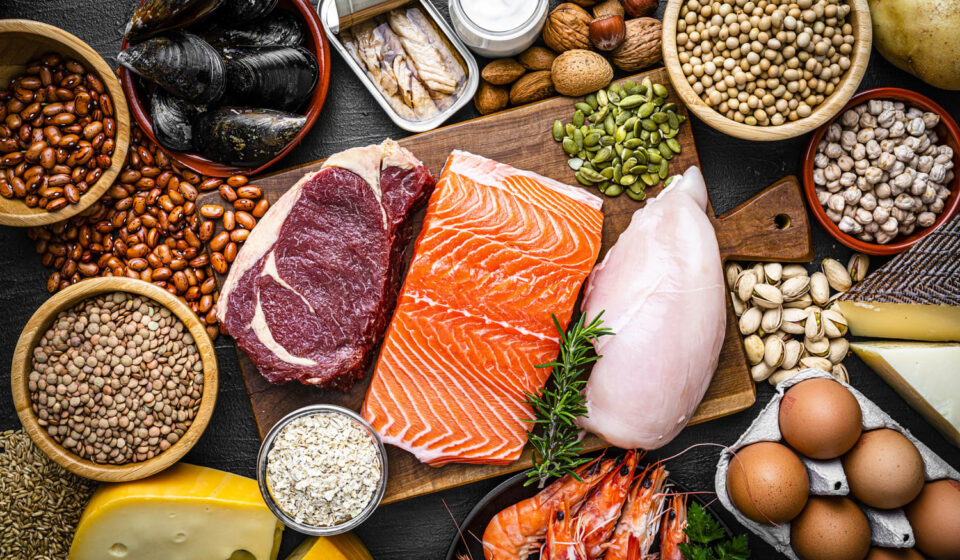
Not all protein sources are equal — here are the most practical options ranked by protein density:
Animal-Based (Complete Proteins)
These contain all 9 essential amino acids in adequate amounts:
- Chicken breast: ~31g per 100g cooked
- Turkey breast: ~30g per 100g cooked
- Lean beef: ~26g per 100g cooked
- Canned tuna: ~25g per 100g (34g per can)
- Salmon: ~25g per 100g cooked
- Shrimp: ~24g per 100g cooked
- Cottage cheese: ~22g per 200g
- Greek yogurt (plain): ~17-20g per 200g
- Eggs: ~6g per egg
Plant-Based (Often Incomplete — Combine Sources)
As covered in our comprehensive guide to plant-based protein — plant proteins vary enormously in quality and digestibility:
- Tempeh: ~19g per 100g (best plant protein — fermented, complete)
- Edamame: ~17g per cup (complete protein, high fiber)
- Tofu (firm): ~17g per 200g
- Lentils: ~18g per cooked cup
- Chickpeas: ~15g per cooked cup
- Black beans: ~15g per cooked cup
- Seitan: ~25g per 100g (but very low digestibility — DIAAS 0.40)
Plant protein note: Due to lower digestibility, plant protein targets should be slightly higher — aim for 1.0-1.1g/lb rather than 0.8-1g/lb if relying primarily on plant sources.
Protein Supplements
Convenient, not essential — useful for hitting targets on busy days:
- Whey protein isolate: ~25g per scoop — highest leucine content, best for muscle preservation
- Casein protein: ~24g per scoop — slow-digesting, ideal before sleep
- Pea/rice blend (70:30): ~20-25g per scoop — best plant-based option
How to Actually Hit Your Target Every Day
Knowing your target is one thing — consistently hitting it without obsessive tracking is another.
Build Every Meal Around Protein First
Before anything else goes on your plate — decide on your protein source. Then add vegetables, carbohydrates, and fats around it. This mental restructuring produces higher protein intake without requiring calorie counting.
A practical day for someone targeting 150g:
- Breakfast: 3 eggs + 200g Greek yogurt = ~38g protein
- Lunch: 170g chicken breast + salad = ~50g protein
- Snack: 200g cottage cheese = ~22g protein
- Dinner: 170g salmon = ~42g protein
- Total: ~152g ✅
Don’t Skip Breakfast Protein
Starting the day with a high-protein breakfast regulates appetite for the entire day — reducing cravings and total calorie intake significantly compared to carb-heavy or skipped breakfasts. The effect persists across the full day, not just the morning.
As covered in our guide to the best weight loss breakfast foods — eggs, Greek yogurt, and cottage cheese are the highest-return breakfast investments for appetite control.
Prep Protein in Bulk
Batch cooking protein at the start of the week removes the friction that causes people to miss their targets. A fridge stocked with cooked chicken, hard-boiled eggs, and portioned Greek yogurt makes hitting protein almost automatic — even on the busiest days.
Swap Snacks for Protein
Most snacking defaults to carbohydrate-heavy foods — crackers, fruit, granola bars. Replacing these with protein-forward snacks (Greek yogurt, cottage cheese, hard-boiled eggs, string cheese) quietly adds 20-30g of protein to daily totals without significant calorie addition.
As covered in our guide to snacking for adults — protein-first snacking is the most impactful behavioral shift for appetite management between meals.
Can You Eat Too Much Protein?
This comes up constantly — and the concerns deserve honest answers.
“High protein damages kidneys”
This concern is legitimate for people with existing kidney disease — protein restriction is genuinely recommended for damaged kidneys.
For healthy kidneys — multiple long-term studies find no kidney harm at intakes up to 2g per pound in healthy adults. As covered in our detailed guide to high-protein diets — are they safe — the kidney concern does not apply to people with normal kidney function.
If you don’t know your kidney function — a baseline creatinine and eGFR test before significantly increasing protein is reasonable, particularly for people over 50.
“Protein turns to fat”
Technically possible in a calorie surplus — but protein is the least efficient macronutrient for fat storage. In practice, protein’s satiety effects make significant overconsumption very difficult. Nobody accidentally eats 300g of protein.
“You can only absorb 30g per meal”
A persistent myth with no solid research behind it. Your body absorbs essentially all the protein you eat — at different rates for different sources. Spreading protein across meals optimizes muscle protein synthesis throughout the day — but there’s no magical 30g ceiling above which protein is wasted.
Protein Timing — Does It Matter?
Somewhat — but far less than total daily intake.
What the research shows:
Distributing protein reasonably evenly across 3-4 meals optimizes muscle protein synthesis better than concentrating it in one or two sittings. Eating 150g of protein at dinner is less effective than spreading it across the day.
The post-workout window:
The “anabolic window” — the idea that you must eat protein immediately after training — is significantly overblown. Getting protein within 2 hours of training is adequate for most people. Total daily protein matters far more than precise timing.
Pre-sleep protein:
Casein protein (from cottage cheese or casein powder) before sleep reduces overnight muscle catabolism — particularly relevant for people trying to preserve muscle during significant calorie restriction.
Signs You’re Not Eating Enough Protein
Not sure if your intake is adequate? These are the most common indicators:
- Constant hunger even shortly after eating
- Strong cravings for carbohydrates and sugar throughout the day
- Slow recovery from exercise — persistent soreness
- Losing scale weight but not seeing body composition improve
- Declining strength despite consistent training
- Persistent fatigue and low energy
- Getting sick frequently
- Hair loss (protein deficiency accelerates telogen effluvium)
If several of these apply — increasing protein is likely one of the highest-leverage changes available. The improvement in hunger, energy, and body composition is often noticeable within 1-2 weeks of consistent adequate intake.
The Bottom Line
The official protein recommendation is a floor — not a target.
For anyone exercising, trying to lose fat, using GLP-1 medications, or wanting to maintain muscle and metabolism as they age — 0.7-1g per pound of bodyweight daily is what the evidence consistently supports.
The practical implementation:
- Calculate your target (bodyweight in lbs × 0.7 to 1.0)
- Build every meal around a protein source — protein first
- Prep protein in bulk to remove daily friction
- Swap carbohydrate snacks for protein-forward alternatives
- Use protein supplements as insurance, not foundation
The single most common dietary change that produces the fastest improvement in how people feel, how well they control hunger, and how their body composition responds to a calorie deficit — is simply eating more protein.
It’s not complicated. It’s just protein.
What’s your go-to high-protein meal — and what changed when you started hitting your protein target consistently? Share in the comments.
Stop Wondering What to Eat This Week
Get my free 7-Day High-Protein Weight Loss Meal Plan delivered straight to your inbox — a simple week of satisfying, protein-focused meals designed to make healthy eating easier without complicated calorie tracking.
- 7 full days of breakfast, lunch, dinner & snacks
- One complete shopping list for the whole week
- A quick high-protein food cheat sheet
- Simple daily tips to help you stay on track
Free PDF • Delivered by email • Unsubscribe anytime
Check your inbox 💜
Your free 7-day high-protein meal plan is on its way.