Intuitive Eating and Weight Loss: What It Is, What the Research Shows, and Who It’s For

A different relationship with food — not a diet, but a framework for eating that lasts

Intuitive eating is one of the most misunderstood concepts in the nutrition space. It gets dismissed by some as “just eating whatever you want” and oversold by others as a guaranteed path to a healthy weight. Neither characterization is accurate.
This article explains what intuitive eating actually is, what the research shows about its relationship with weight, and who it might be a good fit for.
What Intuitive Eating Actually Is
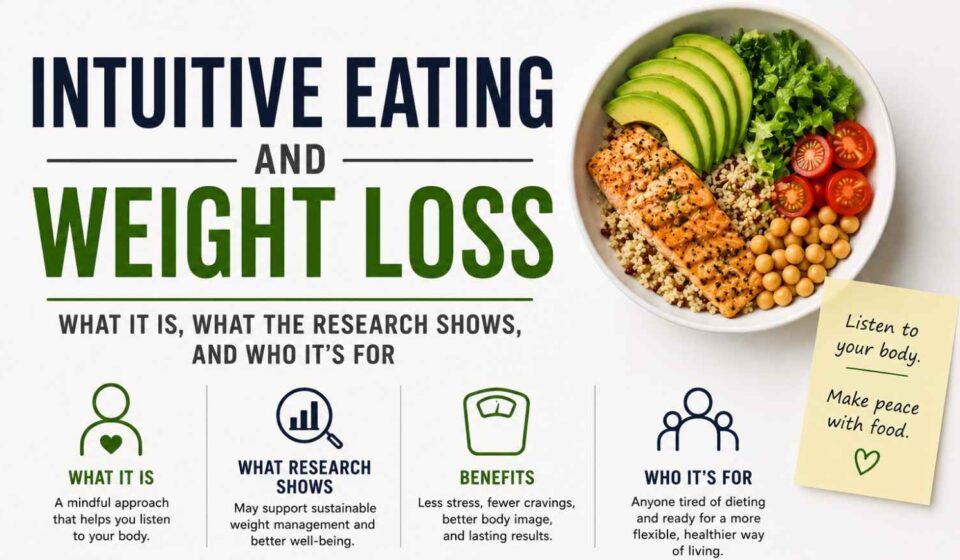
Intuitive eating is a framework developed by dietitians Evelyn Tribole and Elyse Resch in 1995, built around ten core principles. It’s not a diet. It doesn’t prescribe specific foods, quantities, or timing.
At its core, intuitive eating is about rebuilding trust in your body’s hunger and fullness signals — signals that years of dieting, food rules, and cultural messaging around “good” and “bad” foods can erode significantly.
The ten principles:
- Reject the diet mentality
- Honor your hunger
- Make peace with food
- Challenge the food police
- Discover the satisfaction factor
- Feel your fullness
- Cope with your emotions with kindness
- Respect your body
- Movement — feel the difference
- Honor your health with gentle nutrition
The framework asks people to eat when hungry, stop when satisfied, and remove the moral weight that “healthy” eating culture places on food choices.
What Intuitive Eating Is NOT
It’s not “eat whatever you want all the time.” Intuitive eating still involves paying attention to how food makes you feel — physically, energetically, and emotionally. It’s not license for mindless eating.
It’s not anti-health. The tenth principle specifically addresses gentle nutrition — making food choices that honor both enjoyment and health, without rigidity.
It’s not guaranteed weight loss. This is important. Intuitive eating is not primarily a weight loss approach — it’s a framework for building a sustainable, peaceful relationship with food. Weight changes may happen as a side effect, but they are not the goal.

What the Research Shows
Research on intuitive eating is genuinely positive — but the outcomes measured are broader than just weight.
Consistently documented benefits of intuitive eating:
- Reduced emotional eating and disordered eating behaviors
- Improved body image and self-compassion
- Reduced anxiety and guilt around food
- Better psychological wellbeing overall
- Improved relationship with hunger and fullness cues
- Greater dietary variety
On weight: The research is mixed. Some studies find modest weight loss or weight maintenance in people who adopt intuitive eating. Others find weight neutrality. The approach doesn’t consistently produce intentional weight loss in the way a structured calorie deficit does.
The honest framing: intuitive eating is not primarily a weight loss tool. It’s a framework for improving the psychological and behavioral relationship with food — which may have downstream effects on weight, but that’s not its primary mechanism or promise.
Who Intuitive Eating Is Well Suited For
People with a history of restrictive dieting cycles. If you’ve spent years oscillating between strict diets and periods of overeating, intuitive eating’s rejection of food rules may help break that cycle more effectively than another structured approach.
People whose relationship with food involves significant anxiety, guilt, or shame. Intuitive eating specifically addresses the psychological dimension of eating that traditional diet advice ignores.
People who feel disconnected from their body’s hunger and fullness signals — possibly from years of eating by the clock, eating past fullness, or ignoring hunger to follow diet rules.
People whose primary goal is wellbeing rather than a specific number on the scale. Intuitive eating is genuinely excellent for this goal.
The Gentle Nutrition Component
Intuitive eating is sometimes presented as incompatible with caring about nutrition — but principle ten (honor your health with gentle nutrition) directly contradicts this.
Gentle nutrition means making food choices that feel good and support your health — without rigidity, without labeling foods as “good” or “bad,” and without letting nutrition knowledge override your body’s signals.
In practice, most people who genuinely practice intuitive eating find that their food choices become more nutritious over time — not because they’re following rules, but because they learn how different foods actually make them feel. Highly processed foods often lose their appeal when they’re no longer forbidden.
Intuitive Eating and Structured Approaches: Are They Compatible?
This is a common question — can you pursue intentional fat loss while also practicing intuitive eating principles?
The honest answer: it depends on the individual and the approach.
Some people find that the mindfulness components of intuitive eating — eating slowly, without distraction, paying attention to hunger and fullness — naturally support a calorie-appropriate intake without formal tracking. This is the premise behind our guide to how to lose weight without counting calories.
Others find that combining intuitive eating principles with some dietary structure — such as prioritizing protein at meals, or using the plate method — provides useful scaffolding without the rigidity of strict dieting.
For people whose history with food involves significant restriction or disordered patterns, adding intentional weight loss goals to intuitive eating practice is something best explored with the support of a registered dietitian who specializes in this area — rather than through self-directed approaches.
When to Seek Professional Support
If your relationship with food involves significant distress — ongoing guilt or shame after eating, frequent episodes of eating that feel out of control, restrictive patterns that affect your daily life, or strong fear of certain foods — working with a professional who specializes in eating behavior is more appropriate than any self-directed dietary approach.
A registered dietitian with training in intuitive eating or Health at Every Size (HAES) can provide individualized support that goes well beyond what any article can offer.
In many countries, eating disorder specific support is available:
- UK: Beat Eating Disorders — beateatingdisorders.org.uk
- Australia: Butterfly Foundation — butterfly.org.au
- Canada: National Eating Disorder Information Centre — nedic.ca
- International: eating-disorders.org.uk/information/international-helplines
If you’re struggling with your relationship with food and would like help finding appropriate support, that’s worth prioritizing alongside any other health goals.
The Bottom Line
Intuitive eating is a legitimate, evidence-backed framework for building a sustainable relationship with food — with genuine benefits for psychological wellbeing, eating behavior, and food-related anxiety.
It is not primarily a weight loss tool. Its primary promise is a more peaceful, sustainable relationship with eating — which for many people is a more meaningful goal than any number on a scale.
Whether intuitive eating is right for you depends on your goals, your history with food, and what you’re looking for. For people primarily focused on intentional fat loss through a structured approach, the dietary strategies covered throughout this blog provide a practical framework. For people whose primary need is to step back from restrictive patterns and rebuild trust with their body, intuitive eating may be the more appropriate starting point.
Both are valid. The right approach is the one that genuinely serves your wellbeing.
Have you explored intuitive eating — either as a standalone approach or alongside other dietary changes? Share your experience in the comments.