
Your 30s aren’t when weight loss stops working — they’re when the approach needs to evolve
If you’ve noticed that losing weight in your 30s feels harder than it did in your 20s, you’re not imagining it. Some genuine changes have occurred — but they’re far less dramatic than most people fear, and they’re highly addressable with the right approach.
Here’s what actually changes after 30, what stays the same, and the specific adjustments that make the biggest difference.
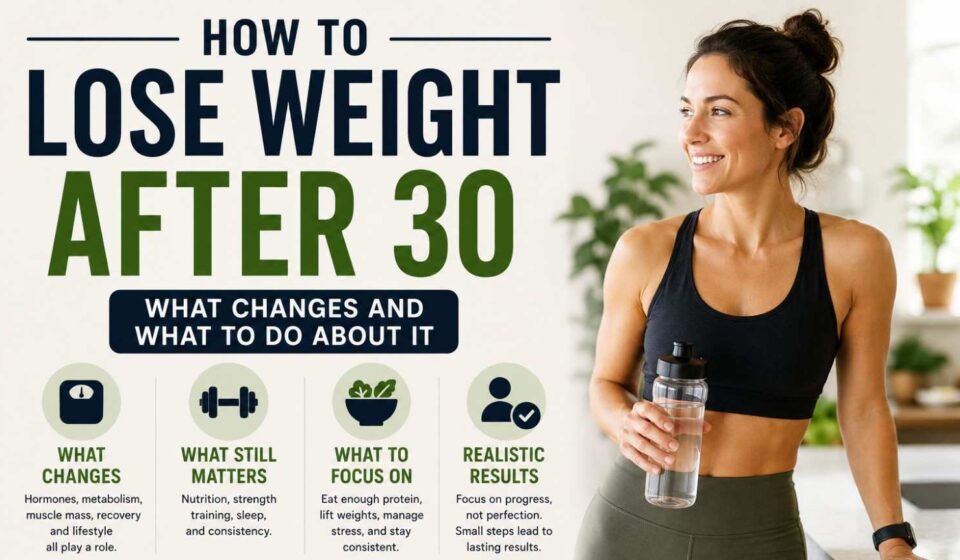
What Actually Changes After 30
Muscle Mass Begins Declining
Starting around age 30, most people begin losing a small amount of muscle mass each year — a process called sarcopenia. Less muscle means a slightly lower resting metabolic rate, which means the same food intake that maintained weight at 25 produces slow, gradual weight gain at 35.
This is the primary metabolic change of the 30s — and it’s almost entirely preventable through resistance training.
Life Gets More Complicated
This isn’t biology, but it’s real: careers, relationships, children, mortgages, aging parents, and the accumulated responsibilities of adult life in the 30s mean less time, higher stress, disrupted sleep, and less mental bandwidth for the habits that support healthy weight.
Cortisol from chronic stress promotes fat storage. Sleep deprivation disrupts hunger hormones. Reduced exercise time means less calorie burn. These lifestyle factors often explain more of the “why is this harder now” than any metabolic change.
Metabolism Slows — But Less Than People Think
The resting metabolic rate declines by roughly 1–2% per decade after 30 — which is meaningful but not the dramatic shift many people assume. The bigger driver of weight gain in the 30s is typically the muscle loss and lifestyle changes above, not a fundamentally broken metabolism.
What Doesn’t Change After 30
The fundamentals of fat loss still work exactly the same way. A calorie deficit produces fat loss. Adequate protein preserves muscle. Strength training builds and maintains metabolic rate. Sleep and stress management support hormonal health. These principles are just as effective at 35 as at 25 — they just require more intentionality to implement.
Strategy 1: Start Strength Training — Or Do More of It
If there’s one thing that separates people who manage weight successfully in their 30s from those who struggle, it’s resistance training.
Strength training directly counters the muscle loss that drives 30s metabolic slowdown. It builds or preserves the lean muscle that keeps resting metabolic rate elevated. And the body is still highly responsive to training stimulus in the 30s — muscle gains happen readily for people who haven’t been training.
Three sessions per week of compound movements — squats, deadlifts, rows, presses — is the minimum effective dose for meaningful body composition change.
Strategy 2: Increase Protein Intentionally
Protein intake that was “probably fine” in the 20s often becomes inadequate in the 30s, when muscle preservation during a calorie deficit becomes more important.
The 30s are a good time to consciously hit protein targets — 0.7–1g per pound of bodyweight — rather than hoping it happens incidentally. As covered in our guide to how much protein you actually need per day, this is the most important dietary variable for body composition at any age.
Building every meal around a protein source is the simplest practical approach.
Strategy 3: Address Sleep and Stress Directly
For many people in their 30s, the primary obstacle to fat loss isn’t diet or exercise — it’s the hormonal environment created by inadequate sleep and chronic stress.
Cortisol from work stress, family demands, and general life pressure promotes abdominal fat storage and makes fat loss harder regardless of dietary quality. Sleep deprivation disrupts hunger hormones and reduces the capacity for self-regulation that healthy eating requires.
These aren’t secondary considerations — they’re often the primary lever. As covered in our article on why sleep is the most underrated weight loss tool, prioritizing 7–9 hours is one of the highest-return investments in fat loss at this life stage.
Strategy 4: Be Smarter About Alcohol
Drinking patterns established in the 20s often continue into the 30s — but the metabolic tolerance changes. Alcohol contributes empty calories, disrupts sleep quality, impairs fat metabolism for up to 24 hours after consumption, and the recovery time from a night of drinking increases.
For people in their 30s whose weight management is difficult despite good habits, examining alcohol intake honestly is frequently revealing.
Strategy 5: Accept That the Approach Needs to Evolve
The 30s are a good time to make peace with the fact that the less-intentional approach that worked at 22 probably won’t work at 35 — not because the body is broken, but because the hormonal and lifestyle context is different.
More intentional protein intake, more deliberate strength training, active sleep and stress management — these aren’t punishments. They’re the appropriate evolution of a healthy lifestyle into a stage of life where the context has changed.
The people who struggle most in their 30s are often those who keep trying to use the same approach that worked ten years earlier and feel like failures when it doesn’t produce the same results.
What to Expect
The 30s are actually a highly responsive decade for body composition change — the muscle-building response to training is still excellent, fat loss proceeds well with appropriate dietary management, and the habits built in the 30s create the foundation for the more challenging metabolic environment of the 40s and 50s.
Realistic fat loss rate with a well-executed approach: 0.5–1.5 lbs per week — identical to any other adult age group.

The earlier you address the lifestyle factors that drive 30s weight gain — the strength training deficit, the stress load, the sleep quality — the better positioned you are for every decade that follows.
The Bottom Line
Losing weight after 30 requires the same fundamentals as at any age — adequate protein, calorie awareness, strength training, sleep, and stress management — applied with slightly more intentionality than was necessary at 25.
The muscle loss is real but preventable. The metabolic slowdown is real but modest. The lifestyle complexity is real and probably the biggest factor.
Address all three with the strategies above, and the 30s can be — for many people — the decade when they finally build the habits that produce lasting results.
For the complete framework that drives fat loss at 30, 40, 50, and beyond, our guide to how to get rid of belly fat covers all the foundational strategies.
Did you notice weight loss becoming harder in your 30s — and what’s made the biggest difference for you? Share in the comments.
Stop Wondering What to Eat This Week
Get my free 7-Day High-Protein Weight Loss Meal Plan delivered straight to your inbox — a simple week of satisfying, protein-focused meals designed to make healthy eating easier without complicated calorie tracking.
- 7 full days of breakfast, lunch, dinner & snacks
- One complete shopping list for the whole week
- A quick high-protein food cheat sheet
- Simple daily tips to help you stay on track
Free PDF • Delivered by email • Unsubscribe anytime
Check your inbox 💜
Your free 7-day high-protein meal plan is on its way.