
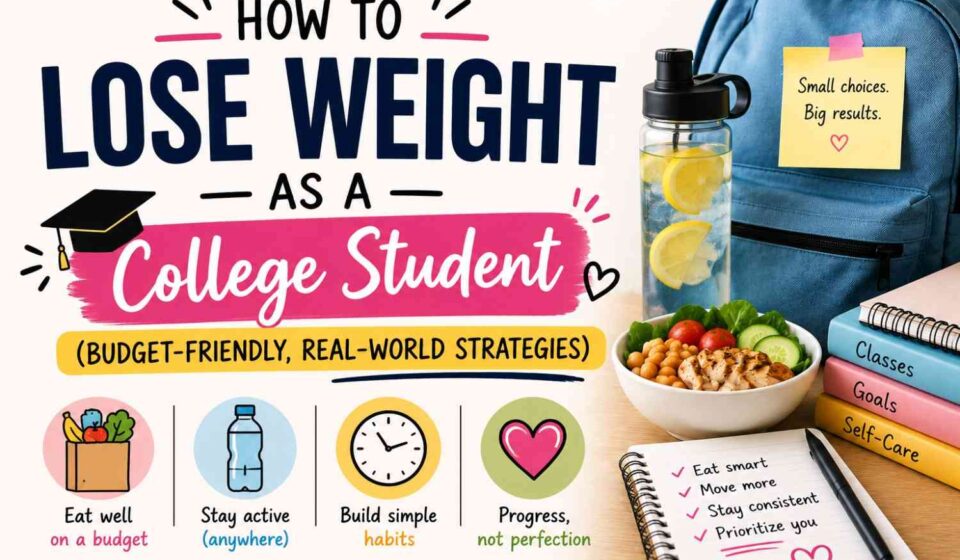

Dining halls, late nights, ramen, and a student budget — here’s how to actually lose weight at university

College is one of the most challenging environments for weight management. The dining hall’s unlimited buffet model. Late-night studying that leads to late-night eating. Limited budget. Alcohol-heavy social culture. Disrupted sleep. High stress. And for many students, the first time living independently without the dietary structure that home provided.
The “freshman 15” is a real phenomenon — not inevitable, but common enough to be culturally recognized. This guide is built for the specific realities of college life — not advice from someone who’s never had to make ramen stretch for a week.
The Specific Challenges of College Weight Management
The Dining Hall Problem
College dining halls are nutritional minefields — designed for maximum palatability and satisfaction, buffet-style so portions are unlimited, and always featuring the calorie-dense comfort foods that students gravitate toward when stressed and tired.
The same dining hall that contains salad bars and grilled chicken also contains pizza stations, pasta bars, ice cream machines, and fried food sections — and they’re all equally accessible and equally free once you’ve paid your dining plan.
Sleep Deprivation Is the Norm
College culture normalizes catastrophically poor sleep — late social nights, all-nighters before exams, irregular schedules that shift dramatically between weekdays and weekends. As covered in our article on why sleep is the most underrated weight loss tool, sleep deprivation disrupts hunger hormones, worsens insulin sensitivity, and directly impairs fat loss. In college, this sleep disruption is often chronic and severe.
Alcohol
For many students, college introduces regular alcohol consumption. Alcohol contributes significant calories (150–300 per drink), lowers food inhibitions, stimulates appetite for calorie-dense foods, and promotes the late-night eating that follows social drinking. The combination of alcohol calories plus drunk food easily adds 1,000+ calories to a social evening.
The Student Budget
Eating healthily on a limited student budget requires specific knowledge — it’s entirely possible, but it’s not intuitive when cheap and convenient options are dominated by ultra-processed foods.
High Academic and Social Stress
Exam pressure, social adjustment, identity formation, relationship dynamics — college involves significant psychological stress that elevates cortisol and drives emotional eating.
Strategy 1: Master the Dining Hall
If you have a dining hall, it’s actually an advantage — because it means meals are already paid for and the ingredients for healthy eating are already available. The key is navigating it strategically.
Build your plate using the plate method:
- Half the plate: salad bar vegetables and non-starchy vegetables
- Quarter plate: lean protein (grilled chicken, fish, eggs, beans, cottage cheese — most dining halls have these)
- Quarter plate: quality carbohydrates (whole grains, sweet potato, rice — in modest portions)
Use the salad bar as your primary station. Load up on vegetables first, then add protein. The salad bar is the most reliable source of nutritious, low-calorie-density food in most dining halls.
Find your protein anchors. Every dining hall has reliable protein sources — usually the grill station (grilled chicken breast or turkey burger without the bun), the egg station at breakfast (eggs, egg whites), the deli station (turkey, tuna), or the soup station (bean soups). Identify these and build meals around them.
Visit the comfort food stations last and in smaller amounts. The pizza and pasta stations aren’t off-limits — but visiting them first leads to filling up on them. Going there after the salad bar and protein station means smaller portions of the calorie-dense options.
Watch liquid calories. Dining halls typically have unlimited soda fountains, juice dispensers, and flavored milk. Switching to water, black coffee, or unsweetened tea at every dining hall visit eliminates hundreds of calories per day.
Don’t go ravenous. Going to the dining hall extremely hungry leads to loading up on whatever is most immediately available — usually the calorie-dense options at the front. Having a small protein-rich snack (Greek yogurt, a handful of nuts) before going helps manage hunger enough to make better choices.
Strategy 2: Eat a High-Protein Breakfast
This is the single highest-impact dining change available for college students.
A protein-rich breakfast sets up the entire day’s appetite hormones differently than skipping breakfast or having a carbohydrate-dominant meal. As covered in our guide to how much protein you actually need per day, protein at breakfast reduces hunger throughout the day — meaning less impulse snacking, smaller portions at subsequent meals, and less late-night eating.
Best dining hall breakfast choices:
- Scrambled eggs or egg omelette (high protein, available at most dining halls)
- Greek yogurt if available
- Cottage cheese with fruit
- Hard-boiled eggs
Avoid: sugary cereals, pastries, bagels alone, juice instead of whole fruit — these are the breakfast choices that produce mid-morning energy crashes and hunger spikes that drive overeating later.
Strategy 3: Budget-Friendly Healthy Eating Off Campus
When cooking in a dorm room or apartment, eating healthily on a student budget requires knowing the most nutritious and cheapest foods:
The best budget health foods:
- Eggs — the most nutritious, cheapest animal protein available. A dozen eggs for $2–4 provides 12 high-protein meals. Scrambled, boiled, fried — endlessly versatile.
- Canned tuna — $1–2 per can, 25g protein, no cooking required. Tuna salad, tuna pasta, tuna with crackers.
- Lentils and dried beans — among the cheapest foods available and extraordinarily nutritious. A bag of red lentils ($2) makes multiple meals.
- Frozen vegetables — as nutritious as fresh, dramatically cheaper, no spoilage. Microwavable bags make preparation minimal.
- Oats — one of the cheapest, most filling, highest-fiber breakfast options. A large container of oats provides weeks of breakfasts.
- Bananas — the cheapest fresh fruit per calorie, high in potassium and fiber.
- Canned beans — black beans, chickpeas, kidney beans — $1 per can, high protein and fiber, no cooking required (eat cold or heat in microwave).
- Greek yogurt — slightly more expensive but protein density justifies the cost for weight management. Buy the large container rather than individual cups.
- Whole grain bread — much more nutritious than white bread at similar prices.
- Frozen chicken breasts — bulk buy frozen chicken, portion and use throughout the week.
- Sweet potatoes — cheap, filling, nutritious, microwave in 5–7 minutes.
As covered in our guide to how to lose weight on a budget, eating healthily on a limited budget is entirely possible with the right food knowledge.
Strategy 4: Handle the Late-Night Eating Problem
Late-night eating is the most common college weight gain driver. The combination of studying stress, social eating culture, and being awake when the brain’s prefrontal cortex (responsible for impulse control) is depleted produces consistent late-night overeating.
Structural approaches:
Don’t keep calorie-dense snacks in your room. If chips, cookies, and processed snacks aren’t in your dorm room, you can’t eat them at 2am. Keep fruit, protein bars, Greek yogurt, and nuts instead.
Have a planned late-night option if needed. A protein shake, Greek yogurt, or cottage cheese provides the psychological satisfaction of eating without the caloric impact of typical late-night snacks.
Eat a protein-rich dinner. A satisfying, high-protein dinner significantly reduces late-night hunger. Arriving at 1am still satisfied from a good dinner is very different from arriving at 1am having skipped dinner.
Identify your late-night triggers. Is it genuine hunger? Boredom? Procrastination? Stress eating while studying? Different triggers have different solutions — genuine hunger responds to a protein snack; boredom responds to changing activities.
Strategy 5: Manage Alcohol Strategically
This section deserves honesty: telling college students not to drink is not realistic advice. The realistic goal is drinking more strategically to minimize the weight impact.
The lower-calorie options:
- Light beer (95–110 calories) vs. craft beer (200–350 calories)
- Spirits with soda water and lime vs. cocktails (typically 150–300+ calories each)
- Dry wine vs. sweet wine or wine spritzers
Eat before drinking. A protein-rich meal before going out reduces alcohol absorption, maintains better decision-making, and reduces the appetite stimulation of alcohol on an empty stomach.
Manage the drunk food situation. Late-night takeout after drinking is often where the most calories happen. Having a plan — a protein bar in your bag, a plan to go home and make eggs, a specific order at the place you usually go — removes the decision-making that impaired judgment handles poorly.
Reduce frequency where possible. Three drinks twice per week is very different from three drinks six nights per week in its weekly caloric and metabolic impact.
Strategy 6: Move Between Classes
College campuses are actually excellent environments for daily walking — classes are spread across campus, libraries are distances from dorms, coffee shops are walks away. Students who walk between classes without taking shuttle services accumulate 5,000–8,000 steps without dedicated exercise time.
Campus movement strategies:
- Walk between all campus locations rather than taking shuttles or driving
- Take stairs in academic buildings
- Walk during phone calls
- Use the campus gym — most student fees include this and it’s one of the best fitness value propositions available
As covered in our guide to how to lose weight by walking, daily walking provides meaningful fat loss benefit that accumulates significantly over semesters.
Strategy 7: Sleep as a Non-Negotiable
This is difficult advice in a college culture that valorizes sleep deprivation — but it’s backed by clear evidence. Students who sleep less eat more the following day, make worse food choices, and have worse body composition over time.
Practical college sleep strategies:
- Set a consistent bedtime even if it means missing some social events
- Treat all-nighters as genuine last resorts, not a study strategy
- Use the 8am slot sparingly if morning alertness requires staying up late to compensate
- Protect sleep before exams rather than sacrificing it — sleep consolidates learning and improves performance
Even improving from 5 to 7 hours of sleep produces measurable improvements in appetite hormone regulation and calorie intake the following day.
Strategy 8: Campus Resources
Most college campuses have resources that students underuse:
Campus gym and fitness facilities — usually included in student fees, often surprisingly well-equipped, and significantly less intimidating than commercial gyms.
Student health services — can provide dietary counseling, mental health support for stress and emotional eating, and medical evaluation if weight management is genuinely difficult despite lifestyle effort.
Student wellness programs — many universities run weight management, nutrition, and fitness programs specifically for students.
Cooking classes — some universities offer basic cooking skills classes that dramatically expand food preparation capability even in limited housing.
Realistic Expectations for College Students
Weight loss in college doesn’t need to be dramatic to be meaningful. Maintaining weight rather than gaining is a genuine success given the college environment. Losing 0.5 lbs per week consistently over a semester produces 8–10 lbs of meaningful fat loss.
The habits built during college — around protein intake, dining hall navigation, alcohol management, and daily movement — are the ones that persist into professional life. Building them during college is an investment in the health trajectory of the next several decades.
The Bottom Line
Losing weight in college is harder than in most life situations — but not impossible. The environment requires specific strategies: dining hall navigation, budget-friendly food knowledge, late-night eating management, strategic alcohol choices, and campus movement habits.
The fundamentals remain the same: adequate protein, meaningful daily movement, sufficient sleep, and dietary quality that supports a modest calorie deficit. Applied specifically to the college context, these produce real results without requiring the expensive food or equipment that most weight loss advice assumes.
For the complete fat loss framework that applies in any life situation, our guide to how to get rid of belly fat covers all the foundational strategies.
Are you a college student managing weight loss — and what dining hall or budget strategies have worked for you? Share in the comments.