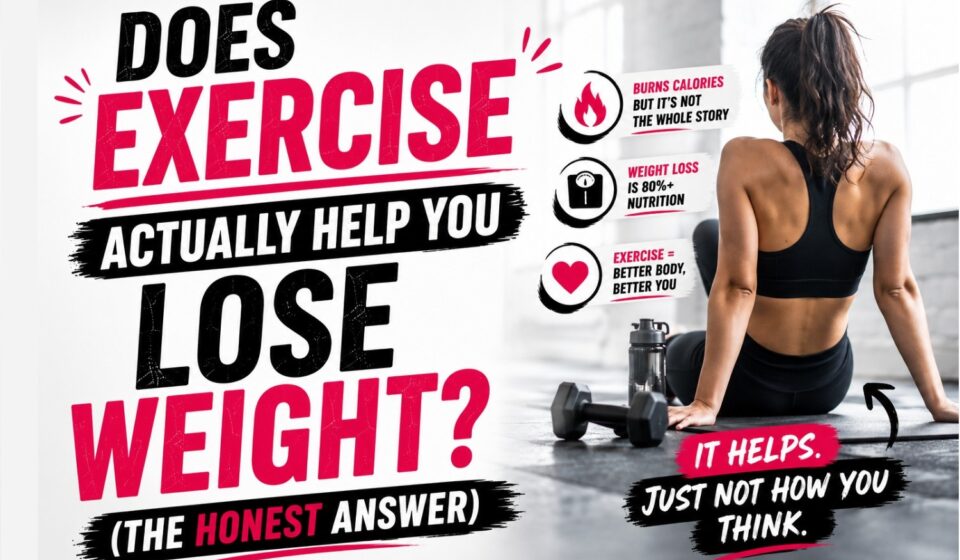
Does Exercise Actually Help You Lose Weight? (The Honest Answer)

The relationship between exercise and weight loss is more complicated — and more interesting — than most people think

“Just exercise more and you’ll lose weight.” It’s the most common weight loss advice in existence. It’s also incomplete, misleading, and responsible for a lot of failed attempts.
Does exercise help with weight loss? Yes — but not in the way most people think, not as much as most people expect, and not without understanding the specific ways it helps and the specific ways it doesn’t.
This guide gives you the honest, research-based answer.
The Surprising Research on Exercise and Weight Loss
The most striking finding in exercise and weight loss research is how little weight loss exercise produces when used alone — without dietary changes.
A landmark analysis by exercise scientists found that people who exercised without changing their diet lost an average of just 2–3 lbs over several months of consistent exercise. Not 20 lbs, not 10 lbs — 2–3 lbs.
This isn’t because exercise doesn’t burn calories. It does. The problem is something researchers call “compensatory responses.”
Why Exercise Alone Produces Disappointing Weight Loss
Compensatory Eating
When you exercise, you burn more calories — but you also get hungrier. Many people unconsciously eat more after exercising, either because they’re genuinely hungrier or because they feel they’ve “earned” more food.
Studies using precise food intake tracking find that many people consume 50–100% of the calories they burned exercising in additional food intake afterward — often without being aware of it.
The classic example: a 45-minute run burns approximately 400 calories. A post-run protein bar, extra serving at dinner, and a slightly larger lunch adds up to 350–500 calories. Net calorie deficit from the run: close to zero.

Compensatory Rest
People who exercise often become less active outside of their exercise sessions — unconsciously reducing NEAT (non-exercise activity thermogenesis), the background daily movement that contributes significantly to total calorie expenditure.
Someone who runs for an hour might sit more, fidget less, and take fewer steps throughout the rest of the day — partially or fully compensating for the calories burned running.
The Metabolic Adaptation Response
The body is remarkably good at maintaining its weight setpoint. When exercise creates a calorie deficit, the body responds with subtle adjustments — reduced organ activity, slightly lower body temperature, reduced spontaneous movement — that partially compensate for the increased calorie burn.
So Exercise Doesn’t Help With Weight Loss?
Not so fast. Exercise produces significant weight loss benefits — just different ones than most people expect, and through mechanisms that diet alone can’t replicate.
Exercise Is Critical for Body Composition
This is the most important thing exercise does for weight loss that diet cannot replicate: it determines whether the weight you lose is fat or muscle.
In a calorie deficit without exercise, 20–30% of weight lost comes from muscle — not just fat. With strength training and adequate protein, this drops to 5–10%. The difference in body composition at the same weight is dramatic — and it determines how you look, how you feel, and how easy it is to maintain the loss.
Someone who loses 20 lbs through diet alone looks different — often smaller but soft — than someone who loses 20 lbs with strength training. The muscle built or preserved through training creates the toned, defined appearance that “I want to lose weight” usually actually means.
Strength Training Raises Resting Metabolic Rate
Building muscle raises the number of calories burned at rest — permanently. Each pound of muscle burns approximately 6 calories per day without any activity. Add 5 lbs of muscle and you’re burning 30 more calories per day doing nothing.
This sounds small — but over years, it means the person who strength trains can eat more while maintaining the same weight than the person who doesn’t. This is the most sustainable long-term metabolic advantage available.
Exercise Is the Strongest Predictor of Weight Maintenance
Here’s where exercise’s contribution becomes clearest: not in the initial weight loss phase, but in keeping the weight off afterward.
Research from the National Weight Control Registry — tracking thousands of people who have maintained significant weight loss for years — finds that exercise is the single most consistent behavior among long-term maintainers. Almost all of them exercise approximately 60–90 minutes per day (including walking).
The reason: exercise partially compensates for the reduced metabolic rate that follows weight loss, and it counteracts the muscle loss that would otherwise lower calorie-burning capacity over time.
Exercise Directly Reduces Visceral Fat
Exercise — particularly strength training and aerobic exercise — directly reduces visceral belly fat through metabolic mechanisms that operate independently of calorie deficit. People who exercise consistently have less visceral fat than people who don’t, even at the same body weight.
As covered in our guide to how to get rid of belly fat, visceral fat reduction is one of the most important health benefits of exercise — regardless of what the scale shows.
Exercise Improves the Conditions for Fat Loss
Beyond direct effects, exercise improves the hormonal and metabolic environment that supports fat loss:
Insulin sensitivity: Exercise dramatically improves insulin sensitivity — reducing the fat-storage hormonal environment that makes fat loss harder for people with insulin resistance.
Cortisol management: Regular moderate exercise (particularly walking) reduces baseline cortisol — directly addressing one of the primary drivers of belly fat accumulation.
Sleep quality: Exercise improves sleep quality — which in turn improves the hunger hormones and metabolic function that support dietary adherence and fat loss.
Mood and motivation: Exercise produces neurochemical changes (dopamine, serotonin, endorphins) that improve mood and reduce the emotional eating that undermines dietary efforts.
The Right Way to Think About Exercise and Weight Loss
The most useful framing: diet drives fat loss, exercise drives body composition and metabolic health.
Diet is responsible for the calorie deficit that produces fat loss. Exercise determines:
- How much of the lost weight is fat vs. muscle
- How good the body looks at the lower weight
- How sustainable the lower weight is long-term
- The metabolic and health improvements that matter as much as the number on the scale
When people use exercise as their primary weight loss tool — running more without changing diet — they get disappointing results because they’ve misidentified what exercise does best.
When people use diet as their primary fat loss tool and exercise for body composition and metabolic health — they get dramatically better outcomes.
How Much Exercise Actually Contributes
With realistic, sustainable exercise alongside a 500-calorie dietary deficit:
Walking 10,000 steps daily: Adds approximately 300–400 calories of daily expenditure. Net contribution to fat loss after compensatory adjustments: approximately 0.2–0.4 lbs per week additional fat loss beyond diet alone.
Strength training 3x per week: Adds approximately 200–350 calories per session plus EPOC. Net contribution: approximately 0.1–0.2 lbs per week additional fat loss.
One HIIT session per week: Adds approximately 300–400 calories plus EPOC. Net contribution: approximately 0.1–0.2 lbs per week additional fat loss.
Combined total: Regular exercise adds approximately 0.4–0.8 lbs of additional weekly fat loss beyond dietary deficit alone.
Over 6 months, this represents an additional 10–20 lbs of fat loss compared to diet only — significant, but not the primary driver.
As covered in our guide to how to speed up weight loss, exercise accelerates fat loss meaningfully — it just doesn’t replace dietary management as the foundation.
The Best Exercise Choices for Weight Loss
Given all of the above, here’s the priority order:
1. Daily walking (highest return on investment)
Walking is the most effective exercise for weight loss relative to its impact on hunger and compensatory eating. It doesn’t trigger the “I need to eat more” response that intense exercise does, reduces cortisol, can be done every day without recovery days, and produces consistent calorie burn.
8,000–10,000 steps per day is the single most sustainable exercise habit for long-term weight management. As covered in our guide to how to lose weight by walking, this single habit produces real, consistent fat loss support.
2. Strength training (essential for body composition)
Three sessions per week of compound movements preserves and builds muscle during fat loss — determining body composition quality at the goal weight and supporting long-term metabolic rate.
3. HIIT (efficient calorie burn with metabolic benefits)
One to two weekly HIIT sessions add meaningful calorie burn and insulin sensitivity improvements. As covered in our guide to HIIT for beginners, even short HIIT sessions produce significant metabolic benefits.
4. Any cardio you enjoy
Running, cycling, swimming — any cardio you’ll actually do consistently contributes to the deficit and cardiovascular health. Enjoyability matters for consistency, and consistency matters more than optimal choice.
The Bottom Line: Does Exercise Help You Lose Weight?
Yes — but:
- Exercise alone produces minimal weight loss without dietary changes
- Exercise contributes approximately 20–30% of fat loss results; diet contributes 70–80%
- Exercise’s biggest contribution is to body composition quality and long-term maintenance — not the initial loss
- The most effective exercise for weight management is daily walking + strength training, not hours of cardio
- Avoiding compensatory eating after exercise is essential to actually getting the caloric benefit
The person who diets without exercising loses weight — but loses muscle alongside fat and struggles to maintain.
The person who exercises without dieting barely loses weight at all.
The person who combines a moderate dietary deficit with daily walking and strength training loses fat, preserves muscle, improves metabolic health, and keeps the weight off.
For the complete framework that integrates diet and exercise for maximum fat loss results, our guide to how to get rid of belly fat covers everything in one place.
Have you tried exercising to lose weight without changing your diet — and what results did you get? Share in the comments.