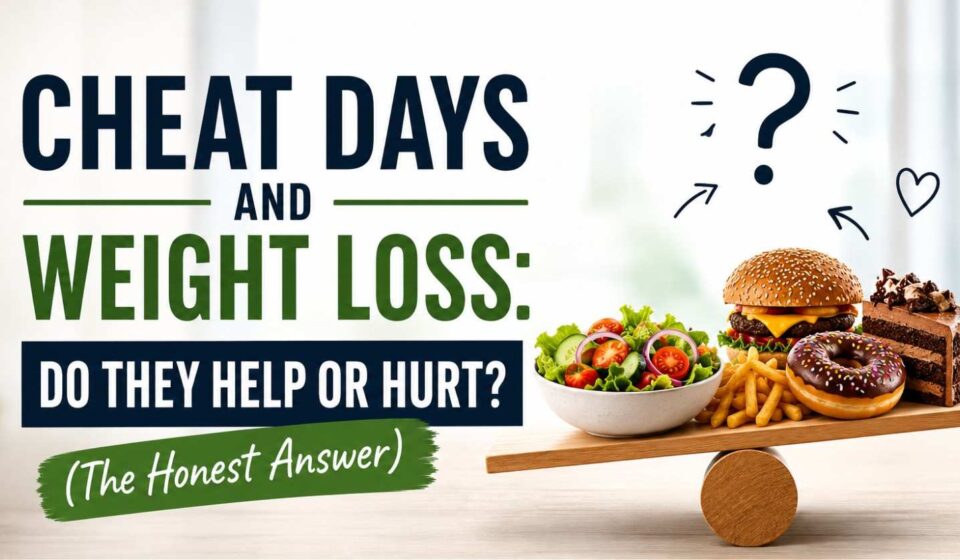

The concept everyone talks about but nobody fully explains — here’s what actually happens
“Cheat day” is one of the most debated concepts in weight loss — some people swear by them as an essential part of their approach, while others argue they’re counterproductive. The truth, as usual, is more nuanced than either extreme.
This article looks at what cheat days actually do metabolically, whether they help or hurt fat loss, and what a smarter approach might look like.

What Is a Cheat Day?
A cheat day is a planned day where someone eating in a calorie deficit allows themselves to eat without restriction — often specifically including foods they’ve been avoiding.
The appeal is obvious: knowing a less restricted day is coming makes stricter days more bearable. It feels like a built-in reward system.
But the concept has some significant practical and psychological problems worth understanding before deciding whether it belongs in your approach.
The Metabolic Case For Cheat Days
Proponents of cheat days make several arguments — some have more evidence behind them than others.
Leptin and metabolism: Prolonged calorie restriction reduces leptin — the hormone that signals fullness and regulates metabolic rate. Some research suggests that periodic higher-calorie days can temporarily restore leptin levels and prevent the metabolic slowdown associated with extended dieting.
This effect is real, but modest. The metabolic benefit of a single higher-calorie day is limited and temporary — it doesn’t dramatically change metabolic rate in the way enthusiasts sometimes claim.
Glycogen restoration: A higher-carbohydrate day replenishes muscle glycogen stores that become depleted during extended calorie restriction. This can improve exercise performance in the days following a higher-calorie day.
Psychological sustainability: This is the strongest argument for planned higher-calorie days. For many people, knowing that flexibility is built into their approach makes the whole system more sustainable. The psychological breathing room reduces the all-or-nothing thinking that derails many fat loss efforts.
The Problems With Traditional Cheat Days
The calorie math often doesn’t work. A typical “cheat day” can easily involve 3,000–5,000+ calories — enough to wipe out an entire week’s carefully maintained deficit. Five days of a moderate deficit followed by one day of significant surplus frequently produces no net deficit and no fat loss for the week.
They can reinforce unhealthy food relationships. Framing certain foods as “cheats” — things you’re not allowed to have except on designated days — can intensify their psychological power. Food that’s forbidden becomes more appealing, and the “cheat” framing can make eating feel like transgression rather than a normal part of life.
They can trigger binge eating patterns. For people prone to all-or-nothing thinking, a designated “anything goes” day can become a vehicle for consuming far more than intended — and the guilt afterward can spiral into extended periods of abandoning healthy habits entirely.
The word “cheat” itself is problematic. It implies you’re breaking rules, deceiving someone, or doing something wrong. Healthy eating isn’t a test with rules to break — it’s a set of habits that support your wellbeing.
A Better Framework: Flexible Eating Instead of Cheat Days
Rather than designating specific “cheat days,” a more sustainable and psychologically healthier approach is building flexibility directly into your overall eating pattern.
This means:
No foods are permanently off-limits. When nothing is forbidden, nothing has the amplified appeal that comes from restriction. You can have pizza on a Tuesday if you want it — not because it’s a designated cheat day, but because it fits into an overall eating pattern that’s mostly nutritious.
Planned higher-calorie occasions rather than unstructured cheat days. A dinner out, a birthday celebration, a holiday meal — these are natural occasions for eating more freely. Planning for these specific occasions is different from declaring a weekly “anything goes” day.
The 80/20 approach. Eating well most of the time — roughly 80% of meals — while allowing genuine flexibility 20% of the time. This produces good results while feeling far less restrictive than strict dieting. It’s not cheating. It’s normal eating with good overall habits.
What Actually Matters for Sustainable Fat Loss
The cheat day debate somewhat misses the larger point: the most important variable in fat loss is consistency over time, not perfection on any given day or week.
A week where you ate perfectly six days and had a relaxed seventh is nutritionally similar to a week where you were moderately intentional every day. The outcome over months is determined by patterns, not individual days.
What produces lasting fat loss:
Overall dietary quality most of the time — protein at most meals, vegetables at most meals, minimal processed food and added sugar most of the time. Not perfection. Most of the time.
A sustainable approach — one that can be maintained through stressful weeks, social occasions, holidays, and difficult life events without completely collapsing. Flexibility is built in, not scheduled on specific days.

A healthy relationship with food — where eating is neither a source of guilt and shame nor a free-for-all. Where all foods can be eaten without moral weight, in quantities that support your goals and your enjoyment of life.
As covered in our article on how to build healthy eating habits for life, sustainable long-term change comes from habits that become identity — not from rigid rules that eventually break.
If You Want to Keep a Version of Planned Flexibility
If the psychological benefit of planned higher-calorie occasions genuinely helps you sustain your approach, here’s how to structure it more effectively than a traditional cheat day:
Plan specific occasions rather than blanket days. “I’m going to enjoy dinner out on Saturday” is different from “Saturday is my cheat day where anything goes.” One is intentional; the other is an open door that often leads further than intended.
Stay anchored by protein. Even on more relaxed days, maintaining adequate protein keeps hunger more manageable and reduces the likelihood of the day spiraling further than intended.
Don’t extend it. “One cheat meal became a cheat day became a cheat weekend” is a familiar pattern. Having a planned occasion for a meal or an evening — rather than a full unstructured day — keeps the flexibility purposeful.
Remove the guilt framing entirely. You’re not cheating. You’re eating. Some days you eat more, some days you eat less, some days you eat things that are particularly delicious. That’s normal human eating, not moral failure.
The Bottom Line
Cheat days — as traditionally conceived — are a mixed tool at best. The metabolic arguments are modest. The psychological benefit is real for some people but counterproductive for others. The calorie math often undermines the deficit they’re supposed to support.
A more useful framework: flexible eating with no permanently forbidden foods, planned enjoyment of specific occasions, and an overall dietary pattern that’s nutritious most of the time without being rigid all of the time.
Less “cheat day.” More “this is just how I eat — mostly well, occasionally with genuine enjoyment of whatever I feel like.”
For the complete approach to sustainable fat loss that doesn’t require scheduled cheating, our guide to how to get rid of belly fat covers all the foundational strategies.
Do you use cheat days in your approach — and do you find them helpful or counterproductive? Share honestly in the comments.
Stop Wondering What to Eat This Week
Get my free 7-Day High-Protein Weight Loss Meal Plan delivered straight to your inbox — a simple week of satisfying, protein-focused meals designed to make healthy eating easier without complicated calorie tracking.
- 7 full days of breakfast, lunch, dinner & snacks
- One complete shopping list for the whole week
- A quick high-protein food cheat sheet
- Simple daily tips to help you stay on track
Free PDF • Delivered by email • Unsubscribe anytime
Check your inbox 💜
Your free 7-day high-protein meal plan is on its way.