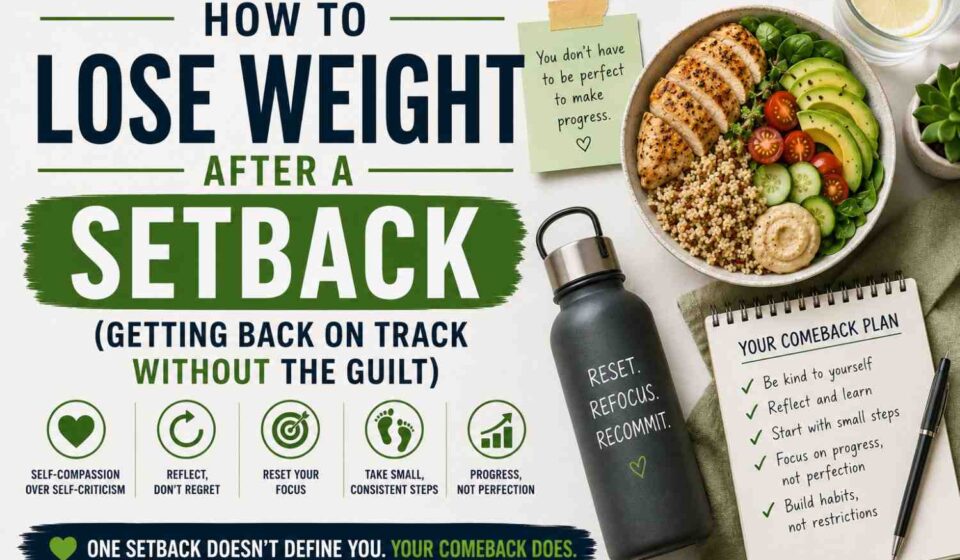
How to Lose Weight After a Setback (Getting Back on Track Without the Guilt)

Everyone falls off track. What separates people who succeed long-term is what they do next.
Setbacks are not the exception in weight loss — they’re the rule. Almost everyone who has ever worked toward a health goal has experienced a period where things fell apart: a stressful month, an injury, a holiday that stretched into weeks, a difficult life event that made self-care feel impossible.
The setback isn’t the problem. What happens after it is.

This article is about getting back on track in a way that’s sustainable, compassionate, and doesn’t set you up for another cycle of all-or-nothing thinking.
First: Acknowledge What Happened Without Judgment
Before any practical strategies, the most important step is this: acknowledge the setback honestly and without excessive self-criticism.
This matters more than most people realize. Research consistently shows that shame and self-criticism after a setback predict longer periods of continued struggle — not faster recovery. People who respond to setbacks with self-compassion return to their healthy behaviors faster and maintain them longer than those who engage in self-punishment.
You don’t need to minimize what happened or pretend it doesn’t matter. You also don’t need to catastrophize it or use it as evidence that you’re fundamentally broken or incapable.
What happened, happened. It doesn’t define you. The question is simply: what’s the next small step forward?
Understand What Caused the Setback
Before jumping back into action, taking a few minutes to understand what actually caused the setback is one of the most valuable things you can do — because understanding it helps prevent the same thing from derailing you again.
Common setback causes:
Life stress and overwhelm — work pressure, relationship difficulties, family crises, grief. When psychological resources are depleted, the habits that require the most willpower are the first to go. Eating well and exercising regularly are usually near the top of that list.
All-or-nothing thinking — one off-meal became a written-off day, which became a written-off week, which became a written-off month. The belief that anything less than perfect means starting over from scratch.
Unrealistic expectations — expecting faster results than are biologically possible, then losing motivation when the scale doesn’t reflect the effort.
Social and environmental factors — a holiday, a change in routine, a period of travel, a new job. External changes disrupting established habits.
Physical factors — illness, injury, pain, fatigue, hormonal changes that made the previous approach unsustainable.
Identifying the actual cause allows you to address it — rather than simply applying more willpower to the same approach that already failed once.
Reframe What “Getting Back on Track” Actually Means
One of the most damaging mindsets around setbacks is the idea of returning to exactly where you were before — restoring the exact habits, the exact plan, the exact level of restriction that was in place before the setback.
This rarely works, for a simple reason: if that exact approach was completely sustainable, it probably wouldn’t have been derailed in the first place.
Getting back on track doesn’t mean returning to a previous state. It means finding the next workable version of your approach — one that accounts for what you’ve learned about what caused the setback and what you’re realistically capable of right now.
This might look like:
- A less aggressive approach that’s more durable under pressure
- Building in explicit rest or flexibility days that were missing before
- Addressing an underlying stressor that was making habits harder to sustain
- Starting with fewer habits and building more gradually
The First Step Back: Choose One Thing
The instinct after a setback is often to go all-in immediately — completely overhaul everything, make up for lost time, restart with maximum intensity.
This almost always produces another short-lived effort followed by another setback.
The more effective approach: choose one single thing to restart, and do only that for the first week.
Not the full routine. Not everything at once. One thing.
It might be the morning protein breakfast that used to be automatic. It might be the evening walk. It might be drinking adequate water. Whatever feels most manageable right now — start there.

This creates a small win. Small wins restore self-efficacy — the belief that you’re capable of change. And self-efficacy is what makes the next step, and the one after that, possible.
Address the All-or-Nothing Thinking Directly
If your setback was prolonged by the thought “I’ve already ruined it, so I might as well eat everything” — this pattern needs direct attention, because it will recur.
All-or-nothing thinking treats healthy eating as a binary state: either you’re “on” the plan perfectly, or you’ve failed and everything is off. This framing turns every imperfect meal into a catastrophe and every small slip into permission to abandon everything.
The alternative framing: every meal is its own opportunity, completely independent of the meal before it. A challenging lunch doesn’t make dinner a write-off. A difficult week doesn’t make the following Monday a “fresh start” — because you don’t need a fresh start. You just need the next meal.
This is genuinely one of the most important mindset shifts in long-term healthy eating — and as covered in our article on how to build healthy eating habits for life, it’s one of the factors most associated with lasting behavior change.
Be Honest About Where You Are Now
After a setback — particularly a prolonged one — your current capacity might be genuinely different from where you were before.
Sleep might be worse. Stress might be higher. Motivation might be lower. Physical fitness might have decreased if you stopped exercising for a period.
Starting from an honest assessment of where you actually are right now — not where you were six months ago, and not where you think you “should” be — prevents the frustration of holding yourself to a standard that doesn’t match your current reality.
This isn’t lowering your standards. It’s being intelligent about what’s achievable right now as a foundation for building back.
Rebuild Gradually, Not All at Once
Once you’ve started with one small habit, add additional habits gradually — as each becomes stable — rather than layering everything back simultaneously.
Week 1: One habit re-established Week 2–3: First habit stable, add a second Week 4–5: Two habits stable, add a third
This gradual rebuilding feels slower than the “all-in restart” approach — but it produces habits that are actually stable under real-life conditions rather than brittle plans that collapse at the first disruption.
What to Do About the Weight That Came Back
For many people, the most difficult part of a setback isn’t the habits — it’s the number on the scale.
A few things worth knowing:
Not all of it is fat. Weight can increase rapidly during a setback due to water retention (from increased sodium, carbohydrates, or stress hormones), not actual fat gain. This water weight can add several pounds quickly and resolve just as quickly when habits stabilize.
The fat that did return responds to the same approaches that worked before. It’s not permanently different or harder to lose because it was regained. Your body hasn’t changed its fundamental biology.
Weighing yourself immediately after a setback is often counterproductive. The number can be discouraging in a way that undermines the motivation to restart. Consider waiting a week or two after reestablishing habits before checking the scale — when the water retention has cleared and you have some behavioral momentum.
When the Setback Is Ongoing
Sometimes what looks like a setback is actually a signal that something more significant needs addressing — not just a motivation or habits issue.
If setbacks are frequent, prolonged, and connected to significant emotional distress around food, eating, or body image, it may be worth talking to a professional who specializes in this area rather than continuing to apply more dietary strategies.
A registered dietitian who specializes in non-diet approaches, or a therapist who works with food and body image, can provide support that goes beyond practical eating advice. This isn’t a sign of failure — it’s recognizing that some challenges are better addressed with professional support.
The Longer View
Zooming out: most people who have successfully maintained healthy habits long-term have had multiple setbacks along the way. The path looks less like a straight line and more like a general upward trend with significant dips.
A setback doesn’t erase the progress that came before it. The habits you built, the knowledge you gained, the relationship with your body you developed — these aren’t lost because of a difficult period.
Getting back on track after a setback is genuinely easier than the original effort — because the habits were established once and can be re-established faster. The neural pathways exist. They just need to be reactivated.
A Simple Framework for the First Week Back
Day 1: Acknowledge the setback without judgment. Identify what caused it. Choose one small habit to restart.
Days 2–7: Do only that one thing. Don’t add anything else. Focus on consistency over perfection.
End of week 1: Reflect. Is this one habit stable? What’s the next small addition?
Week 2 onward: Add one habit at a time as each becomes stable. Rebuild gradually.
The goal for the first week isn’t dramatic change. It’s rebuilding the experience of showing up — however imperfectly — which is the foundation everything else is built on.
The Bottom Line
Setbacks are universal. What varies is the response. People who succeed long-term aren’t people who never fall off track — they’re people who return to their habits without excessive guilt, self-punishment, or catastrophizing.
One small step. The next meal. No drama. That’s how you get back on track.
For the full framework of healthy eating and lifestyle habits that make setbacks less frequent and recovery faster, our guide to how to get rid of belly fat covers all the foundational strategies in one place.
Have you experienced a major setback and found a specific approach to getting back on track that worked? Share in the comments — real experience with recovery from setbacks is some of the most valuable content in this space.
Stop Wondering What to Eat This Week
Get my free 7-Day High-Protein Weight Loss Meal Plan delivered straight to your inbox — a simple week of satisfying, protein-focused meals designed to make healthy eating easier without complicated calorie tracking.
- 7 full days of breakfast, lunch, dinner & snacks
- One complete shopping list for the whole week
- A quick high-protein food cheat sheet
- Simple daily tips to help you stay on track
Free PDF • Delivered by email • Unsubscribe anytime
Check your inbox 💜
Your free 7-day high-protein meal plan is on its way.