
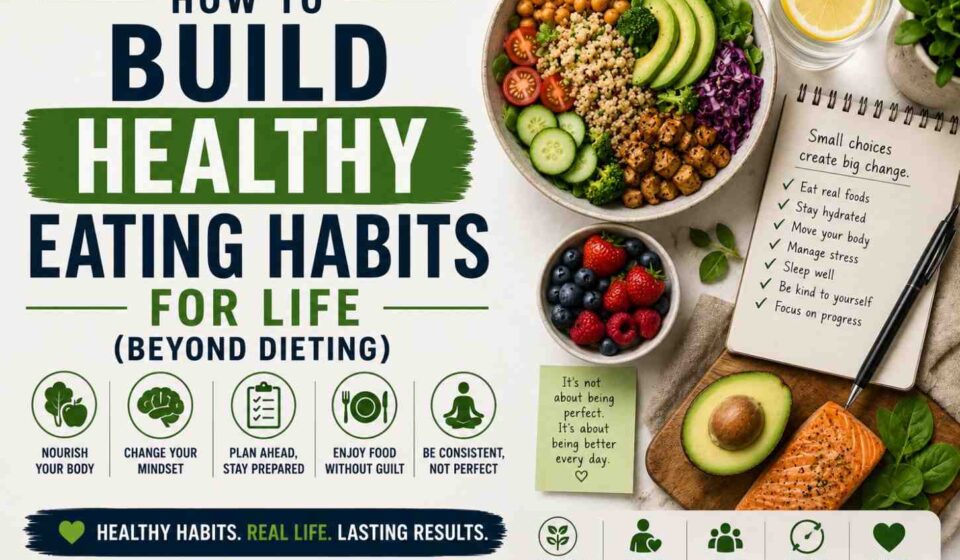
How to Build Healthy Eating Habits for Life (Beyond Dieting)

Diets end. Habits don’t. Here’s how to build an eating pattern you can actually sustain forever.

Most people have dieted multiple times. They’ve lost weight, regained it, started again, lost it again, regained more. The problem isn’t a lack of knowledge about what to eat. Most people know that vegetables are better than chips and water is better than soda.
The problem is sustainability. Diets are temporary by design — they’re restrictions you follow until you reach a goal, then stop. Habits are permanent — they become the default way you operate without conscious effort.
This article is about the latter. Not a new diet to follow. A set of habits to build — slowly, intentionally, and permanently.
The Difference Between Dieting and Habit Building
Dieting starts with restriction. You follow rules about what you can and can’t eat, count something (calories, points, carbs), and sustain this through willpower until the goal is reached or the willpower runs out.
Habit building starts with addition. You add one small positive behavior at a time, practice it until it’s automatic, then add another. The goal isn’t a finish line — it’s a permanently different way of eating.
The research is clear on which approach produces lasting results: habits. People who successfully maintain long-term healthy weight and eating patterns describe their eating as “just how I eat” — not as a diet they’re following. The habits have become identity.
Why Habit Change Works (And Why It Feels Slow)
Habits form through repetition — the same behavior, in the same context, enough times that it becomes automatic and requires minimal conscious effort.
The neuroscience: repeated behaviors create and strengthen neural pathways. Initially, choosing a salad over fries requires deliberate thought. After months of consistently choosing the salad in the same lunch context, the decision becomes increasingly automatic — the habit loop is formed.
This process takes time — research suggests 21 to 66 days for a new behavior to become automatic, with significant individual variation. It feels frustratingly slow compared to the immediate structure of a new diet. But the payoff is that once a habit is established, it requires almost no ongoing willpower — it just happens.
The Fundamental Approach: Add Before You Subtract
The most common habit-building mistake is starting with restriction — taking away foods you love before adding anything positive.
Restriction creates deprivation. Deprivation creates craving. Craving creates eventual breaking point. This is the restrict-binge cycle that keeps most diets from lasting.
The alternative: start by adding genuinely positive habits. More protein at breakfast. More vegetables at dinner. More water throughout the day. These additions naturally crowd out less nutritious choices without the psychological weight of restriction.
Once positive additions are established — once the salad at lunch is automatic, the protein at breakfast is automatic, the water bottle is always full — the less nutritious choices reduce naturally, without feeling like they’ve been taken away.
The Habits Worth Building — In Rough Priority Order
Habit 1: Eat a Protein-Rich Breakfast
This is the highest-leverage single eating habit available. A protein-rich breakfast — eggs, Greek yogurt, cottage cheese, or a protein smoothie — sets up the entire day’s appetite hormones differently than a carbohydrate-heavy or skipped breakfast.
People who eat adequate protein at breakfast consistently eat fewer total calories throughout the day — not through conscious restriction, but through better-regulated hunger hormones.
How to build it: Start with the same protein-rich breakfast every day for 3 weeks. Repetition in the same context is how habits form. Once it’s automatic, vary it.
Habit 2: Drink Water First Thing Every Morning
A large glass of water immediately after waking — before coffee, before food — rehydrates after overnight fasting and provides the first of many hydration checkpoints throughout the day.
How to build it: Keep a full glass of water on your nightstand. It’s the first thing you see when you wake up. The environmental cue makes the habit effortless.
Habit 3: Fill Half Your Plate With Vegetables
Not counting vegetables. Not weighing them. Just filling half your plate with non-starchy vegetables before adding anything else.
This single visual habit reduces the calorie density of every meal without any calculation — vegetables are so low in calories that they displace more calorie-dense foods without creating deprivation.
How to build it: Use the plate method described in our portion control article as a visual template for every dinner. After a few weeks, it becomes automatic.
Habit 4: Eat Slowly and Without Screens
Satiety hormones take approximately 15–20 minutes to register after eating begins. Eating quickly consistently produces overeating because the fullness signal arrives after you’ve already eaten past satisfaction.
Eating without screens removes the distraction that delays satiety signal registration and disconnects eating from the physical experience of being satisfied.
How to build it: Start with one screen-free meal per day — dinner is typically easiest. Build to all meals over several weeks.
Habit 5: Stop Eating Liquid Calories
Replacing sweetened drinks with water, black coffee, or unsweetened tea is one of the most impactful single dietary changes available. Liquid calories provide essentially no satiety — your appetite doesn’t register them the same way it registers solid food.
This habit doesn’t require willpower once established — it becomes “I just don’t drink soda” rather than “I’m trying not to drink soda.” The identity shift is the habit.
How to build it: Replace one sweetened drink per day with water for the first week. Then two. By week four, most people find they genuinely don’t want the sweetened drinks anymore.
As covered in our guide to the best and worst drinks for weight loss, this single habit change can remove hundreds of daily calories without affecting food intake at all.
Habit 6: Plan Tomorrow’s Meals Tonight
Decisions made when hungry and tired consistently favor convenience and palatability over nutrition. Decisions made the night before — when you’re not hungry and have more cognitive capacity — consistently favor intention.
Spending 2 minutes each evening deciding what you’ll eat tomorrow removes the in-the-moment food decisions that most frequently undermine healthy eating.
How to build it: Add “plan tomorrow’s meals” to your evening routine alongside brushing your teeth. Two minutes. The habit stack onto an existing routine makes it stick.
Habit 7: Batch Cook One Thing Per Week
Full meal prep every Sunday is the ideal — but even one batch-cooked item transforms weekday eating. A pot of lentil soup. A tray of roasted chicken. A batch of hard-boiled eggs.
Having one ready-to-eat healthy option that requires zero effort makes it the easiest choice when hunger hits and time is short.
How to build it: Pick one Sunday. Cook one thing. Eat it during the week. See how much easier the week’s eating is with even one prepared item available.
Habit 8: Keep Healthy Food Visible and Accessible
You eat what you see. A bowl of fruit on the counter gets eaten. Vegetables washed and at eye level in the fridge get eaten. Healthy snacks in a clear container on the desk get eaten.
The same food hidden at the back of the fridge, unwashed, uncut, and requiring preparation effort — doesn’t get eaten.
This is environmental design — making the healthy choice the easiest choice through physical arrangement rather than willpower.
How to build it: The next time you return from grocery shopping, spend 10 minutes washing, cutting, and positioning healthy food visibly. Notice how much more of it gets eaten.
How to Build Multiple Habits Without Overwhelm
The most common habit-building mistake: trying to change everything at once.
Starting simultaneously with new breakfast, new lunch, new dinner, no snacks, more water, no alcohol, daily exercise, and eight hours of sleep produces overwhelm, failure on multiple fronts, and often complete reversion to previous patterns.
The better approach: One new habit at a time.
Week 1–3: Focus only on protein-rich breakfast. Everything else stays the same. When breakfast feels automatic, add the next habit.
Week 4–6: Add morning water. Breakfast is already established — you’re only managing one new behavior.
Week 7–9: Add vegetables at dinner. Two habits are now automatic.
Continue adding one habit every 2–3 weeks. In six months, six habits are established and automatic. In a year, twelve habits form the foundation of a permanently different eating pattern.
Progress this gradual feels frustratingly slow in the first month. But the habits established this way are permanent — they don’t require ongoing willpower because they’ve become “just how I eat.”
Handling Setbacks Without Spiraling
Setbacks are not failures. They’re universal. Every person who has built lasting healthy eating habits has had weeks where the habits slipped, meals where everything went wrong, and periods where old patterns reasserted themselves.
The difference between people who build lasting habits and people who don’t isn’t the absence of setbacks — it’s what happens after them.
The spiral pattern: Slip → guilt → “I’ve ruined it” → abandon the habit entirely → feel worse → harder to restart
The resilient pattern: Slip → notice it → return to the habit at the next meal → no drama
The next meal is always a fresh start. Not the next Monday, not the next month, not after you’ve “made up” for the slip. The next meal.
Self-compassion after setbacks isn’t soft — it’s the behavior most associated with long-term habit maintenance in research. People who forgive themselves for slips return to their habits faster and maintain them longer than people who engage in self-criticism.
As covered in our article on how to stay motivated to lose weight, building systems rather than relying on motivation — and practicing self-compassion after setbacks — is what sustains long-term change.
When Eating Habits Feel Complicated
For some people, building healthy eating habits is genuinely more complex than the strategies above address — because the relationship with food itself is complicated.
Emotional eating, binge patterns, restrictive cycles, or long histories of difficult dieting can make straightforward habit-building advice feel unhelpful or even counterproductive.
If that resonates — if food feels less like a practical challenge and more like an emotional one — working with a registered dietitian who specializes in intuitive eating or a therapist who works with disordered eating patterns can be more helpful than any specific eating strategy.
The goal is always a peaceful, sustainable relationship with food. Sometimes that requires support beyond habit tips and meal plans.
The Long View
Building healthy eating habits for life isn’t a 30-day challenge or a 12-week program. It’s a years-long process of gradually shifting what “normal” eating looks like for you.
One year of consistent, patient habit building looks like this:
- January: Protein at breakfast is automatic
- March: Morning water is automatic. Vegetables at dinner are usually there.
- June: Liquid calories are mostly gone. Meals are mostly slower and screen-free.
- September: Batch cooking happens most Sundays. Visible healthy food is just how the kitchen is organized.
- December: “I just eat this way now” — not a diet, not a program, not something that requires ongoing willpower.
This is what sustainable fat loss and long-term healthy weight looks like — not repeated rounds of dramatic restriction followed by rebound, but gradually normalized patterns that become identity.
For the complete dietary and lifestyle framework that these habits support most effectively, our guide to how to get rid of belly fat covers all the foundational strategies in one place.
Which eating habit has made the biggest difference for you — and how long did it take before it felt automatic? Share in the comments.