
How to Lose Weight Without Going to the Gym

No membership, no equipment, no excuses — here’s what actually works
The gym is great. But it’s not a requirement for losing weight.
Millions of people have lost significant amounts of fat without ever setting foot in a gym — and millions more are stuck thinking they can’t make progress until they get a membership, find the time, or feel less self-conscious walking through those doors.
If that’s you, this article is going to change your perspective. Because the truth is, the gym is a tool — a useful one — but the fundamentals of fat loss have very little to do with where you exercise.
Here’s everything you need to lose weight without a gym, backed by the same science that drives every other article on this blog.
First: Where Does Weight Loss Actually Come From?
Before getting into the strategies, it’s worth being clear on this: fat loss is primarily driven by what you eat, not how you exercise.
Research consistently shows that diet accounts for roughly 70–80% of fat loss results, with exercise making up the remaining 20–30%. This doesn’t mean exercise doesn’t matter — it absolutely does, for body composition, metabolism, health, and sustainability. But it does mean that someone who cleans up their diet without exercising at all will lose more fat than someone who exercises intensely but eats poorly.
The gym speeds things up and improves the quality of the weight you lose. But it’s not the engine. Food is.
This is liberating news if you can’t or won’t go to a gym right now. You have access to 70–80% of the solution without leaving your house.
Strategy 1: Fix Your Diet First
Since diet is the primary driver, this is where your energy goes first.
The most impactful dietary changes for fat loss without a gym:
Eat more protein. Protein is the single most important macronutrient for fat loss — it keeps you full, burns calories during digestion, and preserves the muscle you have so your metabolism doesn’t slow down as you lose weight. Aim for 0.7–1g per pound of bodyweight daily. Our full guide on how much protein you actually need per day breaks this down with specific targets and food sources.
Cut added sugar. Liquid sugar especially — soda, juice, sweetened coffee, alcohol — adds hundreds of calories with zero satiety. Eliminating it alone can create a meaningful calorie deficit without changing anything else. The changes that happen when you do this consistently are dramatic — we cover them in detail in our article on what happens when you cut sugar for 30 days.
Build meals around whole foods. Eggs, Greek yogurt, lean protein, vegetables, legumes, oats, berries — the foods covered in our guide to the best foods to eat to lose weight fast are your foundation. They’re filling, nutritious, and naturally keep calories in check without counting.
Create a moderate calorie deficit. You don’t need to obsess over numbers, but being broadly aware of your intake helps. A deficit of 400–500 calories per day produces steady, sustainable fat loss of about 1 lb per week. Apps like MyFitnessPal make tracking easy if you want to be precise, or you can simply follow the protein-first, whole-food approach and let the satiety do the work.
Strategy 2: Walk — A Lot More Than You Are Now
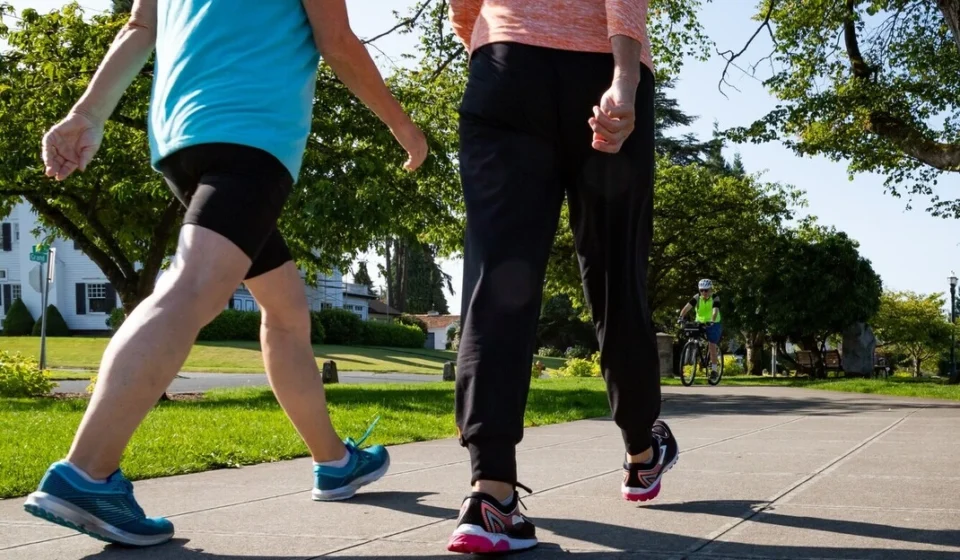
If there’s one exercise recommendation for losing weight without a gym, it’s this: walk more.
Walking is the most underrated fat loss tool available to almost everyone. It burns calories, lowers cortisol, improves insulin sensitivity, requires zero equipment or skill, needs no recovery time, and can be layered on top of daily life without carving out dedicated workout time.
The target: 8,000–10,000 steps per day.
For most sedentary people, this represents a significant increase — and the calorie burn adds up fast. 10,000 steps burns roughly 400–500 extra calories per day for an average adult, which is nearly a pound of fat per week from walking alone, without changing a single thing about what you eat.
Practical ways to get more steps without “going for walks”:
- Walk during phone calls instead of sitting
- Park further away from every destination
- Take stairs instead of elevators always
- Walk to nearby errands instead of driving
- Add a 20-minute walk after dinner — this also significantly improves blood sugar control after meals
- Get off public transport one stop early
A cheap fitness tracker or your phone’s built-in step counter is enough to monitor this. Seeing the number makes a real difference for motivation.
Strategy 3: Do Bodyweight Strength Training at Home
Here’s the piece most people skip when they decide to lose weight without the gym — and it’s the one that makes the biggest difference to body composition.
Strength training without equipment is entirely possible and genuinely effective, especially for beginners and intermediate exercisers. Your bodyweight provides plenty of resistance to build lean muscle, raise your resting metabolism, and ensure that the weight you lose comes from fat rather than muscle.
A simple, effective bodyweight routine you can do anywhere:
Lower body:

- Squats — 3 sets of 15–20 reps
- Reverse lunges — 3 sets of 10 per leg
- Glute bridges — 3 sets of 20 reps
- Wall sit — 3 x 45 seconds
Upper body:
- Push-ups (modify on knees if needed) — 3 sets of 10–15
- Pike push-ups (targets shoulders) — 3 sets of 10
- Tricep dips using a chair — 3 sets of 12
Core:
- Plank — 3 x 30–45 seconds
- Dead bug — 3 sets of 10 per side
- Mountain climbers — 3 sets of 20 reps
Do this routine 3 times per week, with at least one rest day between sessions. It takes 25–35 minutes. As you get stronger, progress by slowing down the tempo, adding pauses at the bottom of movements, or moving to harder variations (single-leg squats, decline push-ups, etc.).
This alone — combined with daily walking and improved diet — is a highly effective fat loss program that requires zero equipment and zero gym membership.
Strategy 4: Use HIIT Workouts at Home
High-intensity interval training is one of the most time-efficient fat loss tools available, and it requires no equipment whatsoever.
A basic home HIIT structure:
- 30 seconds of hard effort
- 30–60 seconds of rest
- Repeat 8–10 rounds
- Total time: 15–25 minutes
Exercise options that need no equipment:
- Jumping jacks
- High knees
- Burpees
- Jump squats
- Mountain climbers
- Speed skaters
- Shadow boxing
Two HIIT sessions per week is plenty — it’s taxing on the body and needs recovery time. Don’t do it every day. Combine it with your bodyweight strength training and daily walking for a complete home fitness program.
YouTube is full of free, guided home HIIT workouts if you prefer to follow along rather than count rounds yourself. Channels like Sydney Cummings, Heather Robertson, and Caroline Girvan have hundreds of free workouts ranging from beginner to advanced.
Strategy 5: Optimize Sleep and Stress
This might be the most important strategy on the list for people who aren’t exercising regularly — because sleep and stress have an enormous impact on fat loss that most people drastically underestimate.
Poor sleep raises cortisol and hunger hormones, tanks insulin sensitivity, and makes your body dramatically more likely to store calories as fat — particularly belly fat. Getting less than 7 hours is essentially a fat storage switch. Our deep dive into why sleep is the most underrated weight loss tool covers exactly why this matters so much and how to fix it.
Chronic stress has a nearly identical effect — elevated cortisol, increased appetite, and direct visceral fat accumulation. Managing stress isn’t optional if fat loss is the goal.
For someone not going to the gym, optimizing sleep and stress gives you a significant metabolic advantage that partially compensates for the reduced exercise volume.
Strategy 6: Stay Active Throughout the Day (NEAT)
NEAT stands for Non-Exercise Activity Thermogenesis — the calories you burn through all movement that isn’t formal exercise. Walking to the kitchen, fidgeting, standing, doing household tasks, playing with kids or pets.
NEAT can vary by up to 2,000 calories per day between individuals, and it’s one of the primary reasons some people seem to stay lean effortlessly while others struggle — it’s not their metabolism, it’s how much they move throughout the day without thinking about it.
Without the gym forcing you to move, consciously increasing NEAT becomes critical. Beyond steps, think about:
- Standing instead of sitting when possible — a standing desk if you work from home
- Doing household chores actively rather than finding shortcuts
- Gardening, DIY projects, active hobbies
- Playing actively with children or pets rather than watching passively
- Taking walking meetings or walking while listening to podcasts or audiobooks
Every bit of movement adds to your daily calorie burn. Without a gym session anchoring your active time, spreading movement throughout the day becomes your primary exercise strategy — and it’s more effective than most people give it credit for.
Strategy 7: Be Consistent on Weekends
This one applies whether you go to the gym or not, but it matters even more when exercise volume is lower.
Many people eat well and move enough Monday through Friday, then spend Saturday and Sunday in a calorie surplus that wipes out the week’s progress. Two days of unrestricted eating and minimal movement can easily cancel five days of a careful deficit.
You don’t need to diet on weekends — just don’t undo the week. Maintaining your protein intake, staying active, and avoiding the all-or-nothing mindset (“it’s the weekend, I’ll restart Monday”) is the difference between people who make steady progress and people who feel like they’re starting over every week.
What a Full Week Without the Gym Looks Like
Here’s how to put all of this together into a practical weekly structure:
Monday: Bodyweight strength training (30 min) + 8,000+ steps Tuesday: 20-min HIIT workout + 8,000+ steps Wednesday: Rest from structured exercise + 10,000 steps Thursday: Bodyweight strength training (30 min) + 8,000+ steps Friday: 20-min HIIT workout + 8,000+ steps Saturday: Active rest — long walk, hike, bike ride, sport + 10,000+ steps Sunday: Full rest + 8,000 steps minimum
Total structured workout time: about 100 minutes per week. That’s it. The rest of your fat loss comes from diet, daily movement, sleep, and consistency.
How Long Will It Take?
Without the gym, results will come slightly slower than with regular weight training — but not dramatically so, especially in the first few months.
A realistic expectation: 0.5–1.5 lbs of fat loss per week with good diet, daily walking, and the home workout structure above. Over 12 weeks, that’s 6–18 lbs — a range that depends on starting point, consistency, sleep, and stress management.
Patience and consistency over perfection is the approach that works. As we cover in our guide to why you’re not losing belly fat, expecting fast results and quitting when they don’t come immediately is the most common reason people fail — not lack of a gym membership.
The Bottom Line
You do not need a gym to lose weight. You need:
- A diet built around protein and whole foods with a moderate calorie deficit
- 8,000–10,000 steps every day
- Bodyweight strength training 3x per week
- HIIT 1–2x per week
- 7–9 hours of sleep
- Managed stress
- Consistency across all 7 days, not just weekdays
That’s a complete fat loss program. No membership required.
The gym is a great tool when you’re ready for it. But it was never the thing standing between you and the body you want.
Are you currently working out at home or thinking about starting? What’s your biggest challenge with staying consistent? Share below.
Stop Wondering What to Eat This Week
Get my free 7-Day High-Protein Weight Loss Meal Plan delivered straight to your inbox — a simple week of satisfying, protein-focused meals designed to make healthy eating easier without complicated calorie tracking.
- 7 full days of breakfast, lunch, dinner & snacks
- One complete shopping list for the whole week
- A quick high-protein food cheat sheet
- Simple daily tips to help you stay on track
Free PDF • Delivered by email • Unsubscribe anytime
Check your inbox 💜
Your free 7-day high-protein meal plan is on its way.