
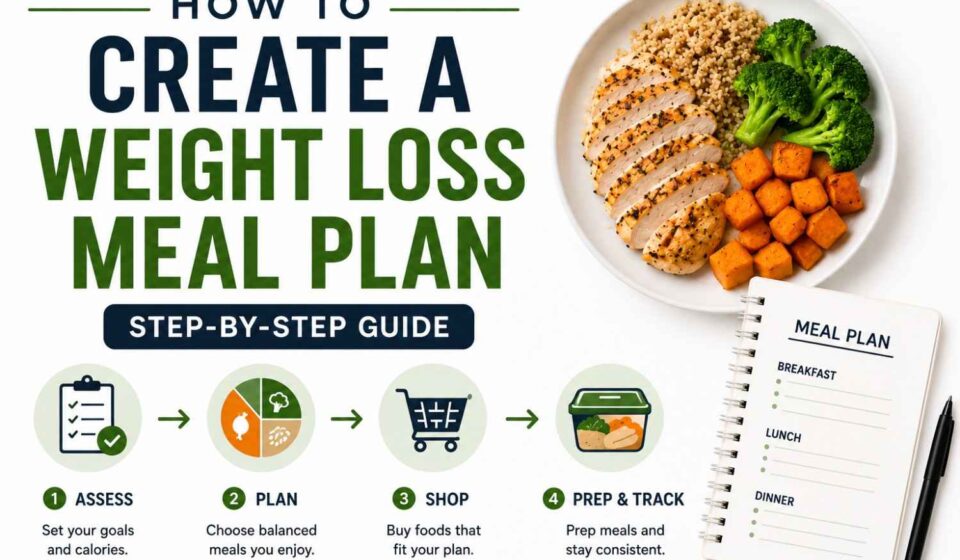

Stop searching for the perfect meal plan. Here’s how to build one that actually fits your life.

Most people looking for a weight loss meal plan want someone to just hand them one. And while that’s understandable, a plan someone else created for a different person with different food preferences, schedule, budget, and lifestyle is unlikely to be the plan you actually stick to.
The most effective meal plan is one built around your life — your preferred foods, your cooking ability, your schedule, your budget. This guide walks you through building exactly that.
Step 1: Set Your Calorie Target
Every effective meal plan starts with knowing how many calories you’re aiming for each day.
Calculate your maintenance calories: Bodyweight (lbs) × 15 = approximate maintenance calories for a moderately active person
Subtract for fat loss: Maintenance minus 400–600 calories = your daily fat loss target
Example: A 170 lb moderately active person:
- Maintenance: 170 × 15 = 2,550 calories
- Fat loss target: 2,550 – 500 = 2,050 calories per day
Minimum floors:
- Women: don’t go below 1,200 calories
- Men: don’t go below 1,400 calories
As covered in our complete guide to how to lose weight with a calorie deficit, a moderate deficit of 400–600 calories produces the best balance of meaningful fat loss and long-term sustainability.
Step 2: Set Your Protein Target
Protein is the most important macronutrient for fat loss quality — it preserves muscle during a calorie deficit, suppresses hunger more effectively than carbs or fat, and has the highest thermic effect.
Target: 0.7–1g per pound of bodyweight
For a 170 lb person: 120–170g of protein per day
As covered in our guide to how much protein you actually need per day, this is the single most impactful dietary variable for body composition during fat loss. Build your meal plan around hitting this target first — then fill remaining calories with carbohydrates and fat.
Step 3: Choose Your Meal Structure
How many meals per day works best for you personally? The research shows total daily intake matters far more than meal frequency — but structure that fits your life will be sustained; structure that doesn’t will be abandoned.
Common structures:
3 meals, no snacks: Breakfast, lunch, dinner. Simple, suits people who prefer defined meal times and aren’t bothered by the gaps.
3 meals + 1–2 snacks: Adds planned snacks between meals. Suits people who experience significant hunger between main meals.
2 meals (intermittent fasting): Skipping breakfast or eating in a compressed window. Suits people who naturally don’t feel hungry in the morning. As covered in our article on whether intermittent fasting is worth it, this works for some people and not others — use it if it suits your lifestyle.
Pick the structure that fits your schedule and hunger patterns, not the one that sounds most effective theoretically.
Step 4: Build Your Protein Sources List
Go through the protein sources you actually enjoy and will realistically eat regularly. Having a personal list removes the decision fatigue of figuring out protein at each meal.
Common protein sources to choose from:
Animal proteins:
- Chicken breast or thighs
- Eggs and egg whites
- Greek yogurt (high protein)
- Cottage cheese
- Salmon, tuna, cod, sardines
- Turkey mince
- Lean beef mince
- Shrimp and other seafood
Plant proteins:
- Lentils and beans
- Tofu and tempeh
- Edamame
- Chickpeas
Quick and convenient:
- Protein powder (whey, pea, casein)
- Canned tuna or salmon
- Rotisserie chicken
Aim to have 3–5 protein sources you regularly rotate through. Variety prevents meal fatigue; a manageable list prevents decision paralysis.
Step 5: Build Your Vegetables List
Non-starchy vegetables are essentially calorie-free relative to the volume they provide. They should fill roughly half your plate at most meals — providing fiber, micronutrients, and physical volume that extends satiety.
Your vegetable rotation — choose what you’ll actually eat:
- Leafy greens (spinach, kale, arugula, romaine)
- Broccoli and cauliflower
- Zucchini and cucumber
- Cherry tomatoes
- Bell peppers
- Mushrooms
- Asparagus
- Green beans
- Celery and carrot (good for snacking)
Step 6: Build Your Carbohydrate Sources List
Carbohydrates aren’t the enemy — but the quality matters, particularly for insulin sensitivity and hunger management.
Higher quality carbohydrate sources:
- Oats (breakfast staple)
- Brown rice or white rice (both work — brown has more fiber)
- Sweet potato
- Quinoa
- Whole grain bread (1–2 slices)
- Lentils and beans (dual protein/carb)
- Berries and fruit
- Chickpeas
Minimize:
- White bread and pasta in large quantities
- Sugary cereals
- Juice and sweetened drinks
- Pastries and baked goods
Step 7: Design Your Meals Using the Template
Now combine your protein, vegetable, and carbohydrate lists using this template:
Breakfast template: Protein (eggs, Greek yogurt, protein shake, cottage cheese) + optional carb (oats, whole grain toast, fruit) + optional fat (nuts, avocado)
Lunch template: Large portion of vegetables + protein + optional carb + healthy fat dressing
Dinner template: Protein + large portion of vegetables + moderate carb
Snack template (if using): Protein-focused (Greek yogurt, cottage cheese, hard-boiled eggs, protein shake)
The rule: Every meal has protein. Half the plate is vegetables at lunch and dinner. Carbs are present but not dominant.
A Sample 7-Day Meal Plan (1,800–2,000 calories, ~140g protein)
Adjust portions up or down to match your personal calorie target.
Monday:
- Breakfast: 3 scrambled eggs + spinach + 1 slice whole grain toast
- Lunch: Large salad with 150g grilled chicken, cucumber, cherry tomatoes, olive oil
- Snack: 200g Greek yogurt with berries
- Dinner: 150g salmon + roasted broccoli + ½ cup brown rice
Tuesday:
- Breakfast: Overnight oats (½ cup oats, Greek yogurt, berries, chia seeds)
- Lunch: Turkey and vegetable soup with small whole grain roll
- Snack: 2 hard-boiled eggs + carrot sticks
- Dinner: Turkey mince stir-fry with mixed vegetables and noodles
Wednesday:
- Breakfast: Protein smoothie (protein powder, frozen berries, spinach, almond milk)
- Lunch: Tuna salad (canned tuna, celery, Greek yogurt instead of mayo) on whole grain bread
- Snack: Cottage cheese with pineapple
- Dinner: Chicken thighs + roasted sweet potato + green beans
Thursday:
- Breakfast: 3 eggs scrambled + mushrooms + cherry tomatoes
- Lunch: Lentil soup + small salad
- Snack: Greek yogurt + almonds
- Dinner: Cod + asparagus + quinoa
Friday:
- Breakfast: Cottage cheese pancakes (cottage cheese, oats, egg, blended and fried)
- Lunch: Large salad with shrimp, avocado, cucumber, lemon dressing
- Snack: Apple + peanut butter
- Dinner: Beef stir-fry with broccoli, peppers, and a small amount of rice
Saturday:
- Breakfast: Veggie omelette (3 eggs, spinach, peppers, feta)
- Lunch: Chickpea and vegetable curry + ½ cup brown rice
- Snack: Protein shake + banana
- Dinner: Salmon fillet + roasted cauliflower + mixed greens salad
Sunday:
- Breakfast: Greek yogurt bowl (200g yogurt, berries, granola — small amount, hemp seeds)
- Lunch: Chicken and vegetable soup made from Sunday batch cooking
- Snack: Hard-boiled eggs + cucumber
- Dinner: Lean mince bolognese with courgette noodles + parmesan
Step 8: Prep for the Week
A meal plan on paper is just intention. Meal prep turns it into reality.
Sunday prep priorities:
- Cook a large batch of protein (chicken thighs, hard-boiled eggs, lentil soup)
- Cook a grain (brown rice, quinoa)
- Wash and cut vegetables for easy access
- Portion snacks into containers
As covered in our meal prep article, even one or two batch-cooked items transforms weekday eating — healthy food ready to grab beats good intentions every time.
How to Adjust Your Meal Plan Over Time
If you’re not losing weight after 2–3 weeks:
- Track your intake honestly for a week — most people discover they’re eating more than they think
- Reduce portion sizes of carbohydrates and fats slightly
- Recalculate TDEE — it may have been overestimated
If you’re losing weight too fast (more than 1.5 lbs/week consistently):
- Add a snack or slightly increase portions
- Very rapid loss at moderate deficit levels usually means TDEE was underestimated — this is fine, just adjust up slightly
If you’re constantly hungry:
- Add more vegetables to meals for volume
- Increase protein slightly
- Check that you’re actually hitting your protein target — hunger is often a protein shortfall
Every 10–15 lbs lost: Recalculate your calorie target — a smaller body burns fewer calories, so the original target needs adjusting.
Making the Meal Plan Sustainable
The most perfectly constructed meal plan fails if it’s not enjoyable and sustainable in real life. A few principles that help:
Include foods you love. A meal plan built entirely around foods you tolerate but don’t enjoy will be abandoned. Make sure genuinely enjoyable meals are in the rotation.
Build in flexibility. One restaurant meal per week, one social occasion per month — these don’t undermine the plan if the rest of the week is consistent. As covered in our article on cheat days and weight loss, planned flexibility is more sustainable than rigid perfection.
Keep it simple. The meals you eat most frequently should be simple to prepare. Save elaborate cooking for weekends or when you have time and energy. Simple, repeatable meals sustain long-term plans better than complicated ones.
Don’t try to be perfect. A plan followed imperfectly for 6 months outperforms a perfect plan followed for 3 weeks. Consistency over time is what produces lasting results.
The Bottom Line
The best weight loss meal plan is one built around your calorie target, your protein needs, your food preferences, and your lifestyle — not a generic template designed for someone else.
The steps: set your calorie target, set your protein target, choose your meal structure, build your food lists, design meals using the protein + vegetables + carb template, prep ahead, and adjust based on results.
For the complete fat loss framework that your meal plan supports — exercise, sleep, stress management, and everything else that affects the results you get — our guide to how to get rid of belly fat covers it all in one place.
What’s the most useful thing in your meal plan that you’d recommend to others? Share in the comments — practical meal planning tips from real experience are invaluable.