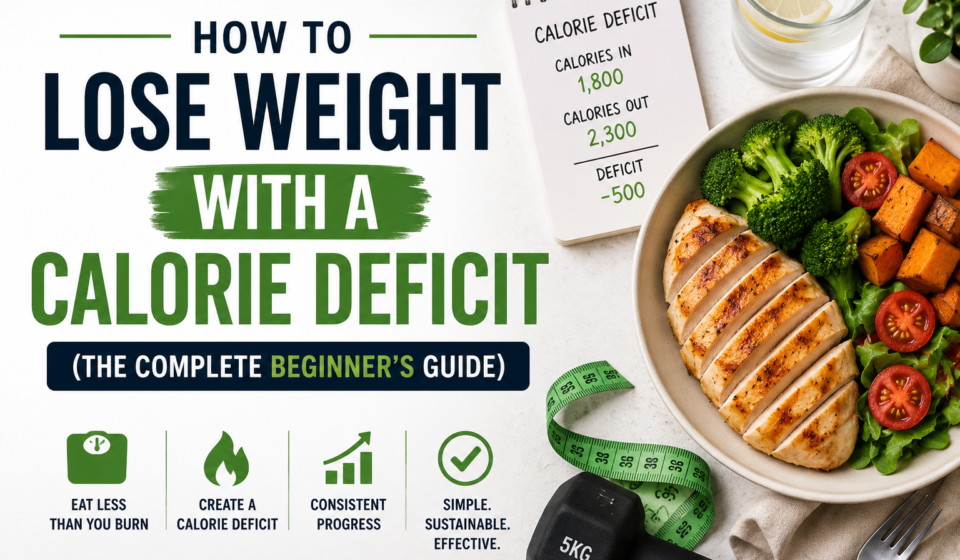
How to Lose Weight With a Calorie Deficit (The Complete Beginner’s Guide)

The fundamental mechanism of all fat loss — explained clearly and practically
Every diet that has ever worked for weight loss has one thing in common: it produced a calorie deficit.
Keto, Mediterranean, low carb, intermittent fasting, Weight Watchers — the specific rules differ, but the underlying mechanism is identical. When you consistently consume fewer calories than your body burns, it draws from fat stores for energy. Fat stores decrease. You lose weight.

Understanding this isn’t defeatist — it’s liberating. It means there’s no magical diet, no forbidden food, no secret combination that unlocks fat loss. There’s a calorie deficit, and there are many paths to creating one. This guide explains exactly how it works and how to use it practically.
What Is a Calorie Deficit?
A calorie deficit occurs when you consume fewer calories than your body expends over a period of time.
Your body burns calories constantly — at rest (BMR), through daily movement (NEAT), through digesting food (TEF), and through exercise. The sum of all these is your Total Daily Energy Expenditure (TDEE) — the number of calories you burn per day.
When calorie intake falls below TDEE: deficit → body draws from fat stores → fat loss When calorie intake equals TDEE: maintenance → body weight stays stable When calorie intake exceeds TDEE: surplus → body stores excess energy as fat → weight gain
This is the law of energy balance. It’s not a theory or a diet trend — it’s thermodynamics applied to human metabolism.
How Much of a Deficit Do You Need?
One pound of body fat contains approximately 3,500 calories of stored energy. In theory:
- 500 calorie daily deficit = 3,500 calories per week = approximately 1 lb of fat loss per week
- 250 calorie daily deficit = 1,750 calories per week = approximately 0.5 lb per week
- 1,000 calorie daily deficit = 7,000 calories per week = approximately 2 lbs per week
In practice, the relationship isn’t quite this linear — metabolic adaptation, water weight fluctuations, and muscle mass changes all affect the actual rate of weight loss. But the 3,500 calories per pound framework provides a useful approximation.
The sweet spot for most people: 400–600 calorie daily deficit
This produces:
- 0.8–1.2 lbs of fat loss per week
- Meaningful progress without severe hunger
- Minimal metabolic adaptation
- Sustainable deficit that can be maintained for months
Why not go bigger? A 1,000+ calorie daily deficit produces:
- Significant muscle loss alongside fat
- Triggering of adaptive thermogenesis (metabolism drops to compensate)
- Severe hunger that leads to compliance failure
- Nutrient deficiencies from inadequate food intake
Slower deficits produce better quality weight loss over the long term — more fat, less muscle, preserved metabolism.
Step 1: Find Your TDEE
Before you can create a deficit, you need to know how many calories you’re currently burning.
Simple calculation:
Multiply your bodyweight in pounds by a multiplier based on activity level:
- Sedentary (desk job, minimal exercise): bodyweight × 14
- Lightly active (1–3 exercise sessions per week): bodyweight × 15
- Moderately active (3–5 sessions per week): bodyweight × 16
- Very active (6–7 sessions + physical job): bodyweight × 17–18
Example: A 180 lb person with a desk job who exercises 3x per week: 180 × 15 = 2,700 calories maintenance To lose 1 lb per week: 2,700 – 500 = 2,200 calories per day
This is an estimate — use it as a starting point and adjust based on actual results over 2–4 weeks.
Step 2: Set Your Calorie Target
Based on your TDEE: subtract 400–600 calories for your daily fat loss target.
Minimum floors — never go below:
- Women: 1,200 calories per day
- Men: 1,400 calories per day
For most people:
- A 150 lb woman burning 1,800 cal/day: target 1,300–1,400 calories
- A 200 lb man burning 2,500 cal/day: target 1,900–2,100 calories
- A 250 lb man burning 3,000 cal/day: target 2,400–2,600 calories
Step 3: Track Your Intake (At Least Initially)
Most people underestimate their food intake by 20–40%. Someone who thinks they’re eating 1,800 calories might actually be consuming 2,200–2,500 — easily explaining why weight loss stalls despite apparent effort.
Tracking apps:
- MyFitnessPal — most widely used, enormous food database, barcode scanner
- Cronometer — better for tracking micronutrients alongside calories
- Lose It — simpler interface, good for beginners
How long to track: 4–8 weeks of strict tracking develops genuine awareness of portion sizes and calorie content. After this, many people maintain their deficit intuitively.

As covered in our guide to how to use a food journal to lose weight, even imperfect tracking produces dramatically better awareness than none at all.
Step 4: Prioritize Protein Within the Deficit
This is the most important dietary principle within a calorie deficit.
When eating fewer calories, your body draws energy from both fat stores and muscle. Without adequate protein, significant weight loss comes from muscle rather than fat — producing worse body composition at a lower weight.
Adequate protein within a deficit:
- Signals the body to preserve muscle and burn fat preferentially
- Has the highest satiety of any macronutrient — making the deficit feel manageable
- Burns more calories through digestion (25–30% thermic effect)
Target: 0.7–1g per pound of bodyweight, across meals. For a 160 lb person: 112–160g per day.
As covered in our guide to how much protein you actually need per day, this is the single most important dietary variable for body composition during fat loss.
The Calorie Deficit and Exercise
Exercise contributes to a calorie deficit — but less than most people assume:
- 30-minute brisk walk: 150–200 calories
- 45-minute moderate run: 400–500 calories
- 45-minute strength training: 250–350 calories
- 30-minute HIIT: 300–400 calories
A 30-minute run burns roughly the same calories as one slice of pizza — which is why “out-exercising a bad diet” is so difficult.
Exercise’s most important fat loss contribution isn’t the calories burned during the session — it’s the muscle building that raises resting metabolic rate and the insulin sensitivity improvements that help your body process calories more efficiently.
Create the majority of your deficit through diet. Use exercise to contribute additional deficit and build muscle. Don’t rely on exercise calorie estimates to justify eating more — these are often inaccurate and can eliminate your deficit entirely.
As covered in our article on how to lose weight without counting calories, diet does approximately 70–80% of the fat loss work.
Common Calorie Deficit Mistakes
Not Accounting for Liquid Calories
Drinks are the most common source of untracked calories — coffee drinks, juice, alcohol, and smoothies add hundreds of calories that many people never count.
A large flavored latte: 350–450 calories. Two glasses of wine: 250 calories. A glass of orange juice: 110 calories. These additions can eliminate an entire day’s deficit without a single solid bite of food.
Underestimating Portions
Eyeballing portions consistently produces significant underestimation — particularly for calorie-dense foods like oils, nuts, cheese, and nut butters.
A tablespoon of olive oil is 120 calories. Two tablespoons is 240. A “handful” of almonds ranges from 100 to 300 calories depending on generosity. Weighing food with a kitchen scale for the first few weeks is genuinely revelatory for most people.
Inconsistency on Weekends
Five days of a 500-calorie deficit followed by two days of a 500-calorie surplus produces zero net deficit and zero fat loss. Weekend eating is the most common reason people track carefully and still don’t see results.
As covered in our article on how to break a weight loss plateau, weekend consistency is one of the most overlooked fat loss variables.
Not Adjusting as Weight Changes
As you lose weight, your TDEE decreases — a smaller body burns fewer calories. Recalculate your TDEE every 10–15 lbs of weight loss and adjust your calorie target accordingly.
Creating Too Large a Deficit
Cutting calories dramatically for faster results reliably backfires. As covered in our guide to how to speed up your metabolism naturally, severe restriction triggers adaptive thermogenesis — metabolism drops to match reduced intake, and fat loss slows or stops despite severe restriction.
Moderate, consistent deficits beat large, unsustainable ones every time.
Creating a Deficit Without Obsessive Tracking
For people who find calorie counting stressful, a deficit can be created through food quality changes rather than precise tracking. These strategies naturally create deficits:
- Eliminating liquid calories (soda, juice, alcohol, sweetened coffee)
- Eating protein first at every meal
- Filling half the plate with vegetables
- Eating slowly and without screens
- Cutting added sugar and processed snacks
These approaches don’t provide the precision of calorie counting — but for many people, they’re sustainable in a way that tracking never is.
The Calorie Deficit and Body Composition
A calorie deficit produces weight loss — but the quality depends enormously on what you do within the deficit.
Deficit with low protein and no exercise: Significant muscle lost with fat. Body fat percentage may not improve. Metabolic rate decreases.
Deficit with adequate protein (0.7–1g/lb) and strength training: Weight lost is predominantly fat. Muscle preserved or built. Body composition improves dramatically.
The second scenario produces the physical transformation most people actually want — not just a lower number on the scale, but a fundamentally different body composition.
What to Expect Week by Week
Week 1: Often 3–5 lbs lost — primarily water and glycogen. Real weight loss but not all fat. Week 2 will be slower.
Weeks 2–4: 0.5–1.5 lbs per week of genuine fat loss at a 400–600 calorie deficit. The sustainable long-term pace.
Month 2–3: Continued steady loss. The approach becoming habitual. Hunger typically more manageable.
Month 3+: Possible plateau as TDEE decreases — time to recalculate and adjust.
The Bottom Line
A calorie deficit is the mechanism of all fat loss — not a specific diet, food, supplement, or protocol. Whatever approach produces a consistent calorie deficit produces fat loss.
The practical steps:
- Calculate your TDEE
- Subtract 400–600 calories for your daily target
- Track intake initially to understand actual consumption
- Prioritize protein within the deficit
- Add strength training to preserve muscle
- Adjust as weight changes and plateaus occur
For the complete framework that maximizes the quality of fat loss within a calorie deficit — protein targets, exercise, sleep, and stress management — our guide to how to get rid of belly fat covers everything in one place.
What’s been your biggest challenge maintaining a calorie deficit — tracking, hunger, weekends, or something else? Share in the comments.
Stop Wondering What to Eat This Week
Get my free 7-Day High-Protein Weight Loss Meal Plan delivered straight to your inbox — a simple week of satisfying, protein-focused meals designed to make healthy eating easier without complicated calorie tracking.
- 7 full days of breakfast, lunch, dinner & snacks
- One complete shopping list for the whole week
- A quick high-protein food cheat sheet
- Simple daily tips to help you stay on track
Free PDF • Delivered by email • Unsubscribe anytime
Check your inbox 💜
Your free 7-day high-protein meal plan is on its way.