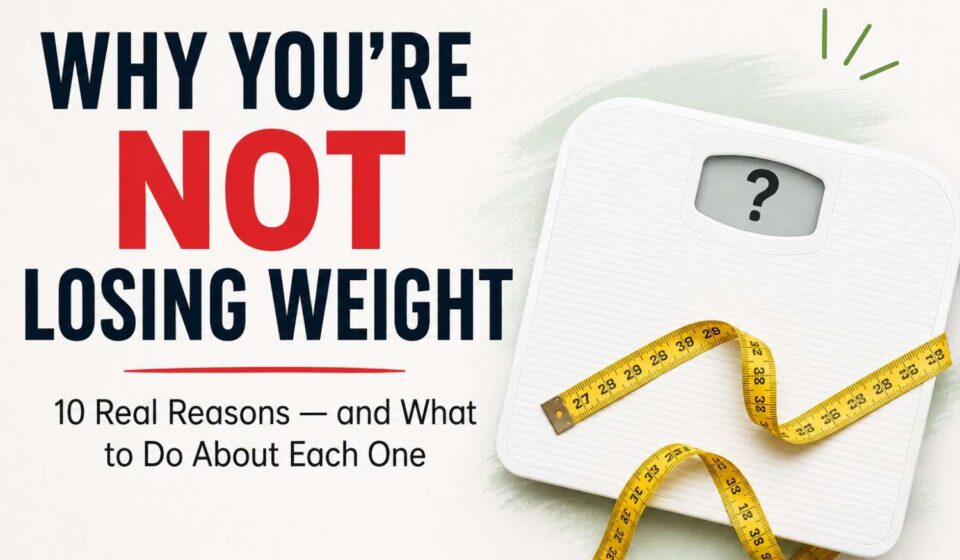

You’re trying. The scale isn’t moving. Here’s what’s actually going on.
Few experiences are more frustrating than genuinely trying to lose weight and seeing no results. You’ve changed what you eat. You’re exercising. You’re doing everything you think you’re supposed to do — and nothing is happening.
This isn’t failure. In most cases, it’s one or more of these ten specific, addressable reasons.
Reason 1: You’re Eating More Than You Think
This is the most common reason people don’t lose weight despite believing they’re eating less — and it’s more forgiving to understand than it sounds.
Research consistently shows that people underestimate their food intake by 20–40%. Not because they’re lying or weak — because eyeballing portions is genuinely inaccurate, restaurant and packaged food portions are much larger than serving sizes, and small extras throughout the day (the handful of nuts, the sip of someone else’s drink, the bit of cooking oil) add up invisibly.
What to do: Track your food intake honestly for 2 weeks — including everything. Most people find at least one significant source of untracked calories they weren’t accounting for. As covered in our guide to how to lose weight with a calorie deficit, awareness of actual intake is the foundation of everything.
Reason 2: Your Calorie Deficit Is Too Small
Even if you’re tracking accurately, the deficit you think you have might not actually be large enough to produce visible results.
Your TDEE (total daily energy expenditure) may be lower than you think — particularly if you have a desk job, have lost significant muscle mass, or have a history of crash dieting that has suppressed your metabolic rate.
What to do: Recalculate your TDEE honestly, using sedentary multipliers if your daily movement is genuinely low. Then track for a week at that target and see if weight moves. A deficit of 400–500 calories per day should produce 0.5–1 lb per week.
Reason 3: You’re Not Eating Enough Protein
Low protein intake is one of the most common and most impactful dietary mistakes for people trying to lose weight. Without adequate protein, fat loss comes with significant muscle loss — which slows metabolism, reduces the toned appearance most people are aiming for, and makes maintaining results harder.
Low protein also means higher hunger throughout the day — making the deficit harder to maintain.
What to do: Target 0.7–1g of protein per pound of bodyweight. As covered in our guide to how much protein you actually need per day, this is the single most important dietary variable for fat loss quality. Build every meal around a protein source first.
Reason 4: You’re Inconsistent on Weekends
Five days of a 500-calorie deficit followed by two days of eating at maintenance or surplus produces minimal or zero net weekly deficit — and therefore minimal fat loss, regardless of how well the weekdays went.
Weekend overeating is the most common reason people track carefully and still don’t see results. A Friday night dinner out, a Saturday takeaway, and a Sunday brunch can easily eliminate an entire week’s deficit.
What to do: Track weekends with the same attention as weekdays for a few weeks to see what’s actually happening. You don’t need to eat identically on weekends — but the deficit needs to exist on a weekly basis, not just a weekday basis.
Reason 5: You’re Not Sleeping Enough
This one surprises people — but the evidence is unambiguous. Sleep deprivation disrupts hunger hormones (ghrelin spikes, leptin drops), worsens insulin sensitivity, elevates cortisol, and reduces the metabolic rate. People who sleep under 6 hours consistently lose significantly less fat — and more muscle — than those sleeping 7–9 hours, even on identical diets.
As covered extensively in our article on why sleep is the most underrated weight loss tool, poor sleep is a direct and significant obstacle to fat loss that can’t be compensated for through dietary discipline alone.
What to do: Treat 7–9 hours of sleep as a fat loss strategy, not just a health recommendation. If sleep is genuinely poor due to sleep apnea, insomnia, or other issues, addressing these with medical support directly improves fat loss outcomes.
Reason 6: Your Stress Levels Are Too High
Chronic stress elevates cortisol — the hormone that promotes fat storage (particularly visceral belly fat), increases hunger for calorie-dense foods, and makes the body resistant to fat loss even in a genuine calorie deficit.
People under significant work, relationship, or financial stress often find that fat loss stalls despite good dietary habits. The cortisol environment is working against them.
What to do: Active stress management isn’t optional for fat loss — it’s a physiological requirement. Daily walking, adequate sleep, breathing practices, reducing unnecessary stressors, and protecting personal recovery time all reduce cortisol and improve fat loss outcomes. As covered in our guide to how to get rid of belly fat, cortisol management is one of the most important and least discussed fat loss levers.
Reason 7: You’re Drinking Your Calories
Liquid calories are the most commonly overlooked source of caloric excess. Unlike food, drinks don’t trigger the same satiety signals — you can consume 400 calories of juice, coffee drinks, smoothies, or alcohol without feeling meaningfully fuller.
A single large flavored latte: 350–450 calories. Two glasses of wine: 250 calories. A post-workout “healthy” smoothie: 300–500 calories. These additions can eliminate the entire dietary deficit without a single bite of food.
What to do: Account for every calorie in every drink — including coffee, alcohol, juice, smoothies, and protein shakes. Switch to water, black coffee, or unsweetened tea as default drinks, reserving caloric beverages for occasions rather than daily consumption.
Reason 8: You’ve Hit a True Plateau
If you’ve been losing weight consistently and it has stalled, you may have hit a genuine plateau — where your reduced body weight has lowered your TDEE to match your current intake, eliminating the deficit.
This is biology working as intended — not failure. As covered in our article on how to break a weight loss plateau, the plateau isn’t permanent — it requires an intentional adjustment to break.
What to do: Recalculate your TDEE based on your current (lower) weight. Reduce calorie intake slightly, increase activity slightly, or both. Consider a diet break (eating at maintenance for 1–2 weeks) to partially restore hormonal and metabolic function before resuming the deficit.
Reason 9: You Have an Underlying Medical Issue
For some people — particularly those who have genuinely implemented the strategies above consistently for months without results — an underlying medical condition may be a significant contributor.
Conditions that impair weight loss:
- Hypothyroidism — reduces metabolic rate by 15–40% in significant cases. A simple blood test diagnoses it. Very common, particularly in women over 40. Covered in our article on how to lose weight with hypothyroidism.
- PCOS — insulin resistance and hormonal imbalances make weight loss harder. Covered in our article on how to lose weight with PCOS.
- Insulin resistance — promotes fat storage and makes fat mobilization harder.
- Certain medications — antidepressants, antipsychotics, corticosteroids, and some blood pressure medications promote weight gain.
- Sleep apnea — disrupts sleep quality, elevates cortisol, and impairs fat loss. Covered in our article on how to lose weight with sleep apnea.
What to do: If you’ve genuinely implemented good dietary and lifestyle habits for 3+ months and results are minimal, see a doctor. Ask for thyroid testing, fasting insulin and glucose, and a review of any medications that might be contributing.
Reason 10: Your Approach Isn’t Sustainable — And You Keep Restarting
This is the most honest and most uncomfortable reason on the list: the approach you’re using may work in theory but not in practice — because it’s too restrictive, too complicated, or too misaligned with your actual life to maintain consistently.
A week of perfect dieting followed by two weeks of abandonment produces far worse outcomes than a moderate, imperfect approach maintained for months. The repeated restart cycle — highly motivated beginning, gradual breakdown, guilt, restart — is so common it feels normal. But it produces poor results and significant psychological cost.
What to do: Ask honestly whether the approach you’re using is genuinely sustainable for 6–12 months. If the answer is no, the approach needs to change — not your effort level. Building habits gradually as covered in our article on how to build healthy eating habits for life produces more durable results than any intensive approach that you can’t sustain.
When Lifestyle Changes Aren’t Enough
If you’ve worked through this list honestly — addressed the dietary, sleep, stress, and lifestyle factors — and are still not seeing results after 3+ months of genuine effort, it may be worth exploring whether medical support is appropriate for your situation.
Some people’s metabolic and hormonal environment makes fat loss significantly harder than lifestyle changes alone can address. This isn’t weakness — it’s biology. GLP-1 based prescription treatments have demonstrated meaningful fat loss results in people who have struggled despite consistent lifestyle effort.
Breeze Meds is a telehealth weight loss program where licensed doctors evaluate whether prescription weight loss medication is medically appropriate for your specific situation — addressing the metabolic root causes that can make fat loss resistant to lifestyle intervention alone.
Check eligibility & pricing at Breeze Meds →Affiliate disclosure: We may earn a commission if you use this link. Breeze Meds provides telehealth weight-loss services. Prescription medication is only provided following an evaluation by a licensed healthcare professional and is not guaranteed.
The Bottom Line
Not losing weight despite trying is almost always explained by one or more of these ten reasons — and every one of them is addressable.
Work through the list honestly. Most people find 2–3 factors that, once addressed, break the stall and restore progress.
If you’ve genuinely addressed all ten and results remain minimal, a medical evaluation is the appropriate next step — not more of the same effort that hasn’t been working.
Which of these ten reasons resonates most with your experience? Share in the comments — you’re in very good company, and understanding the specific obstacle is the first step to moving past it.
Stop Wondering What to Eat This Week
Get my free 7-Day High-Protein Weight Loss Meal Plan delivered straight to your inbox — a simple week of satisfying, protein-focused meals designed to make healthy eating easier without complicated calorie tracking.
- 7 full days of breakfast, lunch, dinner & snacks
- One complete shopping list for the whole week
- A quick high-protein food cheat sheet
- Simple daily tips to help you stay on track
Free PDF • Delivered by email • Unsubscribe anytime
Check your inbox 💜
Your free 7-day high-protein meal plan is on its way.