
A calorie deficit doesn’t have to mean constant hunger. Here’s how to stay full while losing fat.

The biggest reason diets fail isn’t lack of willpower. It’s hunger.
Persistent, gnawing hunger makes every food decision a battle. It makes social situations with food unbearable. It makes sleep harder. And eventually — inevitably — it wins.
The good news: a calorie deficit doesn’t have to mean constant hunger. The specific foods you eat, the way you structure your meals, and a few simple habits can produce genuine satiety within a meaningful deficit. Here’s how.
Why Some Diets Leave You Ravenous (And Others Don’t)
Not all calories produce the same fullness. A 500-calorie bowl of oatmeal with eggs produces dramatically different satiety than a 500-calorie bag of chips — even though the calorie count is identical.
The difference comes down to several factors:
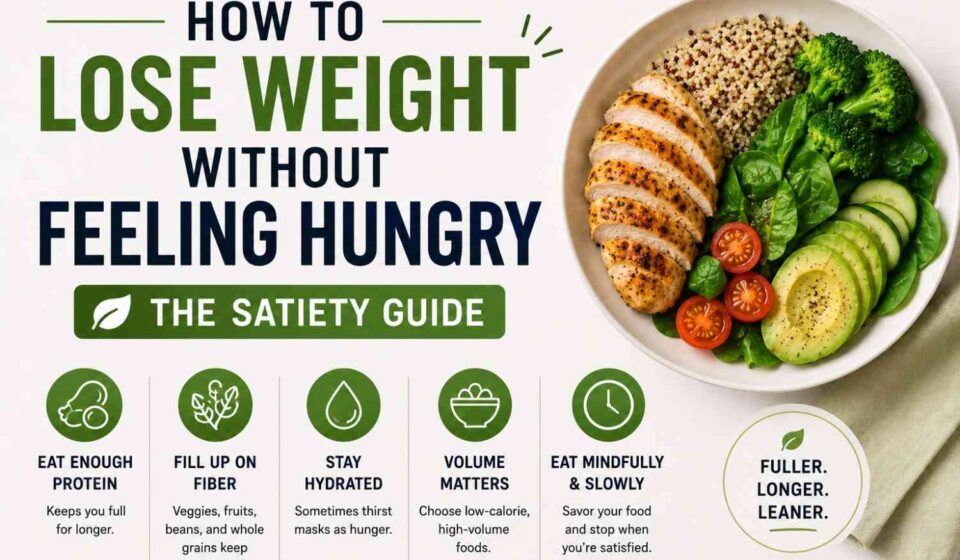
Protein content — protein triggers the strongest satiety hormone response of any macronutrient. It suppresses ghrelin (the hunger hormone) and stimulates peptide YY and GLP-1 (fullness hormones) more powerfully than carbohydrates or fat.
Fiber content — dietary fiber slows gastric emptying, adds physical bulk, and feeds gut bacteria that produce additional satiety signals. High-fiber foods keep you full for significantly longer than low-fiber equivalents.
Volume — foods with high water content (vegetables, fruit, soup) provide physical volume in the stomach that stretches satiety receptors and signals fullness.
Calorie density — the number of calories per gram of food. Low calorie density foods (vegetables, fruit, lean protein) allow larger physical quantities for fewer calories. High calorie density foods (nuts, oils, processed food) provide large calorie counts in small physical volumes.
Eating speed and processing — whole foods eaten slowly require more chewing and take longer to consume, allowing satiety hormones more time to register before overeating occurs.
The Most Powerful Satiety Tool: Protein
This cannot be overstated. Protein is the most important dietary factor for managing hunger during a calorie deficit — bar none.
In study after study, higher protein intakes produce:
- Reduced hunger throughout the day
- Lower total calorie consumption without deliberate restriction
- Better body composition outcomes (more fat lost, more muscle preserved)
The mechanism: protein stimulates the release of multiple satiety hormones, suppresses ghrelin more effectively than carbohydrates or fat, and has the highest thermic effect of any macronutrient — meaning more calories are burned simply digesting it.
Target: 0.7–1g per pound of bodyweight per day, distributed across meals. As covered in our guide to how much protein you actually need per day, this is the single most impactful dietary variable for hunger management and fat loss quality.
High-protein breakfast is particularly important. Starting the day with 25–40g of protein sets up the day’s hunger hormone profile differently than a carbohydrate-dominant or skipped breakfast — reducing hunger throughout the entire day, not just the morning.
The Second Most Powerful Tool: Volume Eating
Volume eating is the strategy of prioritizing foods with high volume and low calorie density — so you can eat a genuinely large amount of food while staying within your calorie target.
The key foods:
Non-starchy vegetables — the foundation of volume eating. Broccoli, spinach, zucchini, cucumber, peppers, mushrooms, celery, cauliflower. These are so low in calories that you can eat enormous amounts without meaningfully affecting your calorie budget.
A huge bowl of salad greens, cucumber, cherry tomatoes, and peppers might contain 80 calories. The same physical volume of chips would be 800+. The physical fullness produced by the bowl is substantially greater.
Soups and broth-based dishes — water incorporated into food produces more satiety than the same water drunk alongside food. A bowl of vegetable soup at 200 calories is far more filling than 200 calories of crackers.
Fruit — high water content, fiber, and modest calories. An entire apple at 80 calories is significantly more filling than 80 calories of fruit juice. Berries, melon, citrus, and apples are particularly good volume eating choices.
Lean protein with high volume — chicken breast, fish, shrimp, egg whites, cottage cheese, Greek yogurt. High protein content with relatively low calorie density.
Fiber: The Underrated Satiety Nutrient
Most people consume 10–15g of fiber per day. The recommended amount is 25–35g. This gap has enormous implications for hunger management.
Soluble fiber — found in oats, beans, lentils, apples, and psyllium — forms a gel in the digestive tract that slows the movement of food, extends the feeling of fullness, and moderates blood sugar response. People who eat adequate fiber consistently report significantly better hunger management than those who don’t.
Practical ways to increase fiber:
- Start breakfast with oats or add chia seeds to yogurt
- Add lentils or beans to at least one meal per day
- Eat vegetables at every meal — not as a side but as a substantial component
- Choose whole fruit over juice
- Use whole grain bread and pasta instead of refined versions
As covered in our article on why you’re always hungry, inadequate fiber is one of the two most common dietary causes of persistent hunger — alongside inadequate protein.
Meal Structure That Minimizes Hunger
How you eat matters as much as what you eat.
Eat protein and vegetables first. When protein and fiber-rich vegetables come first in a meal, they begin triggering satiety hormone release before the more calorie-dense components are reached. People who eat protein and vegetables first consistently eat fewer total calories at a meal than those who eat in a different order.
Eat slowly. Satiety hormones take 15–20 minutes to register after eating begins. Eating quickly means consuming far more food before fullness is felt. Eating slowly — putting utensils down between bites, chewing thoroughly, pausing mid-meal — allows satiety signals to arrive before the meal is finished.
Eat without screens. Distracted eating consistently produces 20–40% higher calorie consumption — the sensory experience of eating doesn’t register fully when attention is elsewhere, delaying satiety signals.
Don’t skip meals. Arriving at a meal ravenously hungry makes portion control and food choice both significantly harder. Regular meals that maintain stable blood sugar prevent the extreme hunger that drives overeating.
Foods That Keep You Full the Longest
Based on research on satiety — specifically the Satiety Index developed by researcher Susanna Holt — these foods produce the most fullness per calorie:
Highest satiety foods:
- Boiled potatoes — surprisingly, one of the highest-satiety foods measured
- Fish — high protein, moderate fat, very filling per calorie
- Oatmeal — slow-digesting, high-fiber, very filling breakfast
- Oranges and apples — high fiber, high water content, very filling
- Eggs — high protein, moderate fat, excellent satiety
- Lean beef — high protein, very satiating
- Lentils and beans — protein + fiber combination is exceptionally filling
- Greek yogurt — high protein, thick texture, very filling
Lowest satiety foods (easy to overeat):
- Croissants and pastries
- Cakes and cookies
- Chips and crackers
- Chocolate bars
- White bread and refined carbohydrates
The Blood Sugar Connection
Blood sugar spikes followed by crashes are one of the most reliable hunger triggers. When blood sugar drops after a high-refined-carbohydrate meal, the body signals urgency for more food — often within 1–2 hours of eating.
Meals that moderate the blood sugar response produce stable energy and sustained satiety:
- Combining protein and fat with carbohydrates slows absorption
- Choosing lower glycemic carbohydrates (oats, lentils, sweet potato) over high glycemic ones (white bread, sugary cereals)
- Eating vegetables and protein before carbohydrates at a meal
- Vinegar with meals — even a tablespoon of vinegar with a meal measurably reduces the post-meal blood sugar spike
Practical Hunger Management Habits
Drink water before meals. Drinking a full glass of water 15–20 minutes before eating reduces meal calorie intake by filling stomach volume and providing a mild satiety signal. It’s one of the simplest, most evidence-backed hunger management strategies available.
Eat high-volume snacks when hungry between meals. If hunger between meals is a problem, address it with high-volume, high-protein snacks — not low-volume, calorie-dense ones. Greek yogurt, cottage cheese, hard-boiled eggs, raw vegetables with hummus, and fruit all provide substantial fullness for modest calorie cost.
Don’t restrict too aggressively. Ironically, very aggressive calorie restriction produces stronger hunger than moderate restriction — through greater ghrelin elevation and stronger metabolic adaptation. A moderate deficit (400–500 calories below maintenance) typically produces manageable hunger; a 1,000+ calorie deficit often produces overwhelming hunger that leads to compliance failure. As covered in our guide to how to lose weight with a calorie deficit, moderate deficits produce better long-term outcomes than aggressive ones.
Time your eating to manage hunger patterns. If you’re hungriest in the evenings, don’t “save calories” for earlier meals — front-load calories slightly to manage the period when hunger is strongest for you.
A Sample Day of Eating That Keeps You Full
Here’s what genuinely satisfying eating within a calorie deficit looks like in practice:
Breakfast (high protein, moderate fiber): 3 scrambled eggs + large handful of spinach + 1 slice whole grain toast + black coffee ~400 calories, ~28g protein, ~5g fiber
Lunch (high volume, high protein): Huge salad: 3 cups mixed greens + chicken breast + cucumber + cherry tomatoes + peppers + olive oil and lemon dressing ~450 calories, ~40g protein, ~8g fiber
Afternoon snack: 200g plain Greek yogurt + berries + chia seeds ~200 calories, ~18g protein, ~5g fiber
Dinner (protein + vegetables + moderate carb): Salmon fillet + large portion roasted broccoli and zucchini + ½ cup quinoa ~500 calories, ~42g protein, ~8g fiber
Total: ~1,550 calories, ~128g protein, ~26g fiber
This is a meaningful deficit for most people — and virtually no one eating this way reports significant hunger, because protein and fiber are doing the satiety work throughout the day.
The Bottom Line
Hunger during fat loss is not inevitable — it’s usually a signal that protein is inadequate, fiber is low, food volume is insufficient, or the deficit is too aggressive.
Fix these factors and a calorie deficit becomes manageable rather than miserable:
- Protein at every meal, toward 0.7–1g per pound of bodyweight
- Non-starchy vegetables as the foundation of volume and fiber
- Adequate fiber from whole foods throughout the day
- Moderate deficit rather than aggressive restriction
- Slow eating, no screens, protein and vegetables first
For the complete fat loss framework that manages hunger while producing consistent results, our guide to how to get rid of belly fat covers everything in one place.
What’s the single most effective strategy you’ve found for managing hunger while losing weight? Share in the comments — practical experience is invaluable here.