
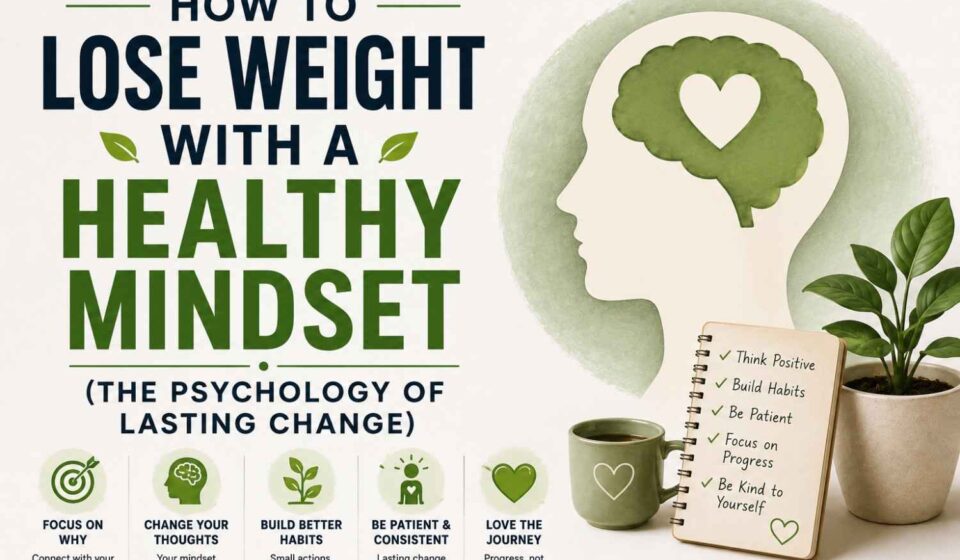
How to Lose Weight With a Healthy Mindset (The Psychology of Lasting Change)

What you think about weight loss matters as much as what you do about it

Most weight loss advice focuses on what to eat and how to exercise. Very little focuses on how to think — and yet the psychological dimension of weight loss is often what determines whether someone succeeds or fails long-term.
Two people can follow identical diets and exercise programs and get dramatically different results — because the mindset they bring to the process shapes their consistency, their response to setbacks, their relationship with food, and ultimately how sustainable their approach is.
This article covers the mindset shifts that make the biggest practical difference.
Shift 1: From “Diet” to “Lifestyle”
The word “diet” implies a temporary state — something you do until you reach a goal, then stop. This framing sets up the rebound that follows most diets, because the behaviors that produced the weight loss end when the “diet” ends.
A lifestyle is permanent. It’s not what you do for 12 weeks — it’s how you live. The behaviors that support a healthy weight are either part of your life or they’re not. There’s no finish line to cross.
What this shift looks like in practice:
Instead of “I’m on a diet until I lose 20 lbs,” try “I’m building a way of eating I can sustain indefinitely, and weight loss is happening as a result.”
Instead of “I’ll start eating well on Monday,” try “The next meal is an opportunity to eat well — not Monday, not after the holiday, now.”
This isn’t semantic. People who frame their approach as lifestyle change rather than dieting consistently maintain results better than those who frame it as a temporary diet.
Shift 2: From “All or Nothing” to “Always Something”
All-or-nothing thinking is one of the most destructive patterns in weight loss. It sounds like:
- “I already had the cookie so the day is ruined”
- “I missed my workout so I might as well skip the whole week”
- “I can’t do this perfectly so there’s no point trying”
This thinking turns small slips into complete abandonment — and it’s responsible for the endless restart cycle that many people experience.
The alternative: always something. Something is always better than nothing. An imperfect meal is better than an abandoned day. A 10-minute walk is better than no movement. A slightly higher-calorie day is better than a written-off week.
The 80/20 rule applied to mindset: If 80% of your choices support your goals, the other 20% will not derail your progress. You don’t need perfection. You need consistency — and consistency is compatible with imperfection.
As covered in our article on how to stay consistent with weight loss, the never-miss-twice rule is more important than any perfect streak.
Shift 3: From “I Have to” to “I Want to”
“I have to eat salad.” “I have to go to the gym.” “I’m not allowed to eat that.”
Language of obligation and restriction creates resentment. It frames healthy choices as punishments and reinforces the idea that you’re depriving yourself of something you really want.
“I choose to eat in a way that makes me feel good.” “I’m going to the gym because I value how I feel afterward.” “I’m having less of that because I feel better when I do.”
Language of choice and values creates ownership. The same behavior — eating a nutritious meal — feels completely different depending on whether you’re doing it because you have to or because you choose to.
This isn’t positive-thinking fluff. It’s self-determination theory — psychological research on autonomy and motivation consistently shows that people persist with behaviors they’ve chosen far longer than behaviors they feel compelled to perform.
Shift 4: From Outcome Goals to Process Goals
“Lose 30 lbs” is an outcome goal. You can’t directly control it — you can only influence it. The scale doesn’t always respond to effort on the timeline you expect. Tying your sense of progress entirely to an outcome you can’t fully control is a reliable recipe for frustration and demotivation.
Process goals are about behaviors you can directly control: “Eat protein at every meal this week.” “Walk 8,000 steps per day.” “Drink 2 liters of water daily.” “Prep lunches on Sunday.”
When you consistently hit your process goals, the outcome follows — usually. And on weeks when the outcome doesn’t follow (the scale doesn’t move despite good behavior), hitting your process goals still provides a sense of accomplishment and evidence that you’re doing what needs to be done.
The shift: Define success as executing the behaviors, not as achieving the number. The number is a lag indicator — it follows consistent behavior by weeks or months. Behavior is what you control today.
Shift 5: From Self-Criticism to Self-Compassion
This might be the most important mindset shift on this list — and the one most people are most skeptical about.
“I need to be harder on myself.” “I deserve to feel bad about what I ate.” “Guilt will motivate me to do better.”
The research says the opposite. Studies on self-compassion and behavior change consistently find that people who treat themselves with kindness after setbacks return to healthy behaviors faster, maintain them longer, and experience better outcomes than those who engage in self-criticism.
Self-criticism activates the same threat response as external criticism — the brain responds to internal attacks with stress, anxiety, and the desire to escape the uncomfortable feeling (often through the very behavior that caused the guilt in the first place).
Self-compassion doesn’t mean not caring or excusing poor choices. It means acknowledging the slip, understanding what caused it, and deciding on the next action — without the extended punishment loop that derails progress.
After a setback: “That wasn’t what I planned. I understand why it happened. What’s the next good choice I can make?”
As covered in our article on how to lose weight after a setback, the speed of recovery from slips — not the absence of slips — is what separates people who succeed long-term.
Shift 6: From Body Hatred to Body Respect
Many people start a weight loss journey from a place of disliking or hating their body. The implicit belief: “I’ll start respecting my body when it looks different.”
This rarely works as a long-term motivator. Shame and self-contempt produce short bursts of action followed by burnout. And treating fat loss as a prerequisite for self-respect means living in a permanent state of conditional self-acceptance — which is exhausting and psychologically corrosive.
Body respect as a starting point — not a reward — produces more sustainable behavior change. Treating your body well because it deserves to be treated well (regardless of what it looks like) produces healthier behaviors than treating it well as a punishment for being the wrong size.
What body respect looks like in practice:
- Eating nutritious food because your body functions better on it, not because you’re punishing yourself
- Moving because movement feels good and supports energy, not because you’re “burning off” what you ate
- Sleeping adequately because your body needs it, not as a strategy to manipulate your metabolism
- Speaking to yourself with the same basic dignity you’d extend to anyone else
Shift 7: From Short-Term Thinking to Long-Term Vision
Most weight loss thinking is short-term: “How quickly can I lose this?” “What’s the fastest approach?” “Will I see results in time for the event?”
Speed-focused thinking produces aggressive, unsustainable approaches — crash diets, extreme exercise programs, elimination of entire food groups — that produce rapid short-term results and rapid rebounds.
Long-term thinking asks: “What can I genuinely sustain for the next 5 years?” “What approach will I still be following in 2 years?” “What habits do I want to have established by the time I’m 10 years older?”
The answer to these questions points toward moderate, enjoyable, sustainable approaches that produce slower but permanent change.
A useful exercise: Imagine yourself 5 years from now, having consistently followed your current approach. Does that future feel genuinely possible? If not, the approach probably needs to be more sustainable — not more aggressive.
Shift 8: From Comparing to Others to Competing With Yourself
Other people’s transformations — on social media, in before-and-after photos, in weight loss groups — can be motivating or devastating depending on how you relate to them.
Someone else’s 3-month transformation says nothing about your timeline. They may have started at a different weight, had different hormones, different stress levels, different sleep quality, different metabolic history. Comparing your week 8 to someone else’s week 12 provides no useful information.
Your own progress compared to where you were is the only meaningful comparison. Are you stronger than you were 2 months ago? Do you have more energy? Are your habits more established? Is your relationship with food healthier?
These comparisons provide genuine, relevant feedback. External comparisons mostly don’t.
Putting It Together: A Healthy Weight Loss Mindset in Practice
The daily practice:
- Approach each day as a fresh start — yesterday’s choices don’t define today’s
- Focus on the behaviors you control, not the outcomes you can’t
- When something goes wrong, ask “what’s the next good choice?” rather than “what does this mean about me?”
- Notice progress beyond the scale — energy, strength, habits, how you feel
- Speak to yourself with the same kindness you’d extend to a friend
The long-term practice:
- Build an identity around the person you’re becoming, not the weight you’re losing
- Invest in enjoyable, sustainable behaviors rather than maximally effective ones you’ll abandon
- Make peace with the timeline — real change takes months and years, not weeks
- Find genuine reasons to take care of your health that go beyond appearance
The Bottom Line
The most nutritionally perfect diet and the most optimally designed exercise program will underperform for someone with an unsustainable mindset — because consistency over time is what produces lasting results, and consistency requires a psychological foundation that can weather setbacks, imperfect weeks, and slow progress.
Shifting from diet to lifestyle, from perfectionism to consistency, from self-criticism to self-compassion, and from short-term to long-term thinking doesn’t just make weight loss more psychologically comfortable — it makes it more effective.
For the complete framework of practical dietary and lifestyle strategies that this mindset supports, our guide to how to get rid of belly fat covers everything in one place.
Which mindset shift has made the biggest practical difference in your weight loss journey? Share in the comments — the psychological dimension of this process is rarely discussed as openly as it deserves to be.