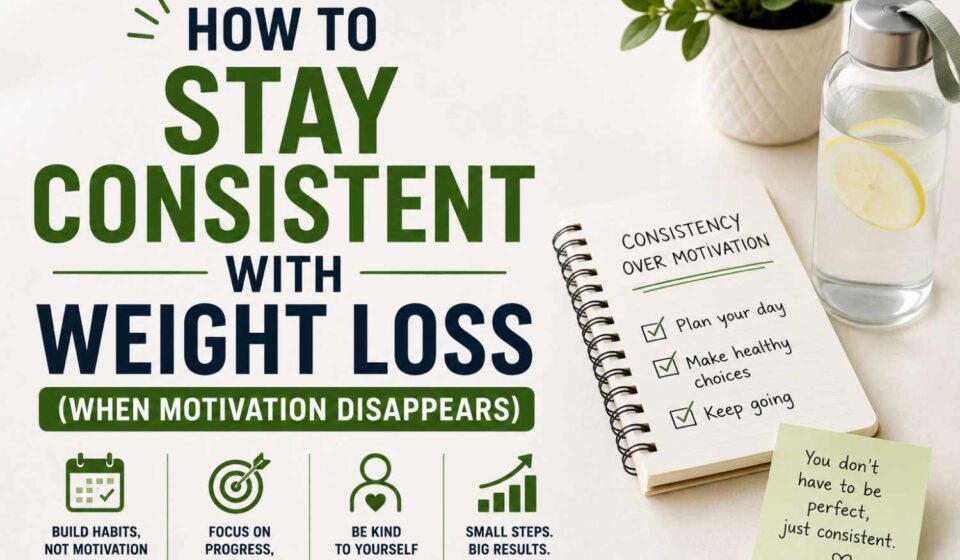
How to Stay Consistent With Weight Loss (When Motivation Disappears)

Motivation gets you started. Consistency gets you results. Here’s how to build the second one.

Every weight loss journey starts with motivation. The first week or two, the new diet feels exciting, the workouts feel energizing, and the progress feels real. Then life happens. Motivation fades. Old habits reassert themselves. The plan that felt effortless in week one becomes a struggle by week six.
This isn’t weakness. It’s the predictable arc of motivation-dependent behavior change — and understanding it changes everything about how you approach consistency.
Why Motivation Is the Wrong Foundation
Motivation is an emotion. Like all emotions, it fluctuates based on energy levels, sleep quality, stress, mood, social environment, and dozens of other factors you don’t fully control.
Building a weight loss approach on motivation is like building a house on sand — it works when conditions are favorable, and collapses when they aren’t.
The people who succeed long-term at weight loss don’t have more motivation than everyone else. They have better systems — habits, environments, and structures that make healthy behavior the default rather than the deliberate choice.
The goal isn’t to stay motivated. The goal is to build a system that works even when you’re not.
Strategy 1: Make the Behavior Smaller Until It’s Undeniable
The most common consistency mistake: setting behaviors at a level that requires high motivation to execute.
“Exercise 5 days per week for 60 minutes” requires significant motivation on good days. On bad days — when tired, stressed, overwhelmed — it’s simply not happening.
“Do 10 minutes of movement every day” requires almost none. It’s so small that there’s no meaningful barrier to doing it.

The paradox: small behaviors done consistently produce better outcomes than larger behaviors done intermittently. Ten minutes of movement every day for a year produces more results than 60-minute sessions done enthusiastically for three weeks then abandoned.
The minimum effective version: Define the smallest version of each healthy behavior that still provides value. On difficult days, do only that. On good days, do more — but never less than the minimum.
Strategy 2: Build Identity, Not Just Habits
There’s a difference between “I’m trying to eat better” and “I’m someone who eats well.” The first is a goal you’re pursuing. The second is who you are.
Identity-based behaviors are dramatically more consistent than goal-based behaviors because they don’t require motivation — they just require acting in accordance with who you are.
How to build identity:
- Use identity language: “I’m someone who exercises regularly” rather than “I’m trying to exercise more”
- Celebrate small wins as identity confirmation: “That was exactly what someone who prioritizes their health would do”
- Connect behaviors to values: “I exercise because I value feeling strong and having energy, not because I’m trying to hit a number”
This shift happens gradually and feels slightly artificial at first — that’s normal. Over time, the repeated behavior and identity framing genuinely merge.
Strategy 3: Design Your Environment for Automatic Behavior
Your environment determines your default behaviors more than your willpower does. The food that’s visible and accessible gets eaten. The workout clothes laid out the night before get used. The vegetables washed and at eye level in the fridge get cooked.
Environmental design removes the need for decision-making at the moment when willpower is most likely to fail — usually when tired, stressed, or hungry.
High-impact environmental changes:
- Keep healthy protein-rich snacks visible and accessible, unhealthy snacks out of sight or out of the house entirely
- Set out workout clothes the night before
- Prep healthy food on Sundays so it’s ready to grab on weekday evenings
- Keep a water bottle visible and full at all times
- Put your running shoes by the door
As covered in our guide to how to build healthy eating habits for life, environmental design is the difference between behaviors that require willpower and behaviors that happen almost automatically.
Strategy 4: Use Habit Stacking
Habit stacking connects new behaviors to existing ones — using already-established routines as triggers for the new behavior you want to build.
The formula: After I [existing habit], I will [new habit].
Examples:
- After I pour my morning coffee, I will log my breakfast
- After I sit down at my desk, I will drink a full glass of water
- After I get home from work, I will change into workout clothes immediately
- After dinner, I will take a 10-minute walk
The existing habit acts as a reliable trigger — no motivation or reminder needed. The new behavior piggybacks on the automatic momentum of the established one.
Strategy 5: Track Something Small Every Day
Daily tracking — even something minimal — maintains engagement with your goals on days when motivation is absent.
It doesn’t have to be comprehensive calorie tracking. It could be:
- A simple yes/no checklist: Did I hit my protein? Did I exercise? Did I drink enough water?
- A daily weight log (not to judge, but to maintain awareness)
- A step count check at the end of the day
- A 30-second review of what went well today
The act of tracking keeps the goal in conscious awareness — which is particularly important during the inevitable periods when motivation drops and goals can drift out of focus entirely for weeks.
Strategy 6: Plan for Obstacles Before They Happen
The most consistent people aren’t those who face fewer obstacles — they’re those who have plans for the obstacles they know are coming.
Work dinners, holidays, stressful weeks, illness, travel — these are predictable disruptions. Having a pre-decided response to each one dramatically reduces their impact on consistency.
Implementation intentions: “If [obstacle], then I will [response].”
- “If I’m traveling for work, I will prioritize protein at every hotel breakfast and take the stairs”
- “If I miss a Monday workout, I will do Tuesday without making up for the missed day”
- “If I overeat at dinner, I will have a normal protein-focused breakfast tomorrow rather than compensating with restriction”
Deciding responses to predictable obstacles in advance removes the need to make decisions in the moment — when you’re tired, tempted, or under pressure.
Strategy 7: Measure Progress Beyond the Scale
The scale is one measure of progress — and a volatile, unreliable one in the short term. Weight fluctuates by 2–5 lbs daily based on water retention, food volume in the digestive system, hormonal cycles, and sodium intake. A week of perfect behavior can show a scale increase. A week of poor behavior can show a decrease.
Relying solely on scale weight for motivation is a reliable way to lose motivation — because the feedback is noisy, delayed, and frequently contradicts the effort.
Additional progress measures:
- Body measurements (waist, hips, arms, thighs) — monthly
- Progress photos — monthly, same lighting and pose
- Strength improvements in workouts
- Energy levels throughout the day
- Sleep quality
- How clothes fit
- Hunger management — are you less hungry than you were?
Multiple progress measures provide feedback that the scale alone doesn’t. On weeks when the scale doesn’t move, these other measures often show progress — which maintains the motivation and evidence of effectiveness that consistency requires.
As covered in our article on how to break a weight loss plateau, non-scale measures are often the most reliable indicators that an approach is working even when weight stalls.
Strategy 8: Make Peace With Imperfection
Perfectionism is one of the most reliable predictors of inconsistency. The belief that anything less than perfect execution means failure produces the all-or-nothing thinking that turns every slip into abandonment.
Consistency doesn’t mean perfection. It means never missing twice — returning to the behavior after every slip without drama, guilt spiral, or extended recovery period.
The goal is a long-term batting average of good behaviors — not a perfect record. An approach that produces good-enough behavior 80% of the time, sustained for 12 months, produces dramatically better outcomes than a perfect approach sustained for 6 weeks then abandoned.
As covered in our article on how to lose weight after a setback, self-compassion after slips isn’t soft — it’s the behavior most associated with long-term consistency in research.
Strategy 9: Find Your Consistency Anchors
Most people have 1–3 behaviors that, when consistently maintained, keep everything else roughly on track. These are personal — what works as an anchor for one person is ineffective for another.
Common examples:
- Morning protein breakfast — when this happens, the rest of the day’s eating tends to follow
- Daily step count — maintaining movement goals keeps the overall mindset engaged
- Sunday meal prep — when this happens, weekday eating is much better
- Daily weigh-in — the accountability keeps awareness high
Identify your own anchors through observation — what behaviors, when maintained, seem to pull your other healthy behaviors along? Prioritize these above everything else. On difficult weeks, maintain only the anchors and everything else can slip.
Strategy 10: Connect to Your Deeper Why
Surface-level motivations — “I want to look better for summer” — fade. Deeper motivations — “I want to have energy to play with my kids,” “I want to be able to walk without pain,” “I want to feel capable and strong in my own body” — are more durable.
When motivation is low, the surface-level why doesn’t compel much. The deeper why often does.
Finding your deeper why: Ask “why does that matter?” repeatedly until you reach something that feels genuinely important.
“I want to lose 20 lbs.” Why? “To look better.” Why does that matter? “To feel more confident.” Why does that matter? “Because I’ve been hiding from social situations and I miss feeling like myself.”
That’s a why worth returning to on difficult days.
The One Principle That Ties Everything Together
Consistency is a skill — and like all skills, it develops through practice, not through sudden transformation.
Every time you maintain a healthy behavior when you didn’t feel like it, you strengthen that skill. Every time you return to a behavior after a slip without drama, you strengthen it further. The consistency compounds over time into something that eventually doesn’t require significant effort — because it’s just who you are and how you live.
Start small. Design your environment. Stack habits onto existing routines. Plan for obstacles. Measure broadly. Be imperfect and keep going.
For the complete framework of healthy eating and lifestyle habits that this consistency supports, our guide to how to get rid of belly fat covers all the foundational strategies in one place.
What’s your most reliable consistency strategy — the one thing that keeps you on track when motivation disappears? Share in the comments.