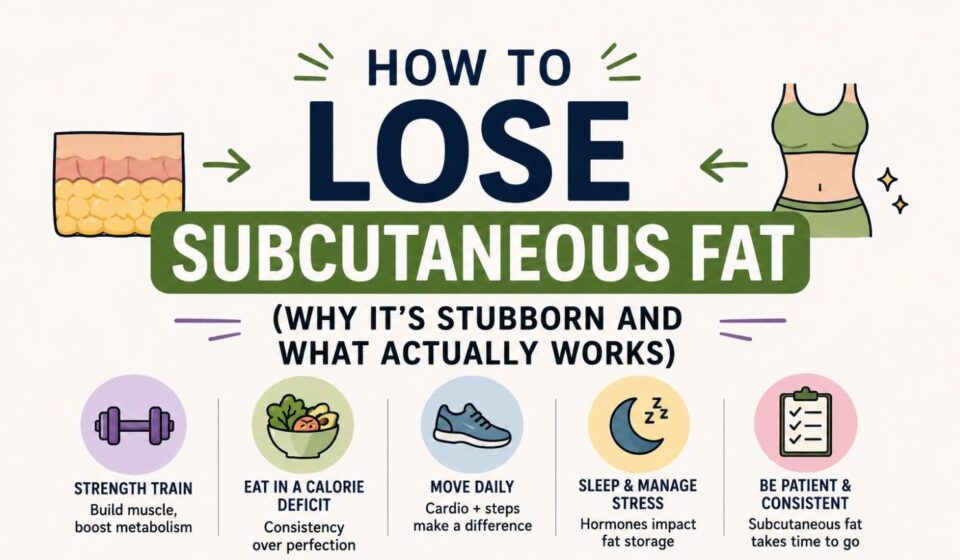
How to Lose Subcutaneous Fat (Why It’s Stubborn and What Actually Works)

The fat you can pinch — here’s why it’s harder to lose than visceral fat and what the evidence says works

When most people talk about wanting to lose fat, they’re talking about subcutaneous fat — the fat stored directly beneath the skin that you can pinch, squeeze, and see. It’s the fat that gives the belly its softness, the thighs their roundness, the arms their wobble.
Subcutaneous fat is different from visceral fat — the deep abdominal fat that sits around internal organs and drives metabolic disease. Understanding the difference matters because subcutaneous fat behaves differently, responds to different interventions at different rates, and has a different metabolic significance.
What Is Subcutaneous Fat?
Subcutaneous fat (from the Latin “under the skin”) is the layer of fat stored in the subcutaneous tissue — the layer between the skin and the underlying muscle. It’s distributed throughout the body but concentrates in specific areas that vary by sex, age, and genetics.
Where subcutaneous fat accumulates:
- Women: Predominantly hips, thighs, buttocks, lower abdomen, and upper arms — the “gynoid” distribution pattern driven by estrogen
- Men: Predominantly abdomen, flanks, and chest — the “android” distribution pattern, often combined with more visceral fat
- Both: Arms, back, neck, face, and calves to varying degrees
Subcutaneous Fat vs Visceral Fat: The Important Difference
Understanding this distinction changes how you approach fat loss:
Visceral fat:
- Located deep in the abdominal cavity, surrounding organs
- Metabolically active — produces inflammatory cytokines, hormones, and compounds that drive insulin resistance and cardiovascular disease
- More dangerous to health
- Responds more readily to dietary changes and exercise — often the first fat to reduce
- The fat responsible for the hard, protruding “beer belly” appearance
Subcutaneous fat:
- Located directly under the skin
- Metabolically less active than visceral fat
- Less dangerous to health in moderate amounts (actually serves some protective functions)
- More resistant to loss than visceral fat
- The soft, pinchable fat that most people want to reduce for aesthetic reasons
This distinction is why someone can lose significant amounts of visceral fat (improving health dramatically) while subcutaneous fat reduces more slowly — the body prioritizes releasing visceral fat first in most cases.
As covered in our article on visceral fat vs subcutaneous fat, the two types respond to intervention differently and at different rates.

Why Subcutaneous Fat Is More Stubborn
Alpha-2 Adrenergic Receptor Density
Subcutaneous fat in certain areas — particularly the lower abdomen, hips, thighs, and back of the arms — has a higher concentration of alpha-2 adrenergic receptors. These receptors respond to adrenaline by inhibiting fat breakdown rather than promoting it.
This receptor profile is why these areas seem to “hold on” to fat more stubbornly than others — the fat mobilization machinery in these cells is partially blocked at the receptor level.
Lower Blood Flow
Subcutaneous fat has lower blood flow than visceral fat — meaning the hormones and signals that trigger fat breakdown reach these cells more slowly and less effectively.
Hormonal Storage Signals
Estrogen specifically directs fat storage toward subcutaneous depots in the hips, thighs, and buttocks — an evolutionary adaptation for reproductive energy reserves. This hormonal programming makes lower body subcutaneous fat particularly resistant to mobilization, particularly in premenopausal women.
Order of Fat Loss
Fat loss tends to occur in roughly the reverse order of fat gain. Recently accumulated visceral fat tends to come off earlier; long-established subcutaneous fat depots in hormonally protected areas often come off last.
What Actually Reduces Subcutaneous Fat
1. Overall Fat Loss Through a Sustained Calorie Deficit
This is the non-negotiable. Subcutaneous fat reduces through overall body fat reduction — there is no way to specifically target subcutaneous fat in a particular area through exercise or any non-medical intervention.
A sustained calorie deficit — 400–500 calories below maintenance daily — produces the systemic fat loss that eventually includes subcutaneous fat stores. The timeline is longer than for visceral fat, but the mechanism is identical.
As covered in our guide to how to lose weight with a calorie deficit, the calorie deficit is the foundation everything else is built on.
2. High Protein Intake for Fat Loss Quality
Without adequate protein during a calorie deficit, weight lost includes significant muscle alongside fat — producing a “softer” appearance at a lower weight rather than the lean, defined look that comes from losing primarily fat.
Adequate protein (0.7–1g per pound of bodyweight) ensures that the subcutaneous fat that is lost isn’t replaced in appearance by muscle loss. As covered in our guide to how much protein you actually need per day, this is the most important dietary variable for body composition quality during fat loss.
3. Strength Training for Body Composition
As overall fat is lost, the appearance of previously hidden muscle comes through — and whether that muscle is developed determines whether fat loss produces a lean, defined look or a simply smaller version of the same shape.
Strength training builds the muscle that creates body definition as subcutaneous fat reduces. The combination of fat loss and muscle development produces the body composition most people are aiming for — not just less subcutaneous fat, but the muscle beneath it visibly defined.
4. Cardiovascular Exercise for Accelerated Fat Loss
Cardio accelerates the calorie deficit that drives fat loss. For subcutaneous fat specifically, some research suggests that moderate-intensity sustained cardio (zone 2 training) may be slightly more effective at mobilizing stubborn subcutaneous fat than high-intensity interval work — though the difference is modest and both produce results.
Walking, cycling, swimming, and other moderate cardio all contribute to the overall deficit and hormonal environment that supports subcutaneous fat reduction.
5. Reducing Insulin Levels
Insulin is a fat storage hormone. Chronically elevated insulin (from high refined carbohydrate and sugar intake) promotes fat storage in subcutaneous depots and suppresses fat mobilization.
Reducing refined carbohydrates and added sugar lowers baseline insulin levels, creating a hormonal environment more conducive to subcutaneous fat release. The effect is less dramatic than for visceral fat — which is more directly insulin-sensitive — but real and worth implementing.
6. Cortisol Management
Chronically elevated cortisol promotes fat storage in the abdominal subcutaneous area specifically. Stress management through sleep, active relaxation, and reduced stressors directly affects subcutaneous abdominal fat retention.
As covered in our guide to how to get rid of belly fat, cortisol management is one of the most important and least discussed fat loss levers available.
7. Patience With Hormonally Protected Areas
For the specific subcutaneous fat in areas that are hormonally protected — lower abdomen, hips, thighs, and buttocks in women particularly — patience is perhaps the most practically important strategy.
These areas are biologically programmed to be the last fat stores released. They will respond to consistent overall fat loss — just later and more slowly than other areas. Many people lose visible fat from their face, arms, and upper body for months before their lower body subcutaneous stores begin visibly reducing.
This is not a sign that the approach isn’t working. It’s normal fat loss physiology.
How Long Does It Take to Lose Subcutaneous Fat?
This depends on how much you have, your genetic fat distribution, your sex, and how consistently you maintain the calorie deficit and lifestyle factors that support fat loss.
General timeline expectations:
Visceral fat: Often responds visibly within 4–8 weeks of consistent dietary change.
Subcutaneous fat in less-hormonally-protected areas (arms, upper back, face): Often visible in 8–16 weeks with consistent fat loss.
Subcutaneous fat in hormonally-protected areas (lower abdomen, hips, thighs): May take 6–12+ months of consistent fat loss to show significant visible reduction, particularly in women.
This extended timeline for certain subcutaneous fat deposits is one of the primary reasons people lose motivation during fat loss journeys — they can see progress elsewhere but the area they care most about seems unchanged for months.
Understanding that this is biology rather than failure — and tracking multiple progress measures rather than fixating on one area — is essential for sustaining the long-term effort that stubborn subcutaneous fat reduction requires.
Medical and Cosmetic Options
For people who have achieved a healthy body weight and body fat percentage and still have localized subcutaneous fat deposits that resist loss — often due to genetic fat distribution — medical options exist:
Liposuction — surgical removal of subcutaneous fat from specific areas. The most direct and effective cosmetic intervention for localized subcutaneous fat. Produces immediate, visible reduction. Requires downtime and carries surgical risks. The fat removed doesn’t return to the treated area if weight is maintained.
CoolSculpting (cryolipolysis) — non-surgical fat freezing that destroys subcutaneous fat cells in targeted areas. Results appear over 2–3 months as destroyed cells are cleared. Effective for localized subcutaneous deposits in people at or near healthy body weight. Requires multiple sessions.
EMSCULPT and similar — electromagnetic muscle stimulation that simultaneously builds muscle and reduces subcutaneous fat in targeted areas. Less evidence than liposuction or CoolSculpting but may produce modest improvements.
These options are worth knowing about — not as first-line interventions, but as legitimate medical options for localized subcutaneous fat that persists at a healthy body weight.
The Body Composition Approach vs The Scale
Subcutaneous fat loss illustrates why scale weight alone is a poor progress measure. As subcutaneous fat reduces and muscle increases from strength training, the scale may show minimal change — while body composition is significantly improving.
More meaningful progress measures for subcutaneous fat loss:
- Tape measure at waist, hips, arms, and thighs — monthly
- Progress photos — monthly, consistent lighting and angles
- How clothes fit — particularly fit in areas where subcutaneous fat concentrates
- Strength improvements — evidence of muscle development occurring alongside fat loss
- Body fat percentage measurement (if accessible)
The Bottom Line
Subcutaneous fat is the soft, pinchable fat beneath the skin that most people most want to reduce. It’s more stubborn than visceral fat — particularly in hormonally protected areas — due to alpha-2 receptor density, lower blood flow, hormonal storage programming, and the natural order of fat loss.
It reduces through the same mechanisms as all fat loss — sustained calorie deficit, adequate protein, strength training, cardiovascular exercise, insulin management, and cortisol reduction — just on a longer timeline, particularly in the lower body.
The most important practical strategy beyond the dietary and exercise fundamentals: patience. Subcutaneous fat in the areas people care most about is often the last to respond. Consistent effort over 6–12+ months produces results that 8-week programs never will.
For the complete fat loss framework that drives subcutaneous fat reduction most effectively, our guide to how to get rid of belly fat covers all the foundational strategies in one place.
Which areas of subcutaneous fat have been most resistant for you — and have you found any specific approach that finally moved them? Share in the comments.