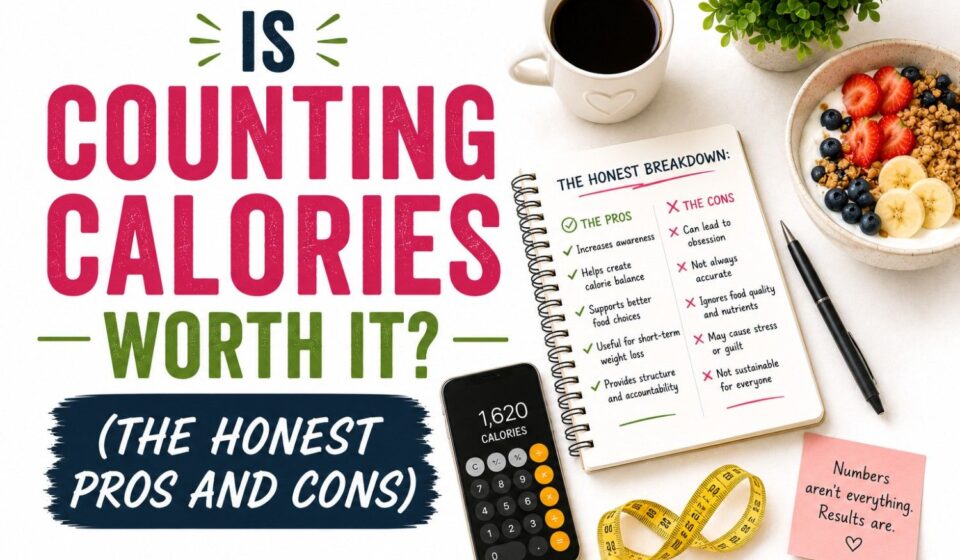

The most debated weight loss strategy — here’s when it works, when it doesn’t, and who should actually do it

Calorie counting is simultaneously the most evidence-backed weight loss strategy available and one of the most controversial. Its defenders say it’s the only approach with genuine transparency. Its critics say it’s obsessive, inaccurate, and damaging to the relationship with food.
Both sides have a point. The honest answer is that calorie counting is a powerful tool that works well for some people and poorly for others — and understanding which category you fall into is more useful than a blanket verdict.
The Case For Counting Calories
It Creates Genuine Awareness
The most powerful effect of calorie tracking isn’t the tracking itself — it’s what the tracking reveals.
Most people who begin tracking calories discover significant gaps between what they thought they were eating and what they were actually eating. The handful of nuts that felt like a light snack: 300 calories. The “healthy” salad with dressing: 600 calories. The splash of olive oil while cooking: 120 calories.
Research consistently finds that people underestimate their calorie intake by 20–40% without tracking. Calorie counting closes this gap — not by restricting, but by creating accurate awareness.
It Makes the Deficit Real
As covered in our guide to how many calories should I eat to lose weight, fat loss requires a genuine calorie deficit. Many people believe they’re in a deficit when they’re not — because their untracked calorie intake exceeds their estimates.
Calorie counting transforms the deficit from theoretical to actual. It’s the difference between aiming in the general direction of a target and being able to see the target clearly.
It Removes Food Moralizing
Counter-intuitively, tracking often reduces anxiety around food rather than increasing it. When everything fits into a calorie budget, no food is “forbidden” — a piece of chocolate can be tracked and accommodated. The all-or-nothing thinking of restrictive dieting (“I’ve already eaten badly today, might as well give up”) is replaced by a budget model: going over on one meal just means being more careful at the next.
The Evidence Supports It
Multiple systematic reviews have found that self-monitoring food intake — calorie tracking being the most common form — is among the behaviors most consistently associated with successful weight loss and weight maintenance.

The people who track longest tend to lose the most weight and maintain the best — not because tracking is magical, but because it maintains the awareness that supports consistent dietary behavior.
The Case Against Counting Calories
Calorie Counts Are Inaccurate
This is a significant and legitimate criticism. The calorie counts on food labels are allowed by the FDA to be off by up to 20%. Restaurant calorie estimates are often wildly inaccurate — studies find restaurant meals averaging 18% more calories than stated. Calorie database entries for home-cooked food vary significantly.
Additionally, the calories absorbed from food vary based on cooking method, individual gut microbiome, and food processing. Two people eating 2,000 calories may absorb meaningfully different actual energy.
The implication: tracking gives an approximation, not a precise count. The approximation is still useful — a consistent 20% undercount affects everyone equally and can be accounted for. But “precise calorie management” is a somewhat misleading term.
Exercise Calorie Estimates Are Wildly Inaccurate
Fitness trackers and exercise apps are notoriously inaccurate for calorie burn — overestimating by 20–90% in many studies. “Eating back exercise calories” based on tracker estimates is one of the most common ways calorie counting fails — the exercise burns 300 calories but the tracker says 600, so the person eats 600 “back,” producing a calorie surplus rather than deficit.
It Can Become Obsessive or Disordered
For people with tendencies toward disordered eating, calorie tracking can reinforce harmful behaviors — providing numerical validation for restriction, creating anxiety around untracked food situations, and becoming a controlling rather than helpful tool.
This is a real concern. Research suggests that people with a history of disordered eating should approach calorie tracking carefully — if at all — and with professional guidance. For these individuals, the harms can significantly outweigh the benefits.
It’s Cognitively Demanding
Consistent calorie tracking requires logging every meal, looking up every food, estimating every portion, and maintaining the discipline to log accurately rather than strategically. For many people, this cognitive load is unsustainable over the months required for meaningful weight loss.
Apps have made tracking significantly easier — but it still requires effort that many people eventually find intolerable.
It Can Create an Unhealthy Relationship With Food
Some critics argue that calorie tracking reduces food to numbers, removes the pleasure and culture from eating, and creates a transactional relationship with food that isn’t sustainable or desirable long-term.
This critique has merit — eating is more than calorie management, and an approach that makes every meal an arithmetic exercise may undermine the food relationships that support long-term healthy eating.
What the Evidence Actually Shows
Calorie tracking works — studies consistently show better weight loss outcomes with food self-monitoring than without it, across multiple populations and time periods.
But adherence to tracking is a major problem — most people who begin calorie tracking stop within weeks to months. And stopping tracking typically produces weight regain.
The best outcomes come from consistent tracking over time — the people who track most consistently lose the most weight. The benefit is proportional to adherence.
Intermittent tracking may be nearly as effective — some research suggests periodic tracking (a few weeks every few months) maintains enough awareness to support weight management without requiring constant daily effort.
Who Should Count Calories
Calorie counting is particularly well-suited for:
- People who are data-oriented and find numerical tracking motivating rather than anxiety-provoking
- People who have been trying to lose weight without results despite believing they’re eating well — tracking often reveals the hidden deficit
- People beginning a weight loss journey who need to understand what their baseline intake actually is
- People who want maximum food flexibility without food rules
- People who have tried other approaches without success and want transparent dietary management
Calorie counting is less well-suited for:
- People with a history of disordered eating or eating disorders
- People who become anxious or obsessive around food numbers
- People who find the cognitive load unsustainable
- People who already eat a well-structured, whole-food diet with natural portion control
- People in social or cultural contexts where tracking is impractical or intrusive
The Middle Approaches
For people who want the awareness benefits of tracking without full-time calorie counting, several middle approaches provide meaningful benefit with less burden:
Track for 2 weeks initially, then stop: Two weeks of honest tracking creates awareness of portions and calorie density that persists even after tracking stops. Most people identify 2–3 significant calorie sources they weren’t accounting for — and can manage those without ongoing tracking.
Track protein only: Hitting protein targets (0.7–1g per pound of bodyweight) naturally structures eating in a way that supports fat loss without tracking every calorie. As covered in our guide to how much protein you actually need per day, protein is the most important dietary variable — and tracking it alone captures much of calorie tracking’s benefit.
Periodic check-in tracking: Track for one week per month to recalibrate awareness and catch gradual drift that occurs when tracking stops.
Use the plate method: Half plate vegetables, quarter protein, quarter carbohydrates — approximates an appropriate calorie deficit for many people without any counting.
Practical Tips if You Decide to Track
Use a food scale, not just volume measurements. For calorie-dense foods (nuts, oils, cheese, nut butter), volume measures are highly inaccurate. A tablespoon of peanut butter estimated by eye routinely contains 2–3 tablespoons.
Log before eating, not from memory. Memory of what was eaten is significantly less accurate than logging in real time.
Track weekends with the same rigor as weekdays. Weekend tracking reveals the most common source of untracked excess.
Don’t obsess over precision — aim for accuracy. Close enough is close enough. A consistent approximation beats perfect precision that produces anxiety and abandonment.
Track for at least 4–6 weeks before judging effectiveness. The first 1–2 weeks often reveal the gap between estimated and actual intake — but the habit of accurate tracking takes several weeks to establish.
Don’t “eat back” exercise calories unless you have very precise exercise calorie data. Standard tracker overestimates of exercise calories are a common way tracking undermines its own benefits.
The Bottom Line
Is counting calories worth it? For most people trying to lose weight — yes, at least initially.
The awareness created by honest calorie tracking is the primary mechanism of its effectiveness — and the information about what’s actually being consumed is valuable regardless of whether you continue tracking long-term.
But calorie counting is a tool, not a requirement. People who can maintain a calorie deficit through dietary structure, food quality focus, or natural portion control without tracking can achieve the same fat loss outcomes. And for people with disordered eating tendencies, the harms of tracking can outweigh the benefits.
As covered in our guide to how to lose weight without counting calories, there are legitimate approaches that achieve similar results through different means — for people for whom tracking doesn’t work.
For the complete fat loss framework that works regardless of whether you track, our guide to how to get rid of belly fat covers everything in one place.
Do you count calories — and has it helped or created more problems than it solved? Share in the comments. The range of genuine experiences with calorie tracking is wide and valuable.