
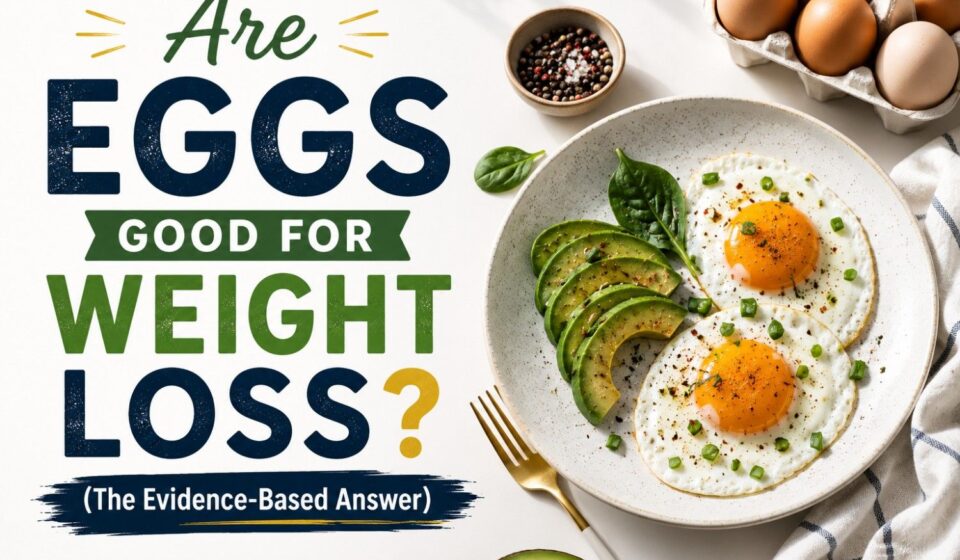

Eggs went from villain to superfood and back again. Here’s what the science actually shows.
Few foods have had a more turbulent reputation than eggs. For decades they were demonized for their cholesterol content. Then research shifted, dietary guidelines changed, and eggs were rehabilitated. Now some weight loss approaches love them; others still avoid them.
The honest answer: eggs are one of the best foods available for weight loss. Here’s why — and the one caveat worth knowing.

The Nutritional Case for Eggs
Two large eggs provide:
- 12g protein — high-quality complete protein with all essential amino acids
- 140 calories — relatively modest for the satiety they produce
- Vitamins B12, B2, B5, A, D, E, K
- Selenium, phosphorus, folate, zinc
- Choline — essential for brain function, often deficient in Western diets
- Lutein and zeaxanthin — protective for eye health
- 1.6g saturated fat, 3.6g unsaturated fat
Eggs are one of the most nutritionally complete foods available — often described as a “near-perfect food” because of the density of nutrition relative to calories.
Why Eggs Are Excellent for Weight Loss
Highest Satiety of Almost Any Food
The Satiety Index — a measure of how filling different foods are per calorie — ranks eggs among the highest of any commonly eaten food. A 2005 study by Holt et al. found eggs were 50% more satiating than white bread at equivalent calories.
The mechanism: the combination of protein (most satiating macronutrient) and fat (slows digestion, extends fullness) produces satiety that persists for hours after eating.
Reduces Total Calorie Intake Throughout the Day
Several controlled studies have specifically measured the effect of eggs at breakfast on total daily calorie intake:
- A study of overweight women found that eating eggs for breakfast (vs. a bagel of equivalent calories) resulted in consuming 417 fewer calories over the following 36 hours — spontaneously, without trying to eat less
- A study of men found egg breakfasts produced significantly lower calorie intake at lunch and dinner compared to cereal breakfasts of equivalent calories
The satiety from eggs at breakfast extends through the day — making everything else more manageable. As covered in our guide to the best high protein breakfast ideas for weight loss, a protein-rich breakfast is one of the most reliably effective dietary habits for total daily calorie management.
Excellent Protein-to-Calorie Ratio
At 6g protein per egg and approximately 70 calories, eggs provide one of the best protein-per-calorie ratios of any whole food:
| Food | Protein | Calories | Protein per 100 cal |
|---|---|---|---|
| Egg (1 large) | 6g | 70 | 8.6g |
| Chicken breast (100g) | 31g | 165 | 18.8g |
| Greek yogurt (100g) | 10g | 59 | 16.9g |
| Canned tuna (100g) | 25g | 116 | 21.6g |
| Cottage cheese (100g) | 11g | 98 | 11.2g |
Eggs aren’t the highest protein-per-calorie food, but they’re excellent — and unlike many high-protein foods, they’re cheap, fast to prepare, and versatile.
Support Muscle Preservation During Fat Loss
Eggs contain all essential amino acids in proportions well-suited to muscle protein synthesis — making them one of the best protein sources for preserving muscle during a calorie deficit.
As covered in our guide to how much protein you actually need per day, adequate high-quality protein during fat loss determines whether the weight lost is fat or muscle. Eggs are an excellent contribution toward that protein target.
Stabilize Blood Sugar
The protein and fat in eggs produce a very modest blood glucose response — essentially no insulin spike. This makes eggs an ideal food for people with insulin resistance, type 2 diabetes, or anyone trying to avoid the blood sugar fluctuations that drive hunger and cravings.
What About Cholesterol?
This is the elephant in the room. Eggs are high in dietary cholesterol — one large egg contains approximately 186mg, and dietary guidelines historically recommended limiting cholesterol to 300mg per day.
The updated science: for most healthy people, dietary cholesterol has a minimal effect on blood cholesterol levels.
What the research shows: The liver produces cholesterol and adjusts its own production based on dietary intake. When you eat more dietary cholesterol, the liver produces less — and vice versa. For most people, this compensatory mechanism means dietary cholesterol has little net effect on blood cholesterol levels.
For the majority of people — approximately 75% of the population — eating eggs has minimal effect on LDL (“bad”) cholesterol. A significant proportion actually see improved HDL (“good”) cholesterol.
A minority of people — called “hyper-responders” — do see increases in LDL cholesterol from dietary cholesterol. Whether this represents increased cardiovascular risk or is largely benign (hyper-responders tend to see increases in both LDL and HDL) is still debated.
Current guidelines: Major health organizations have moved away from specific dietary cholesterol limits. The 2020–2025 US Dietary Guidelines removed the 300mg cholesterol limit that had stood for decades.
The practical advice: For most healthy people, eating 1–3 eggs per day is not associated with increased cardiovascular risk and is clearly beneficial for weight management. If you have a personal or family history of cardiovascular disease or high cholesterol, discuss egg consumption with your doctor.
Whole Eggs vs. Egg Whites
A common weight loss approach is eating egg whites only — discarding the yolk to avoid the fat and cholesterol.
What you get with egg whites:
- 3.6g protein per white
- 17 calories
- Zero fat, zero cholesterol
- Very few micronutrients
What you lose by discarding the yolk:
- The majority of the nutrients (vitamins A, D, E, K, B12, folate, choline are almost entirely in the yolk)
- Half the protein
- The fat that slows digestion and extends satiety
- The cholesterol (which, for most people, doesn’t significantly affect blood cholesterol anyway)
The verdict: Eating whole eggs produces better satiety, better nutrition, and better fat loss outcomes than egg whites only — for most people. The fat and yolk nutrients are features, not problems.
The one exception: if your doctor has specifically recommended limiting dietary cholesterol for medical reasons, egg whites are a reasonable accommodation. For everyone else, eat the whole egg.
How to Prepare Eggs for Weight Loss
Eggs themselves are excellent for weight loss. How you prepare them determines whether they stay that way:
Best preparations:
- Scrambled (in a non-stick pan with minimal butter or cooking spray): ~150 calories for 2 eggs
- Boiled (hard or soft): zero added calories, portable
- Poached: zero added calories
- Baked / shakshuka-style: minimal added fat
Higher calorie preparations (still fine, just be aware):
- Fried in butter: adds 100+ calories depending on butter amount
- Omelette with cheese: depends on cheese quantity — adds 100–200 calories
- Scrambled with cream: adds significant calories
What to avoid:
- Eggs cooked in large amounts of oil or butter without accounting for the added calories
- Eggs in high-calorie processed dishes (egg McMuffins, egg salad with heavy mayo, quiche)
The Best Ways to Use Eggs for Weight Loss
High-protein breakfast: 2–3 scrambled or poached eggs with vegetables. Produces the day-long satiety effect that reduces total calorie intake. This is probably the highest-return way to use eggs for weight loss.
Hard-boiled egg snack: Pre-made hard-boiled eggs in the fridge = zero-preparation high-protein snack. 2 eggs + salt = 140 calories, 12g protein, genuinely filling. One of the best snacks available for hunger management during fat loss.
Egg-based meal prep: Frittatas, egg muffins (eggs baked in muffin tins with vegetables and cheese) — meal-prep friendly, portable, high protein.
Last-resort dinner: When nothing is prepared, 3 scrambled eggs with whatever vegetables are in the fridge = 10-minute, 250-calorie, 20g protein meal. Eggs as a dietary fallback prevent the “nothing is ready so I’ll order pizza” scenario.
How Many Eggs Per Day?
For most healthy people: 1–3 whole eggs per day is well within safe and beneficial territory based on current evidence.
Studies examining egg consumption have found no increased cardiovascular risk at up to 1 egg per day for healthy people, and some studies have extended this to 3 eggs per day without adverse outcomes.
For people with type 2 diabetes or existing cardiovascular disease: the evidence is more mixed and discussions with a doctor are warranted. Some studies show neutral outcomes; others suggest moderation.
Eggs and Weight Loss: The Research
Beyond the satiety studies mentioned above, longer-term research supports eggs for weight loss:
- An 8-week study found that overweight adults eating eggs for breakfast lost 65% more weight than those eating a bagel breakfast of equivalent calories
- Multiple studies have found that egg consumption is associated with better body composition outcomes during calorie-restricted diets
- The combination of eggs and other high-protein foods consistently produces better fat loss quality (less muscle loss) than lower-protein equivalent calorie diets
The Bottom Line
Are eggs good for weight loss?
Yes — emphatically. Eggs are:
- Among the most satiating foods per calorie available
- Proven to reduce total daily calorie intake when eaten at breakfast
- Excellent protein sources that support muscle preservation during fat loss
- Nutritionally dense (vitamins, minerals, choline)
- Versatile, fast to prepare, and inexpensive
The cholesterol concern is largely outdated for most healthy people — current evidence supports 1–3 whole eggs per day without adverse effects on cardiovascular health for the majority of people.
The one practical caveat: how you cook eggs matters. Poached, boiled, or scrambled with minimal added fat keeps calories appropriate. Cooking in large amounts of butter or oil, or pairing with high-calorie additions without accounting for them, turns an excellent weight loss food into a calorie-dense one.
For the complete dietary framework that puts eggs to work as part of a fat loss approach, our guide to how to get rid of belly fat covers everything in one place.
How do you use eggs in your weight loss diet — and what preparation method have you found most satisfying? Share in the comments.
Stop Wondering What to Eat This Week
Get my free 7-Day High-Protein Weight Loss Meal Plan delivered straight to your inbox — a simple week of satisfying, protein-focused meals designed to make healthy eating easier without complicated calorie tracking.
- 7 full days of breakfast, lunch, dinner & snacks
- One complete shopping list for the whole week
- A quick high-protein food cheat sheet
- Simple daily tips to help you stay on track
Free PDF • Delivered by email • Unsubscribe anytime
Check your inbox 💜
Your free 7-day high-protein meal plan is on its way.