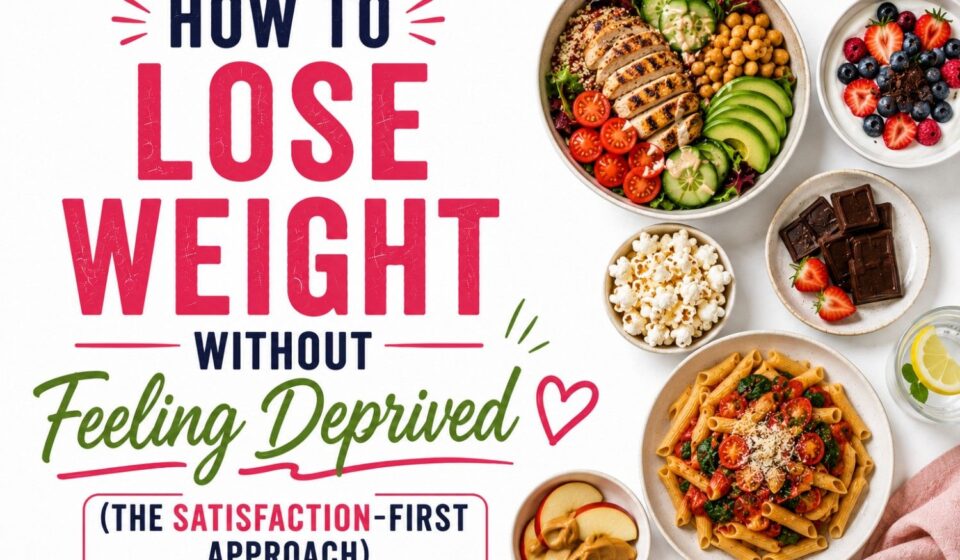

The most sustainable fat loss approach isn’t about eating less — it’s about eating smarter

Deprivation is why diets fail. Not lack of willpower, not lack of knowledge, not lack of motivation — deprivation. The persistent feeling of wanting more than you’re allowing yourself is what eventually breaks every restrictive approach.
The solution isn’t to want less. It’s to build a dietary approach where you feel genuinely satisfied — not just surviving on small portions of food you don’t enjoy — while still creating the calorie deficit that produces fat loss.
This is possible. Here’s how.
Why Deprivation Produces the Opposite of What You Want
When you feel deprived, your brain responds in predictable ways that undermine fat loss:
Forbidden foods become more appealing. Research consistently finds that restriction increases the psychological appeal of restricted foods — not decreases it. The harder you try not to think about pizza, the more you think about pizza.
Willpower depletes. The constant effort of resisting what you want is genuinely exhausting. Willpower is a limited daily resource, and spending it on continuous food restriction leaves less for every other area of life — and eventually runs out.
The all-or-nothing cycle triggers. Most people who feel deprived eventually crack — and when they do, the “I’ve already failed, might as well eat everything” response turns a minor dietary slip into a significant one.
Cortisol rises. The psychological stress of feeling deprived elevates cortisol — which directly promotes belly fat storage and impairs the fat loss you’re working toward.
The goal is to eliminate deprivation from the process — not by abandoning the deficit, but by meeting satisfaction needs in ways that don’t undermine it.
Principle 1: Eat More — Of the Right Things
The most counterintuitive approach to not feeling deprived while losing weight: eat more food. Just different food.
Calorie density — the calories per gram of food — varies enormously. 500 calories of leafy greens and protein requires eating an enormous amount of food. 500 calories of chips requires eating very little.
By shifting toward lower calorie density foods, you can eat a genuinely large volume of food — feel genuinely full and satisfied — while maintaining a calorie deficit.
The lowest calorie density foods (eat freely):
- Leafy greens and non-starchy vegetables — 5–50 calories per 100g
- Broth-based soups — 30–80 calories per serving
- Berries and most fruit — 40–80 calories per 100g
- Lean protein (chicken breast, white fish, shrimp) — high protein per calorie
- Greek yogurt and cottage cheese — high protein, moderate calories
The strategy: Start every meal with a large portion of low-calorie-density food first. A large salad before dinner, a bowl of vegetable soup before lunch, a cup of berries before the main course. This pre-fills the stomach before the calorie-dense parts of the meal — dramatically reducing how much of those you need to feel satisfied.
Principle 2: Prioritize Protein — The Most Satisfying Macronutrient
Protein is the single most important dietary change for eliminating deprivation from fat loss. It:
- Suppresses ghrelin (hunger hormone) more powerfully than carbohydrates or fat
- Stimulates satiety hormones (PYY, GLP-1) that produce genuine fullness
- Digests slowly — keeping you satisfied for 3–4 hours rather than 1–2
- Reduces cravings and late-night snacking
The practical effect: people eating high protein diets at the same calorie level as low protein diets consistently report significantly less hunger and greater dietary satisfaction.
As covered in our guide to how much protein you actually need per day, 0.7–1g per pound of bodyweight — at every meal — is the target. This single change often transforms the experience of fat loss from constant deprivation to genuine manageability.
High protein meals that feel genuinely satisfying:
- 3-egg omelette with vegetables and cheese
- Large Greek yogurt bowl with berries and a tablespoon of nut butter
- Grilled chicken salad with plenty of vegetables and olive oil dressing
- Cottage cheese with fruit and a handful of nuts
- Salmon with roasted vegetables
Principle 3: Include the Foods You Love — Strategically
Restriction of specific beloved foods is one of the primary drivers of diet deprivation. The solution isn’t to never eat the things you love — it’s to include them deliberately and strategically.
The planned inclusion approach:
Identify your highest-priority enjoyment foods — the foods whose absence would make a diet feel genuinely miserable. These could be chocolate, pasta, wine, cheese, bread, or anything else.
Include a planned, deliberate serving of these foods regularly — not as a “cheat” but as a scheduled, accounted-for part of your dietary approach.
A piece of good dark chocolate daily (150 calories) doesn’t derail fat loss — it prevents the deprivation that would eventually produce a 1,500-calorie chocolate binge.
A portion of pasta twice a week, eaten at the right calorie level, is compatible with fat loss and dramatically more sustainable than eliminating pasta entirely.
The key: plan the inclusion rather than eating impulsively. An impulsive serving doesn’t satisfy the same psychological need that a planned, anticipated, deliberately enjoyed serving does.
Principle 4: Eat Slowly and Without Distractions
This changes the experience of eating the same food dramatically.
When you eat slowly and without screens:
- Satiety hormones have time to register before you’ve overeaten
- You actually taste what you’re eating — extracting more enjoyment per calorie
- The meal feels more like an experience rather than a transaction
- You tend to feel genuinely satisfied from smaller portions
The same 400-calorie meal eaten in 8 minutes while watching television and eaten in 20 minutes at a table with attention produces different satiety responses. The slow, attentive version typically produces more satisfaction.
For people trying to avoid deprivation, eating more slowly is one of the most effective and free tools available. You’re not eating less — you’re getting more from what you eat.
Principle 5: Don’t Create Unnecessary Restrictions
One of the most common sources of diet deprivation is self-imposed unnecessary restrictions that aren’t actually required for fat loss.
“I can’t eat after 7pm.” Not required. “I can’t eat carbs.” Not required. “I can’t eat more than 1,200 calories.” Often too low. “I can’t eat fruit because of the sugar.” Not necessary. “I have to eliminate all processed food.” Not required.
Each unnecessary restriction adds to the psychological burden of the diet without producing proportional fat loss benefit. The only things genuinely required for fat loss are: a calorie deficit and adequate protein. Everything else is a preference or an optimization — not a requirement.
Eliminating unnecessary restrictions reduces the deprivation experience without reducing fat loss outcomes.
Principle 6: Build Genuinely Satisfying Meals — Not Just “Clean” Ones
“Clean eating” — plain chicken, plain rice, plain vegetables with no seasoning — is one of the most deprivation-inducing approaches available. Food that’s nutritious but genuinely unpleasant to eat creates misery without producing better fat loss than nutritious food that’s actually enjoyable.
Seasoning costs no calories. Herbs, spices, garlic, lemon juice, mustard, hot sauce — these transform plain food into something genuinely enjoyable at zero or minimal caloric cost.
A chicken breast with generous seasoning, roasted garlic, lemon, and herbs is no higher in calories than a plain boiled chicken breast — and produces an entirely different eating experience.
Investing time and effort into making healthy food genuinely delicious is not indulgence — it’s a survival strategy for long-term dietary adherence.
Principle 7: Address Hunger Between Meals Proactively
Deprivation often feels worst in the 1–2 hours before a meal when genuine hunger has built. Proactively managing this hunger prevents the desperate, deprived state that makes good food choices difficult.
Between-meal hunger strategies:
- A glass of water first — dehydration mimics hunger
- Black coffee or herbal tea — provide oral satisfaction and mild appetite suppression
- A small protein-rich snack if hunger is genuine — cottage cheese, Greek yogurt, hard-boiled eggs at 100–150 calories
- A short walk — changes environment and reduces hunger intensity
As covered in our guide to how to stop hunger while dieting, managing hunger proactively produces dramatically better dietary adherence than white-knuckling through intense hunger.
What Genuine Non-Deprivation Fat Loss Looks Like
A day of eating that produces fat loss without deprivation:
Breakfast: 3-egg omelette with mushrooms, spinach, and cheese + black coffee Genuinely satisfying, 30g protein, ~400 calories
Lunch: Large salad with grilled chicken, avocado, cherry tomatoes, cucumber, olive oil and lemon dressing Enormous volume, genuinely delicious, 35g protein, ~500 calories
Afternoon snack: Greek yogurt with berries and a square of dark chocolate Sweet, satisfying, 18g protein, ~200 calories
Dinner: Salmon with roasted vegetables and a small portion of pasta Complete, enjoyable, 40g protein, ~600 calories
Total: ~1,700 calories, ~123g protein
For most moderately active people, this represents a meaningful calorie deficit — while including real food, real flavors, genuine satisfaction at every meal, and even chocolate.
This is what fat loss without deprivation looks like. Not starvation. Not misery. Just structured, satisfying eating that happens to create a deficit.
The Bottom Line
Losing weight without feeling deprived requires:
- Eating more volume of low-calorie-density foods — vegetables, lean protein, broth soups
- Prioritizing protein at every meal — the most satisfying macronutrient
- Including the foods you love — planned, deliberate, and accounted for
- Eating slowly and with attention — more satisfaction from the same food
- Eliminating unnecessary restrictions — only what’s actually required for fat loss
- Making healthy food genuinely delicious — seasoning, preparation, and effort
- Managing hunger proactively — water, protein snacks, movement
The most sustainable fat loss approach is one you don’t dread continuing. Deprivation produces the opposite of that. Building genuine satisfaction into the process is not a compromise with fat loss — it’s a prerequisite for long-term success.
For the complete framework that produces fat loss without deprivation, our guide to how to get rid of belly fat covers everything in one place.
What’s made the biggest difference to how satisfied you feel while losing weight — a specific food, a meal structure, or a mindset shift? Share in the comments.