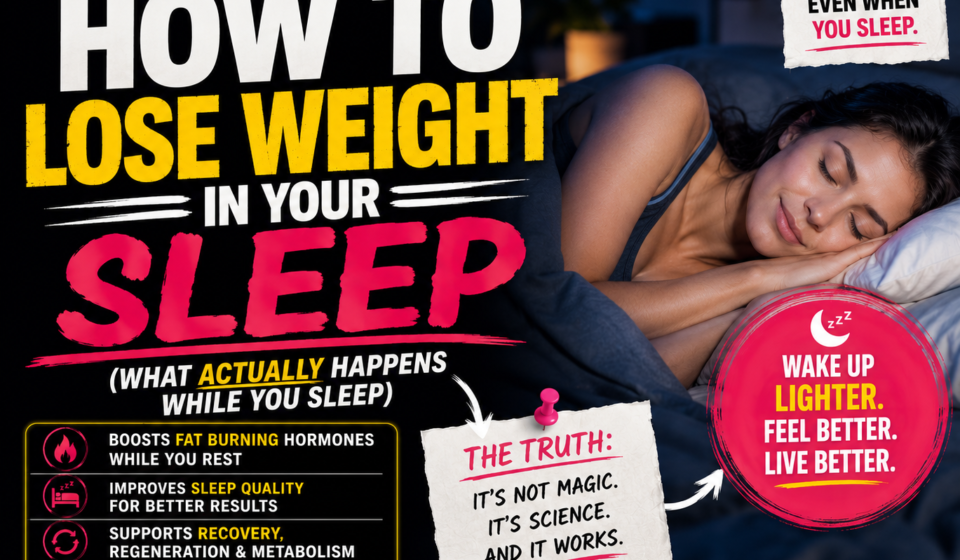
How to Lose Weight in Your Sleep (What Actually Happens While You Sleep)

Your body burns calories, regulates hormones, and determines whether you gain or lose fat while you sleep. Here’s how to optimize it.
“Lose weight in your sleep” sounds like the kind of promise you’d see on a late-night infomercial. But the biology behind it is real — your body is actively doing fat-loss-relevant work while you sleep, and the quality and quantity of that sleep dramatically affects your body composition in ways that most people completely underestimate.
This isn’t about magic tricks or metabolism-boosting teas. It’s about understanding what your body actually does during sleep — and making specific choices that optimize those processes for fat loss.

What Your Body Actually Does While You Sleep
Sleep isn’t passive recovery. It’s an active biological process with specific phases that perform specific functions — and several of them are directly relevant to fat loss.
Growth Hormone Release
The majority of your body’s growth hormone (GH) secretion occurs during the first few hours of deep sleep (slow-wave sleep). Growth hormone:
- Drives fat breakdown and mobilization — it directly stimulates lipolysis (the breakdown of stored fat for energy)
- Supports muscle protein synthesis — rebuilding and maintaining the lean muscle mass that drives resting metabolic rate
- Reduces the proportion of energy stored as fat
Poor sleep — particularly insufficient deep sleep — dramatically reduces GH secretion. Less GH means less fat breakdown overnight and less muscle preservation during a calorie deficit.
Cortisol Regulation
Cortisol — the stress hormone that promotes fat storage, particularly visceral belly fat — follows a specific daily rhythm. It should be lowest in the late evening and overnight, rising gradually to peak in the morning as a natural wake signal.
Sleep deprivation disrupts this rhythm — keeping cortisol elevated through the night when it should be suppressed. Chronically elevated overnight cortisol directly promotes abdominal fat storage and makes the body resistant to fat loss even when dietary intake is controlled.
Hunger Hormone Calibration
Your body calibrates the hunger and fullness hormones that govern the next day’s eating during sleep:
- Ghrelin (the hunger hormone) is suppressed during adequate sleep and surges with insufficient sleep
- Leptin (the fullness hormone) is restored during sleep and depleted by sleep deprivation
- Peptide YY and GLP-1 (additional fullness signals) are similarly affected by sleep quality
A single night of poor sleep measurably dysregulates these hormones — producing the ravenous hunger, poor food choices, and inability to feel satisfied after eating that characterize the day after a bad night.
Insulin Sensitivity Restoration
Insulin sensitivity fluctuates throughout the day, reaching its lowest point in the evening and being restored during sleep. Adequate sleep restores appropriate insulin sensitivity for the following day — meaning carbohydrates and calories are processed more efficiently and less fat is stored.
Sleep deprivation progressively worsens insulin sensitivity — after several nights of poor sleep, insulin resistance approaches levels seen in early prediabetes, dramatically promoting fat storage.
Calorie Burn During Sleep
Your body doesn’t stop burning calories when you sleep — BMR continues at roughly 80% of waking rate, burning approximately 50–80 calories per hour during sleep.
Over 8 hours, that’s 400–640 calories burned while you’re doing nothing — making sleep one of the more metabolically active periods of your day.
This calorie burn is maximized by:
- More deep sleep (higher metabolic demand)
- More lean muscle mass (higher overall BMR)
- Slightly cooler sleeping temperature (mild cold thermogenesis)
The Specific Things That Help You Lose More Fat While Sleeping
1. Eat Protein Before Bed
This is one of the most well-supported sleep-related fat loss strategies — and one of the most counterintuitive for people who’ve been told to avoid eating before bed.
Research specifically on casein protein (the slow-digesting protein in dairy) consumed 30–40 minutes before sleep has found:
- Enhanced overnight muscle protein synthesis
- Better muscle recovery and retention
- No meaningful increase in fat storage
- Some evidence of slightly elevated overnight metabolic rate
The muscle preservation effect matters enormously for fat loss — maintaining or building muscle keeps resting metabolic rate elevated, improving fat loss quality over time.
Best pre-sleep protein sources:
- Cottage cheese (the gold standard — very high in casein, slow-digesting)
- Greek yogurt (high casein content)
- Casein protein powder
- A small portion of chicken or fish
Aim for 25–40g of protein 30–60 minutes before sleep. Keep the overall calorie content modest — the goal is protein, not a full meal.
2. Sleep in a Cool Room
Body temperature and metabolism are intimately connected. Your core temperature must drop by approximately 1–2°F to initiate and maintain deep sleep — the most metabolically active and fat-loss-relevant sleep phase.
A cool sleeping environment (65–68°F / 18–20°C) facilitates this temperature drop, improving sleep quality and potentially activating brown adipose tissue (BAT) — a type of fat tissue that burns calories to generate heat.
Research has found that sleeping in a 66°F room for 4 weeks increased brown fat activity and improved insulin sensitivity compared to warmer sleeping conditions. The calorie-burning effect of mild cold exposure during sleep is modest but real.
Practically: turn the thermostat down at bedtime, use lighter bedding, and consider a cooling mattress pad or cooling pillow if you tend to sleep hot.
3. Sleep in Complete Darkness
Light exposure — even small amounts — during sleep suppresses melatonin production and disrupts the hormonal cascade that drives optimal overnight fat metabolism.

Melatonin does more than promote sleep — it has direct antioxidant and metabolic effects, and low melatonin levels are associated with increased obesity risk and impaired fat metabolism in research.
Blackout curtains, a sleep mask, and eliminating all light sources (including standby lights on electronics) maximize the melatonin-producing, metabolically optimal darkness that overnight fat loss requires.
4. Don’t Eat Right Before Bed (Mostly)
The exception above (protein before bed) aside, eating large meals or significant carbohydrates close to bedtime has several negative effects on overnight fat metabolism:
- Elevates insulin during the period when it should be lowest
- Raises body temperature during digestion, impairing the temperature drop needed for deep sleep
- Keeps the digestive system active when it should be in recovery mode
- Promotes fat storage during the overnight period rather than fat mobilization
The general guideline: finish eating (except for the optional protein snack) at least 2–3 hours before sleep. This aligns with the time-restricted eating approach covered in our article on whether intermittent fasting is worth it — the overnight fasting window promotes fat oxidation during sleep.
5. Exercise — But at the Right Time
Exercise raises overnight growth hormone release and improves sleep quality both directly and through the recovery demand it creates. People who exercise consistently sleep better and burn more fat overnight than sedentary individuals.
Timing considerations:
- Morning or afternoon exercise: generally optimal for circadian rhythm alignment and sleep quality
- Late evening vigorous exercise (within 2 hours of bed): can delay sleep onset for some people by raising body temperature and cortisol — though individual response varies significantly
If late-evening exercise is your only option, the benefits typically outweigh the timing drawback. Don’t skip exercise because you can only do it at 9pm. But if you have flexibility, earlier in the day is generally better for sleep quality.
As covered in our guide to best exercises to lose belly fat for beginners, the type of exercise matters too — strength training produces the muscle mass and GH response that maximizes overnight fat burning.
6. Manage Evening Stress
High cortisol at bedtime directly impairs the sleep quality and overnight hormonal processes that support fat loss. People who go to bed stressed have worse sleep architecture, less growth hormone release, and more overnight fat storage than those who’ve managed their stress effectively.
Evening wind-down practices that reduce cortisol before sleep:
- A short walk after dinner (lowers cortisol, improves blood sugar management, and prepares for sleep)
- Journaling or writing a to-do list for the next day (offloads mental burden)
- Limiting news and social media in the final hour before bed
- A warm bath or shower 1–2 hours before sleep (the subsequent temperature drop signals sleep onset)
- Breathing exercises (box breathing, 4-7-8 breathing) activate the parasympathetic nervous system
7. Limit Alcohol in the Evening
Alcohol is one of the most reliable disruptors of overnight fat-loss-relevant sleep physiology:
- Suppresses growth hormone release by up to 70% during the first half of sleep
- Fragments sleep architecture — more light sleep, less restorative deep sleep
- Keeps cortisol elevated through the night
- Impairs overnight fat oxidation
Even moderate alcohol (1–2 drinks) consumed in the evening measurably impairs sleep quality and overnight metabolic function. For people serious about maximizing overnight fat loss, limiting alcohol to earlier in the day (if at all) makes a meaningful difference.
8. Get Enough Sleep (The Most Important Factor)
All the above optimizations are secondary to one fundamental: actually sleeping long enough.
The hormonal benefits of sleep — GH release, hunger hormone calibration, insulin sensitivity restoration, cortisol suppression — are dose-dependent. You get more of them with 8 hours than with 6, and significantly more with 7–9 hours than with 5–6.
Research is unambiguous: people who consistently sleep 7–9 hours lose more fat (and less muscle) during a calorie deficit than those sleeping 5–6 hours — even on identical diets. As we cover extensively in our article on why sleep is the most underrated weight loss tool, sleep duration is one of the most powerful fat loss levers available.
The research on exactly how many hours produces optimal overnight fat loss consistently points to 7.5–9 hours for most adults. Under 7 hours starts producing measurable negative effects. Under 6 hours produces dramatic negative effects.
The Overnight Fat Loss Optimization Routine
Here’s what an evening optimized for overnight fat loss actually looks like:
7:00pm: Finish main dinner (protein-rich, moderate carbs, not too large) 7:15pm: 15-minute post-dinner walk (lowers cortisol, improves insulin sensitivity, promotes digestion) 8:00pm: Begin winding down — dim lights, reduce screen time 9:00pm: No more screens. Light reading, journaling, conversation 9:30pm: Optional: 25–30g casein protein snack (cottage cheese with berries, or Greek yogurt) 9:45pm: Bath or shower if desired (body temperature drop promotes sleep onset) 10:00pm: Bedroom — cool (66–68°F), completely dark 10:15pm: Sleep
During sleep (what your body is doing):
- Hours 1–3: Maximum growth hormone release → fat mobilization, muscle repair
- Hours 3–5: Sleep cycles continuing, cortisol rising slowly
- Hours 6–8: Lighter sleep, memory consolidation, hunger hormone calibration
Wake time: 6:15am → 8+ hours of optimized overnight fat metabolism
How Much Fat Can You Actually Burn Overnight?
Being realistic: the optimization strategies above can meaningfully improve overnight fat metabolism, but they’re not going to produce dramatic rapid results on their own.
What the improvements actually produce:
- Better preservation of muscle during fat loss (critical for long-term results)
- Reduced next-day hunger (making the day’s calorie control significantly easier)
- Improved insulin sensitivity (better fat utilization throughout the following day)
- 50–100 additional calories burned overnight through optimization (modest but real)
The compounding effect of better overnight fat metabolism — sustained over weeks and months — is significant. But the most important thing sleep does for fat loss isn’t the overnight calorie burn. It’s setting up the hormonal environment for a successful following day.
The Bottom Line
Your body does meaningful fat-loss-relevant work while you sleep — burning calories, releasing growth hormone, calibrating hunger hormones, and restoring insulin sensitivity. Optimizing this process involves:
- Eating protein before bed for muscle preservation and overnight repair
- Sleeping in a cool, dark room for better sleep quality and mild thermogenic benefit
- Finishing main meals 2–3 hours before sleep
- Managing evening stress actively
- Limiting evening alcohol
- Getting 7.5–9 hours consistently — the most important factor of all
None of these strategies replace the foundational fat loss work of diet, exercise, and lifestyle — but they genuinely optimize what your body does with the deficit and stimulus you create during your waking hours.
For the complete fat loss framework that sleep optimization supports most effectively, our guide to how to get rid of belly fat covers everything in one place.
What’s your biggest sleep challenge when it comes to weight loss — falling asleep, staying asleep, or just not getting enough hours? Share in the comments.
Stop Wondering What to Eat This Week
Get my free 7-Day High-Protein Weight Loss Meal Plan delivered straight to your inbox — a simple week of satisfying, protein-focused meals designed to make healthy eating easier without complicated calorie tracking.
- 7 full days of breakfast, lunch, dinner & snacks
- One complete shopping list for the whole week
- A quick high-protein food cheat sheet
- Simple daily tips to help you stay on track
Free PDF • Delivered by email • Unsubscribe anytime
Check your inbox 💜
Your free 7-day high-protein meal plan is on its way.