
The most sustainable calorie management tool that doesn’t require tracking apps or food scales
Portion control sits in a sweet spot that most weight loss approaches miss: it’s more precise than “eating healthy” but far less obsessive than calorie counting every meal. Done well, it creates a meaningful calorie deficit — the mechanism behind all fat loss — without turning every meal into a math problem.
The challenge: most people have no accurate sense of what a proper portion actually looks like. Restaurant portions are 2–3x larger than serving sizes. Packages contain 2–3 “servings” that most people eat in one sitting. And years of eating oversized portions recalibrate what “normal” looks like in a way that consistently undermines fat loss.
This guide gives you practical, immediately usable tools for managing portions — no food scale required.
Why Portion Sizes Have Gotten Out of Control
Understanding the problem helps fix it.
Restaurant portions have grown dramatically. A typical restaurant meal in 2024 contains 2–3x the calories of the same dish 40 years ago. The “portion distortion” of restaurant culture has reshaped what people perceive as a normal meal.
Package sizes are deceptive. A “single serving” on a nutrition label often bears no resemblance to how much most people eat. A bag of chips listed as “3 servings” gets eaten in one sitting. A pint of ice cream labeled as “4 servings” becomes one.
Large plates create large portions. Research by food psychologist Brian Wansink demonstrated that people consistently eat more when using larger plates — the visual cue of a full plate signals “this is one meal’s worth of food” regardless of actual quantity.
Eating while distracted increases portions. People eat 20–40% more when distracted by screens, as the sensory experience of eating doesn’t register fully and satiety signals are delayed.
Social eating increases portions. People eat more in groups — each additional person at a table increases average consumption. This isn’t moral weakness; it’s a well-documented social psychology phenomenon.
The Hand Portion Method — No Equipment Required
This is the most practical, always-available portion control tool in existence. Your hand is proportional to your body — naturally calibrating portions to your size.
Protein: One palm-sized portion per meal
- Approximately 3–4oz of meat, fish, or poultry
- One whole egg per palm (so 3 eggs for a palm-sized portion)
- Roughly 20–30g of protein
Vegetables: Two fist-sized portions per meal (minimum)
- Non-starchy vegetables are low enough in calories that generous portions are entirely appropriate
- Fill half your plate with vegetables as a rule
Carbohydrates: One cupped hand per meal
- Approximately half a cup of cooked grains, pasta, rice, or legumes
- One medium piece of fruit
- One slice of bread
Fats: One thumb-sized portion per meal
- One tablespoon of oil, nut butter, or butter
- A small handful of nuts (10–15 nuts approximately)
- One-quarter of an avocado
For fat loss: 1 palm protein + 2 fists vegetables + 1 cupped hand carbs + 1 thumb fat per meal. Three meals per day with this structure produces a meaningful deficit for most people without any tracking.
This method isn’t perfectly precise — but it’s consistently more accurate than eyeballing, available at every meal including restaurants, and self-adjusting for body size.
The Plate Method — Visual Portion Control
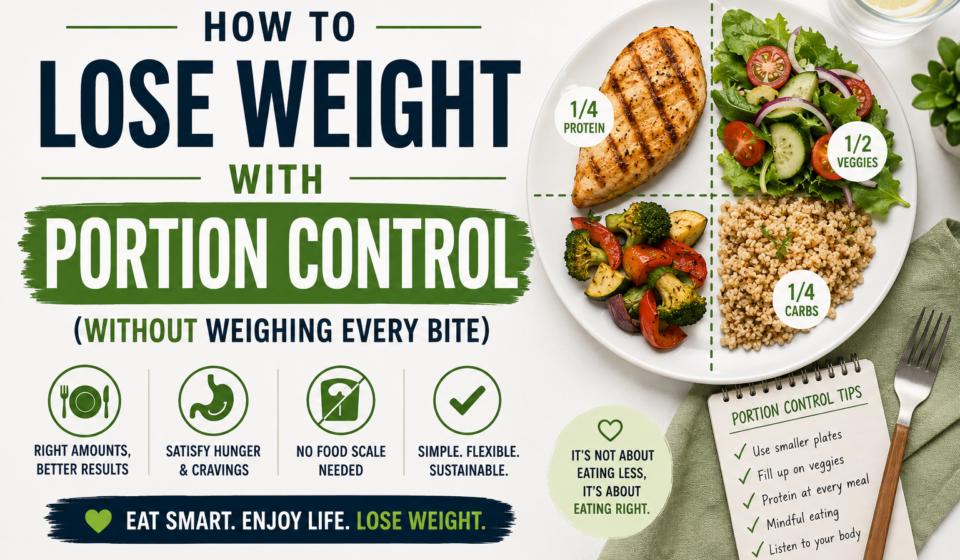
The plate method is used by nutritionists and diabetes educators worldwide because it’s simple, visual, and immediately applicable without any tools.
The division:
- Half the plate: Non-starchy vegetables (salad, broccoli, spinach, peppers, zucchini, green beans)
- Quarter of the plate: Lean protein (chicken, fish, eggs, legumes, tofu)
- Quarter of the plate: Quality carbohydrates (whole grain, potato, rice, pasta, fruit)
- On the side: A small amount of healthy fat (olive oil dressing, small handful of nuts)
This structure naturally manages calorie density — vegetables are so low in calories that filling half your plate with them significantly reduces the calorie content of any meal without requiring calculation.
Research consistently shows that people who use the plate method eat fewer calories, more fiber, and more protein than those who plate food intuitively — without any calorie counting.
For weight loss: The plate method combined with appropriately sized plates (more on this below) produces a natural calorie deficit for most people.
The Container/Plate Size Effect
Plate size directly influences how much people eat — and changing it requires no willpower or tracking.
Studies have found that switching from a 12-inch dinner plate to a 9-inch salad plate reduces serving sizes by 22% — without people feeling less satisfied. The visual cue of a full smaller plate signals the same “complete meal” message as a full larger plate.
Practical changes:
- Use salad plates or side plates instead of dinner plates for main meals
- Use smaller bowls for cereal, pasta, and rice
- Use tall, narrow glasses rather than short, wide ones for beverages (people pour and drink more from wide glasses)
- Pre-portion snacks into small bowls rather than eating from bags
These environmental changes work passively — they don’t require conscious decision-making in the moment, which is when willpower most frequently fails.
Restaurant Portion Control Strategies
Restaurants are the most challenging environment for portion control — portions are designed for satisfaction and return visits, not your calorie deficit.
Before the meal:
- Review the menu online before arriving and decide what you’ll order while not hungry
- Drink a full glass of water before any food arrives
- Ask the server not to bring the bread basket
When ordering:
- Order a starter-sized portion as your main where available
- Ask for half portions if the restaurant offers it
- Order protein and vegetables as the main components, ask for the starchy side separately or reduced
When the food arrives:
- Immediately box half your meal to take home before eating
- This removes the visual cue of a full plate that drives eating beyond fullness
- You have lunch for tomorrow and ate an appropriately sized dinner
The “half and half” rule: Eat half of whatever is served, pause, assess genuine hunger, then decide whether to continue. This simple pause catches the 15–20 minute delay in satiety signaling that causes most restaurant overeating.
Portion Control for Specific Problem Foods
Some foods are particularly difficult to portion control because they’re highly palatable, calorie-dense, and easy to eat mindlessly:
Nuts: Pre-portion into small containers or bags (28g/1oz per serving) at the start of the week. Never eat from a large jar or bag directly.
Cheese: Use a kitchen scale once to understand what 30g (a typical serving) looks like — it’s smaller than most people expect. Use this visual reference going forward.
Olive oil and cooking oils: Use a spray bottle rather than pouring from a bottle. One second of spray = approximately 1g of oil (9 calories) vs. a pour which easily delivers 2–3 tablespoons (240–360 calories).
Pasta and rice: Cook a measured amount rather than cooking a large pot and serving from it. Dry pasta measured before cooking: 75–85g is one serving (approximately one cup cooked).
Alcohol: Use a measuring cup once to understand what 150ml of wine (one standard drink) looks like in your glass — most people pour 250–300ml thinking it’s “one glass.”
Ice cream: Pre-scoop individual portions into small containers and freeze rather than eating from the carton.
The Eating Slowly Strategy — Portion Control Without Portions
One of the most effective and least discussed portion control strategies isn’t about the amount of food you serve — it’s about how fast you eat it.
Satiety hormones — leptin, peptide YY, GLP-1 — take 15–20 minutes to register in the brain after eating begins. People who eat quickly consistently consume significantly more before feeling full than people who eat slowly.
Slow eating strategies:
- Put utensils down between every bite
- Chew each bite thoroughly (20–30 chews for dense foods)
- Take a 2-minute pause halfway through any meal
- Never eat while looking at a screen
- Aim for meals to take at least 20 minutes
These behavioral changes reduce meal calorie intake by 15–20% in research — without changing what’s on the plate. Combined with appropriate portion sizes, the effect is substantial.
Portion Control and Hunger — Managing the Gap
The most common objection to portion control: “I’m still hungry after a controlled portion.”
This is real — particularly in the early weeks before the stomach adapts to smaller volumes. These strategies address it:
Eat more volume, not more calories. The solution to post-meal hunger is usually more vegetables, not more of everything. A plate with double the vegetables at the same protein and carb portion provides more physical fullness at almost identical calorie cost.
Prioritize protein. Protein is the most satiating macronutrient per calorie. A portion-controlled meal centered on protein (one palm-size) produces more satiety than the same calories in carbohydrates. As covered in our guide to how much protein you actually need per day, this is the most impactful single dietary change for managing hunger.
Wait 20 minutes before deciding you’re still hungry. The satiety signal delay means hunger felt immediately after a meal often resolves without additional food. Drink a glass of water and wait before reaching for more.
Plan a structured snack. Planned high-protein snacks (Greek yogurt, cottage cheese, hard-boiled eggs) between meals prevent the ravenous hunger that makes portion control impossible at the next meal.
As covered in our article on why you’re always hungry, persistent post-meal hunger is often about protein and fiber inadequacy — not portion size.
Portion Control in Practice: A Day of Eating
Here’s what portion-controlled eating actually looks like throughout a day:
Breakfast:
- 3 eggs scrambled (palm-sized protein)
- Large handful of spinach and mushrooms cooked in (2 fists vegetables)
- 1 slice whole grain toast (cupped hand carb)
- ½ avocado (thumb fat)
- Black coffee
Lunch:
- Large salad (2+ fists of greens)
- 1 palm grilled chicken
- ½ cup chickpeas (cupped hand carb)
- 1 tablespoon olive oil dressing (thumb fat)
- Cucumber and tomatoes (essentially free calories)
Snack:
- 1 cup Greek yogurt (palm protein)
- Handful of berries
Dinner:
- 1 palm salmon fillet
- 2 fists roasted broccoli and zucchini
- ½ cup quinoa (cupped hand carb)
- 1 tablespoon olive oil used in cooking
Total: Approximately 1,600–1,800 calories for a moderately sized adult — a meaningful deficit for most people without a single calorie counted.
Combining Portion Control With Other Strategies
Portion control works best as part of a broader approach:
With the calorie deficit approach — portion control is one of the most effective non-tracking methods for creating the deficit described in our guide to how to lose weight with a calorie deficit. The hand method approximates the deficit without requiring precise calculation.
With high-protein eating — prioritizing protein within your portions (palm-sized at every meal) makes portion control more effective by maximizing satiety per calorie.
With the food environment strategies from our article on how to lose weight without counting calories — smaller plates, pre-portioned snacks, and removed temptations make portion control passive rather than willpower-dependent.
With mindful eating — slow eating, no screens during meals, and attention to hunger and fullness signals extend and deepen the effects of physical portion control.
The Bottom Line
Portion control is one of the most sustainable, flexible, and practical tools for weight loss — sitting between the imprecision of “eating healthy” and the burden of calorie counting every bite.
The most useful tools: the hand method for immediate, equipment-free portioning; the plate method for visual meal construction; smaller plates for passive calorie reduction; and slow eating for catching satiety signals before overeating.
These tools don’t require apps, scales, or perfect discipline — they work through awareness and environment design in ways that most people can genuinely sustain long-term.
For the complete fat loss framework that portion control supports most effectively, our guide to how to get rid of belly fat covers all the foundational strategies in one place.
What’s your biggest portion control challenge — restaurant meals, snacking, or just not knowing what a proper portion looks like? Share in the comments.
Stop Wondering What to Eat This Week
Get my free 7-Day High-Protein Weight Loss Meal Plan delivered straight to your inbox — a simple week of satisfying, protein-focused meals designed to make healthy eating easier without complicated calorie tracking.
- 7 full days of breakfast, lunch, dinner & snacks
- One complete shopping list for the whole week
- A quick high-protein food cheat sheet
- Simple daily tips to help you stay on track
Free PDF • Delivered by email • Unsubscribe anytime
Check your inbox 💜
Your free 7-day high-protein meal plan is on its way.