How to Lose Weight Without Exercise (What Diet Alone Can Actually Achieve)

Can’t exercise? Don’t want to? Here’s what’s possible through diet and lifestyle alone.

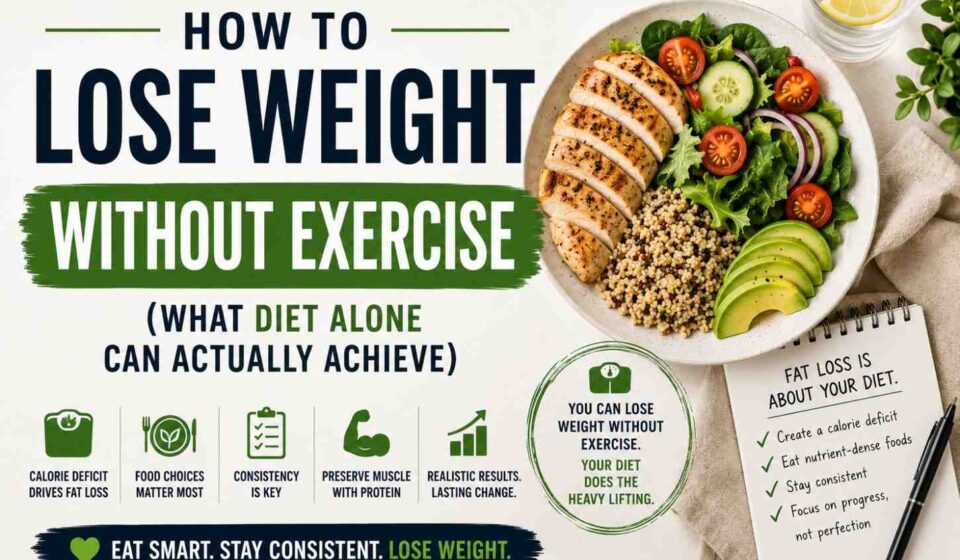
Exercise is valuable for fat loss — but it’s not the most important factor. Nutrition drives approximately 70–80% of weight loss results. This means that for people who can’t exercise due to injury, disability, chronic illness, or simply preference, meaningful fat loss is entirely achievable through dietary and lifestyle changes alone.
This article covers exactly what’s possible without exercise, the strategies that produce the best results, and the lifestyle factors that make a significant difference even without a single formal workout.
The Honest Context: What Exercise Contributes
Before diving into diet-only strategies, it’s worth being clear about what exercise actually contributes to fat loss — and therefore what you’re working without.
Exercise contributes:
- Additional calorie burn during sessions
- Muscle building that raises resting metabolic rate
- Improved insulin sensitivity
- Better sleep quality
- Reduced cortisol over time
- Improved mood and motivation
Losing these contributions means fat loss happens more slowly and the body composition outcome (how toned and defined you look at a given weight) is less favorable than with exercise. But fat loss absolutely still happens through dietary changes alone.
The good news: many of the benefits exercise provides — improved insulin sensitivity, better sleep, reduced cortisol — can also be achieved partially through diet, sleep, and stress management strategies.
Strategy 1: Create a Calorie Deficit Through Diet
This is the entire mechanism of diet-only fat loss. Without exercise adding to calorie expenditure, the deficit must come entirely from eating less than your body burns at rest and through daily movement.
As covered in our guide to how to lose weight with a calorie deficit, a moderate deficit of 400–500 calories below your maintenance produces 0.5–1 lb of fat loss per week — entirely through dietary changes.
For someone without exercise, maintenance calories are lower than for an active person — which means the calorie target needs to reflect a sedentary TDEE:

Sedentary TDEE = bodyweight (lbs) × 14
For a 170 lb sedentary person: 170 × 14 = 2,380 calories maintenance Fat loss target: 2,380 – 400 = ~1,980 calories per day
This is a meaningful amount of food — not starvation — and produces real, consistent fat loss without a single formal workout.
Strategy 2: Make Every Calorie Count With Protein
Without exercise to stimulate muscle protein synthesis and preserve lean mass, adequate protein becomes even more critical than in an exercise-inclusive fat loss approach.
During a calorie deficit without strength training, the body is more likely to use muscle tissue for energy. High protein intake is the primary signal that tells the body to preserve muscle and burn fat instead.
Target: 0.7–1g per pound of bodyweight distributed across meals. Every meal should be built around a protein source — eggs, chicken, fish, Greek yogurt, cottage cheese, legumes, tofu.
As covered in our guide to how much protein you actually need per day, this is the single most important dietary variable for body composition during fat loss — and it’s particularly crucial without exercise.
Strategy 3: Maximize Satiety Within the Calorie Budget
Without exercise, the calorie budget is more limited. This makes satiety management more important — you need each calorie to work as hard as possible for hunger control.
The most satiating dietary approach:
Protein first — the most satiating macronutrient per calorie. Building every meal around a palm-sized portion of protein extends post-meal fullness significantly.
High fiber from vegetables and legumes — fiber is the second most powerful satiety tool. Non-starchy vegetables have so few calories they’re essentially free — filling half your plate with them adds bulk and fiber without meaningfully adding to your calorie count.
Minimal liquid calories — drinks that contain calories (juice, soda, alcohol, sweetened coffee) provide essentially no satiety for their calorie cost. Replacing them with water, black coffee, or unsweetened tea effectively adds calorie budget without reducing fullness.
Eliminate processed snacks — engineered to be easy to overeat, low in protein and fiber, and high in calorie density. Replacing them with protein-rich snacks (Greek yogurt, hard-boiled eggs, cottage cheese) produces far better satiety per calorie.
Strategy 4: Prioritize Sleep — It Does More Work Without Exercise
Sleep is always important for fat loss — but it becomes disproportionately important without exercise, because you lose exercise’s ability to improve the hormonal environment that supports fat loss.
Sleep provides:
- Growth hormone release (supports fat mobilization overnight)
- Hunger hormone calibration (ghrelin and leptin)
- Insulin sensitivity restoration
- Cortisol clearance
Without exercise providing additional hormonal benefits throughout the day, sleep carries more of this metabolic work. Seven to nine hours of quality sleep is non-negotiable for diet-only fat loss.
As covered in our comprehensive article on why sleep is the most underrated weight loss tool, sleep deprivation produces the same physiological obstacles to fat loss whether you exercise or not — and without exercise providing some counterbalancing benefits, the impact is more pronounced.
Strategy 5: Manage Stress — Even More Important Without Exercise
Exercise is one of the most effective cortisol management tools available. Remove it and you lose that cortisol-reducing benefit — making active stress management more essential.
Chronically elevated cortisol promotes fat storage (particularly visceral belly fat), worsens insulin sensitivity, and increases hunger for calorie-dense foods. Without exercise to counter these effects, dietary fat loss is harder in a high-stress environment.
Cortisol management without exercise:
- Daily walks (even short ones — more on this below)
- Breathing exercises and meditation
- Adequate sleep
- Social connection
- Reducing unnecessary stressors
Strategy 6: Walk — The One “Exercise” Worth Including
Even if formal exercise isn’t possible or desired, walking deserves special mention — it’s barely exercise in the conventional sense, requires no fitness base, and has enormous fat loss value.
A 20-minute daily walk:
- Burns an additional 100–150 calories
- Significantly reduces cortisol
- Improves insulin sensitivity
- Supports sleep quality
- Contributes meaningfully to daily step count
For people with physical limitations, even short walks — 5–10 minutes — provide metabolic and hormonal benefits. For people who are choosing not to exercise rather than unable to, walking is the minimum worth considering.
As covered in our guide to how to lose weight by walking, walking is the most underrated fat loss tool available — and it’s accessible to almost everyone regardless of fitness level.
Strategy 7: Improve Insulin Sensitivity Through Diet
One of exercise’s key contributions is improving insulin sensitivity. Without it, the dietary approach needs to work harder on this front.
The most effective dietary strategies for insulin sensitivity:
Reduce refined carbohydrates and added sugar — the most direct dietary intervention. As covered in our article on what happens when you cut sugar for 30 days, reducing sugar intake produces measurable insulin sensitivity improvements within weeks.
Prioritize low glycemic foods — lentils, legumes, non-starchy vegetables, berries, whole grains over refined carbohydrates.
Eat protein and fat with carbohydrates — slows absorption and reduces the insulin response to any carbohydrate-containing meal.
Intermittent fasting — the fasting window lowers insulin levels and improves insulin sensitivity through time-restricted eating rather than exercise. As covered in our article on whether intermittent fasting is worth it, this is a particularly relevant tool for people not exercising.
What to Eat: A Day of Diet-Only Fat Loss Eating
Here’s what a day optimized for fat loss without exercise looks like:
Breakfast: 3 scrambled eggs with spinach and tomatoes. Black coffee. High protein, high volume, minimal carbs — sets up a satiated morning without contributing much to the day’s calorie budget.
Mid-morning: Plain Greek yogurt with berries and chia seeds. Additional protein and fiber to extend morning satiety.
Lunch: Large salad with grilled chicken, cucumber, cherry tomatoes, half an avocado, and olive oil and lemon dressing. High protein, high volume, good fat — genuinely filling lunch.
Afternoon: Hard-boiled egg and a small apple. Small, protein-anchored snack that prevents afternoon hunger without excessive calories.
Dinner: Baked salmon with a large portion of roasted broccoli and cauliflower, small amount of quinoa. Omega-3s, high fiber, complete protein, moderate carbs.
Total: Approximately 1,500–1,700 calories — a meaningful deficit for a sedentary person while being genuinely satisfying due to the protein and fiber content throughout the day.
Realistic Expectations for Diet-Only Fat Loss
Without exercise, fat loss is entirely achievable — but with some important caveats:
Rate of loss: With diet alone, 0.5–1 lb per week is realistic for most people. Slower than exercise-inclusive approaches but absolutely meaningful over months.
Body composition: Without strength training, some muscle may be lost alongside fat — particularly at more aggressive deficits. High protein intake mitigates this significantly.
Maintenance: Without the muscle-building effects of exercise, maintaining weight loss requires ongoing dietary discipline — there’s less metabolic “buffer” from muscle mass.
Health outcomes: Exercise provides health benefits beyond weight loss — cardiovascular health, bone density, mental health — that diet alone doesn’t replicate. For people who are medically able to exercise even minimally, some form of movement is worth including for overall health even if fat loss is the primary goal.
When Exercise Isn’t Possible: Special Situations
Injury or surgery recovery: Focus entirely on dietary strategies during recovery. Even bed-bound patients lose fat with adequate dietary deficit. As healing progresses, reintroduce movement starting with what’s medically permitted.
Chronic pain or disability: Many exercise forms are adaptable — chair-based workouts, water-based exercise (swimming, water aerobics), and very light resistance training are accessible to people with significant physical limitations. Work with a physiotherapist to find what’s possible.
Severe fatigue (chronic illness, ME/CFS): Diet is the appropriate primary focus. Overexertion can worsen underlying conditions. Medical guidance on any exercise is important.
Postpartum (very early): Rest and recovery are the priority. Dietary approaches and short gentle walks are appropriate before medical clearance for exercise. As covered in our article on how to lose belly fat after pregnancy, the first 6 weeks postpartum are for healing, not fat loss.
When Diet Alone Isn’t Moving the Needle
If you’ve been consistent with the dietary strategies above for 3+ months and results are minimal — particularly if you’re unable to exercise due to a medical condition — it may be worth exploring whether there’s a clinical component to your resistance.
Some people’s bodies store fat more aggressively due to hormonal imbalances, insulin resistance, or other metabolic factors that dietary changes alone can’t fully address. This is especially common in people who are unable to exercise, since movement plays an important role in regulating these processes.
ClinicSecret is a telehealth weight loss program that connects you with licensed doctors who evaluate whether prescription weight loss medication — including GLP-1 based treatments that improve insulin sensitivity and reduce appetite — might be appropriate for your situation.
For people who can’t exercise, GLP-1 medications are particularly relevant because they address some of the same metabolic pathways that exercise would normally improve — insulin sensitivity, appetite regulation, and fat storage hormones.
How it works:
- Complete an online medical consultation from home
- A licensed doctor reviews your case
- If medication is medically appropriate, a prescription is issued
- If it’s not the right fit, you’re told honestly
[Check if you qualify at ClinicSecret →]
This is a paid partnership. ClinicSecret is a licensed telehealth provider. Medication is only prescribed following a medical consultation and is not guaranteed.
The Bottom Line
Fat loss without exercise is entirely achievable — diet drives 70–80% of results, and that majority is fully accessible without a single formal workout.
The strategies that work:
- A moderate calorie deficit from dietary changes alone
- High protein at every meal to preserve muscle without exercise stimulus
- Maximum satiety per calorie through protein, fiber, and eliminated liquid calories
- Seven to nine hours of sleep to compensate for lost exercise hormonal benefits
- Active stress management to replace exercise’s cortisol-reducing effects
- Daily walking where at all possible — even short walks matter
- Low glycemic, insulin-sensitive dietary choices to compensate for lost exercise insulin sensitivity benefits
Fat loss through diet alone is slower and produces somewhat less favorable body composition than diet plus exercise — but it’s real, meaningful, and entirely within reach for anyone who commits to the dietary strategies consistently.
For the complete fat loss framework including all dietary strategies, our guide to how to get rid of belly fat covers everything in one place.
Are you currently unable to exercise — or choosing not to? Share what’s working for you in the comments. Diet-only fat loss has its own community of experience worth sharing.