

The most widely used health measurement in the world — and one of the most misunderstood

BMI — Body Mass Index — is everywhere. Doctors use it. Insurance companies use it. Weight loss apps calculate it automatically. Public health systems classify populations by it.
And yet BMI is also one of the most criticized health metrics in medicine — with valid criticisms that are worth understanding if you’re using it to track your own progress or assess your health.
This guide gives you the honest truth about what BMI actually measures, where it’s useful, where it fails, and what better alternatives exist.
What BMI Actually Is
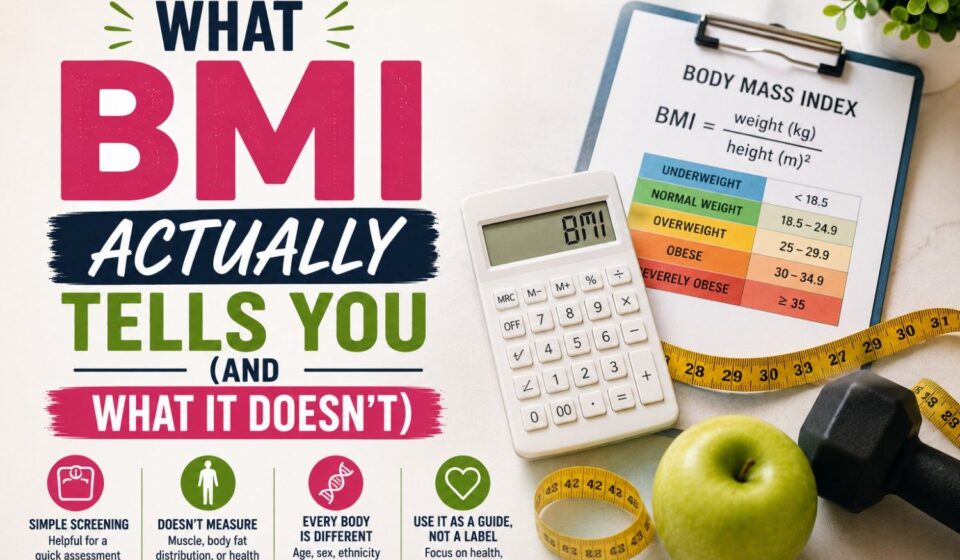
BMI is a simple calculation: weight in kilograms divided by height in meters squared.
BMI = weight (kg) ÷ height (m)²
Or in imperial: BMI = (weight in lbs × 703) ÷ height in inches²
The standard BMI categories:
- Under 18.5: Underweight
- 18.5–24.9: Normal weight
- 25–29.9: Overweight
- 30–34.9: Obese (Class I)
- 35–39.9: Obese (Class II)
- 40+: Severely obese (Class III)
BMI was developed by Belgian mathematician Adolphe Quetelet in the 1830s — not as a clinical tool for individual health assessment, but as a statistical measure for describing populations. It was later adopted by medicine as a convenient proxy for body fatness.
Where BMI Is Useful
Despite its limitations, BMI provides real, practical value in specific contexts:
Population-Level Health Assessment
At the population level, BMI correlates reasonably well with body fat percentage and health outcomes. Higher average BMI in a population is associated with higher rates of cardiovascular disease, type 2 diabetes, and metabolic syndrome. This correlation makes BMI a useful epidemiological tool.
Tracking Individual Progress Over Time
For an individual, BMI changes in the same direction as body fat during weight loss — even if the absolute number doesn’t perfectly represent body fatness. If your BMI goes from 32 to 28 over 12 months, you’ve meaningfully reduced your body weight and almost certainly your body fat.
Identifying Extreme Cases
BMI is more accurate at the extremes — very high BMI (above 35) and very low BMI (below 17) reliably identify people at significantly elevated health risk. The middle ranges (25–32) are where the most misclassification occurs.
Quick Clinical Screening
BMI requires only height and weight — information immediately available in any clinical encounter. For a rapid initial screen to identify people who may warrant further assessment, it’s a practical tool.
Where BMI Fails — The Real Limitations
It Doesn’t Distinguish Muscle From Fat
This is the most significant limitation. BMI measures total body weight relative to height — it has no way to distinguish whether that weight is muscle, fat, bone, or water.
The result: People with very high muscle mass are classified as “overweight” or “obese” despite having low body fat and excellent metabolic health. Many elite athletes, bodybuilders, and highly active people are technically “obese” by BMI despite being among the healthiest people on the planet.
Conversely, people with very little muscle but high body fat — “skinny fat” or normal weight obesity — are classified as “normal weight” despite having metabolic health profiles associated with significantly elevated disease risk.
It Doesn’t Account for Fat Distribution
Where fat is stored matters as much as how much fat there is. Visceral fat (around organs) drives metabolic disease; subcutaneous fat (under the skin) is much less dangerous.
Two people with identical BMIs can have dramatically different visceral fat levels — and dramatically different health risks — depending on where their fat is distributed. BMI captures none of this information.
It Doesn’t Account for Age
Body composition changes with age — muscle decreases and fat increases, typically without significant weight change. An older adult at a BMI of 24 may have significantly more fat and less muscle than a younger adult at the same BMI.
BMI categories were developed primarily based on younger adult populations and don’t adjust for the normal body composition changes of aging.
It Doesn’t Account for Sex
Women naturally carry more body fat than men at the same BMI — because essential fat for reproductive function is higher in women. A woman at BMI 24 and a man at BMI 24 have different body compositions, but BMI treats them identically.
It Doesn’t Account for Ethnicity
The BMI categories were developed based on predominantly white European populations. Research has found that people of Asian descent have higher metabolic risk at lower BMIs — the World Health Organization has suggested lower BMI cutoffs for Asian populations (overweight at 23 rather than 25). People of African descent may have higher muscle mass at equivalent BMIs.
The “Healthy Obese” and “Unhealthy Normal” Paradox
These BMI limitations produce real clinical paradoxes:
Metabolically healthy obesity: Some people classified as “obese” by BMI have normal blood pressure, cholesterol, blood sugar, and inflammatory markers — and carry lower cardiovascular risk than their BMI would predict.
Normal weight metabolic syndrome: Some people classified as “normal weight” by BMI have elevated blood pressure, poor blood sugar regulation, high triglycerides, and elevated cardiovascular risk — because they carry significant visceral fat despite low total weight.
Research suggests approximately 30% of people classified as “normal weight” by BMI have metabolic abnormalities, while 15–25% of people classified as “obese” are metabolically healthy.
This doesn’t mean obesity is harmless — at the population level, higher BMI is clearly associated with worse health outcomes. But at the individual level, BMI alone is an insufficient basis for health assessment.
Better Measurements Than BMI
Waist Circumference
Waist circumference directly measures abdominal girth — a proxy for visceral fat accumulation. It’s simple, cheap, and more predictive of metabolic health outcomes than BMI for most people.
Risk thresholds:
- Men: above 40 inches (102 cm) — elevated risk
- Women: above 35 inches (88 cm) — elevated risk
Waist circumference should be measured at the narrowest point of the torso (typically just above the belly button), without sucking in.
Waist-to-Height Ratio
Waist circumference divided by height — the result should ideally be below 0.5 for most adults. Research suggests waist-to-height ratio is more predictive of cardiovascular risk than BMI across different ethnic groups.
Simple rule: Your waist circumference should be less than half your height.
Body Fat Percentage
Actual body fat percentage — measured by DEXA scan, hydrostatic weighing, or BodPod — provides the most accurate picture of body composition. These methods are more expensive and less accessible than BMI or waist circumference, but provide genuine insight into fat vs. lean mass.
Rough reference ranges:
- Men: 6–17% (athletic-fit), 18–24% (acceptable), 25%+ (excess fat)
- Women: 14–24% (athletic-fit), 25–31% (acceptable), 32%+ (excess fat)
Consumer body fat scales (bioelectrical impedance) are less accurate but track trends over time — useful for monitoring direction of change even if absolute accuracy is limited.
The Metabolic Panel — The Most Important Assessment
Blood markers provide a more complete picture of actual health risk than any body measurement:
- Fasting glucose and HbA1c (blood sugar regulation)
- Fasting insulin (insulin resistance)
- Full lipid panel (LDL, HDL, triglycerides)
- Blood pressure
- C-reactive protein (inflammation)
These markers tell you whether your weight is actually affecting metabolic health — which BMI cannot. Two people at identical BMI with different metabolic panels have dramatically different actual health risk profiles.
What This Means for Your Weight Loss Journey
Don’t Obsess Over Reaching a Specific BMI
A target BMI of 24.9 isn’t inherently healthier than 26 — particularly if you’re building muscle alongside losing fat. Body composition improvement matters more than hitting a BMI category.
Use Multiple Measures
Track waist circumference monthly alongside scale weight. Monitor blood markers periodically. Notice energy levels, fitness improvements, and how clothes fit. These together tell a more complete story than BMI alone.
BMI Is a Starting Point, Not a Verdict
If your BMI is in the “obese” range, it’s a signal worth taking seriously — not because BMI is perfect, but because at the population level, higher BMI is associated with real health risks. Use it as a starting point for further assessment, not as a definitive judgment.
If your BMI is “normal” but you have a large waist circumference, poor blood sugar, high triglycerides, or low HDL — these metabolic markers matter more than the BMI classification.
The Bottom Line
BMI is a simple, imperfect tool that’s useful for population-level assessment and as a rough individual tracking metric — but fails to capture body composition, fat distribution, age, sex, and ethnicity differences that significantly affect actual health risk.
What BMI tells you: A rough, convenient indicator of whether your weight is appropriate for your height — with significant limitations at the individual level.
What BMI doesn’t tell you: How much of your weight is fat vs. muscle, where your fat is distributed, or what your actual metabolic health status is.
Better measures: Waist circumference, waist-to-height ratio, body fat percentage, and metabolic blood markers together provide a far more complete picture of actual health and cardiovascular risk than BMI alone.
For tracking weight loss progress specifically, our guide to how long does it take to see weight loss results covers the full range of progress measures that tell a more complete story than any single number.
For the complete framework that supports genuine health improvement alongside weight loss — not just BMI reduction — our guide to how to get rid of belly fat covers everything in one place.
Has your BMI ever classified you as “overweight” or “obese” in a way that felt inaccurate to your actual health? Share in the comments — this is a conversation worth having.