
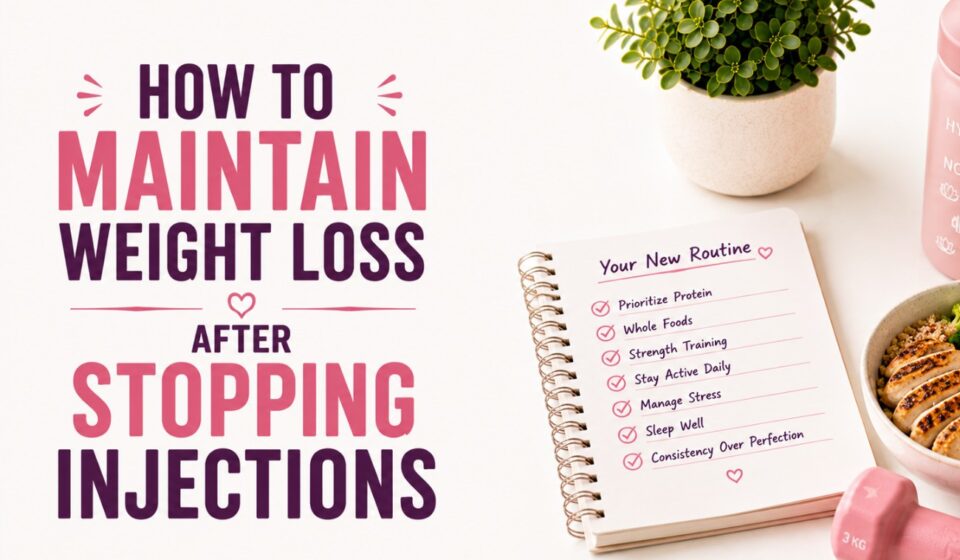

The honest guide to keeping the weight off when the medication ends — what the evidence shows and what actually works
Maintaining weight loss after stopping GLP-1 medications is one of the most challenging aspects of this treatment — and one of the most important conversations to have before starting, not after stopping.
As covered in our guide to what happens when you stop weight loss injections, the clinical trial data is clear: most people regain significant weight after stopping — approximately two-thirds of lost weight returns within 12 months for the average person.
But “average” doesn’t mean “inevitable.” People who take the right steps during treatment — and after stopping — maintain meaningfully more weight loss than those who don’t. Here’s what the evidence shows about what actually works.
Understanding Why Maintenance Is Hard
Before strategies — understanding why maintenance is difficult changes how you approach it.
The Biological Reality
GLP-1 medications work by compensating for what appears to be deficient or insufficient GLP-1 signaling in people with obesity. When the medication stops:
- Hunger hormones (ghrelin) return to pre-medication levels — often within days
- The “food noise” that was silenced returns
- Appetite for calorie-dense foods recovers
- Portion sizes that felt excessive on medication feel normal again
This isn’t psychological weakness. It’s the predictable biological consequence of removing a medication that was managing a chronic hormonal condition.
The Metabolic Reality
Weight loss itself — regardless of method — reduces resting metabolic rate:
- A lighter body burns fewer calories at rest
- Muscle lost during weight loss further reduces metabolic rate
- Adaptive thermogenesis (the body actively reducing energy expenditure to defend against weight loss) persists for years after significant weight loss
The result: the person who lost 40 lbs needs fewer calories to maintain their new weight than someone who was always that weight. When hunger returns at pre-medication levels and metabolic rate is lower, the conditions for weight regain are significant.
What This Means Practically
Maintenance after stopping GLP-1 medications is genuinely harder than maintenance after equivalent weight loss through diet and exercise — because the medication was doing significant hunger management work that the person now has to do themselves.
This is not an excuse for resignation — it’s context for appropriate preparation and strategy.
The People Who Maintain Weight Loss — What They Do Differently
Research on long-term weight loss maintenance (across all methods, not just GLP-1 medications) consistently identifies specific behaviors that predict success:
The National Weight Control Registry — which tracks people who have maintained 30+ lb weight loss for 1+ year — finds consistent patterns:
- High protein diet consistently
- Regular physical activity (average 60 minutes daily)
- Consistent meal patterns — eating similar foods regularly rather than highly variable eating
- Regular self-monitoring — weighing at least weekly
- Low TV/screen watching time
- Eating breakfast regularly
- Consistent dietary behavior on weekends as well as weekdays
These patterns aren’t specific to GLP-1 medication users — but they’re the evidence base for what maintenance looks like in practice.
Strategy 1: Use the Medication Window to Build Real Habits
This is the most important strategy — and it has to happen BEFORE stopping.
The window of reduced appetite on GLP-1 medications is a unique opportunity — hunger management is handled by the medication, freeing up mental and behavioral capacity to establish habits that were previously impossible to maintain.
What to establish during treatment:
Protein habit: Getting 0.8-1g protein per pound of bodyweight daily — as covered in our guide to how much protein you actually need per day. This habit, established when it’s easy on the medication, needs to continue when hunger returns.
Resistance training routine: 2-3x per week — established and ingrained during medication so it continues as a non-negotiable after stopping.
Meal structure: Regular eating times, consistent food choices, planned meals rather than reactive eating. Structural habits survive hunger returning better than purely willpower-based ones.
Alcohol reduction: Many people spontaneously reduce alcohol on GLP-1 medications — establishing this as a long-term pattern rather than letting it revert when medication stops.
The honest question: Are you using the medication to build permanent habits, or just to lose weight while letting the medication do all the work?
The answer to this question predicts long-term maintenance outcomes more than almost anything else.
Strategy 2: Maximize Muscle Mass Before Stopping
Muscle is the most important metabolic asset for long-term weight maintenance.
As covered in our guide to weight loss injections and muscle loss, GLP-1 medications cause some lean mass loss alongside fat loss. People who do resistance training and maintain adequate protein during treatment lose significantly less muscle — and enter the post-medication period with a higher metabolic rate.
Why this matters for maintenance:
Every pound of muscle retained burns approximately 6 calories per day at rest. The difference between entering the post-medication period with good muscle mass vs. poor muscle mass is potentially 60-100+ calories of daily metabolic rate — which compounds significantly over months and years.
The prescription:
- Resistance training throughout treatment and continuing after stopping
- Protein target maintained consistently
- Don’t stop resistance training when medication stops — this is when it becomes most important
Strategy 3: Plan the Medication Taper
Stopping abruptly produces worse outcomes than gradual reduction.
An abrupt stop from the full maintenance dose to zero produces rapid hunger hormone rebound — the body adjusts all at once, making the transition extremely difficult.
The taper approach:
Work with your prescriber to reduce dose gradually rather than stopping abruptly:
- From 2.4mg semaglutide → 1.7mg for 4-8 weeks
- From 1.7mg → 1mg for 4-8 weeks
- From 1mg → 0.5mg for 4-8 weeks
- Then stop
This gradual reduction allows appetite and food behavior to adjust incrementally — establishing habits at each step before the next reduction.
Not every prescriber routinely offers this — ask explicitly whether a taper protocol is available rather than assuming abrupt cessation is the only option.
Strategy 4: Time the Stop Strategically
When you stop matters.
Timing factors to consider:
Weight loss plateau: Stopping while still losing weight wastes the momentum that would continue with ongoing treatment. Consider stopping at or after the plateau — when the medication is maintaining rather than actively reducing weight.
Habit establishment: Don’t stop before dietary and exercise habits are fully established and automatic. At least 6 months of consistent habit practice before stopping gives behaviors the best chance of surviving the transition.
Life stability: Stopping during a period of major life stress (new job, relationship change, bereavement) compounds the difficulty. Timing the stop for a period of relative stability gives maintenance the best conditions.
Season: For some people, stopping during summer (when activity is naturally higher and lighter foods feel natural) is easier than stopping in winter. This is individual — but worth considering.
Strategy 5: Protein as the Primary Dietary Strategy
If there’s one dietary strategy that most predicts post-medication maintenance — it’s protein.
High protein diets produce:
- Greater satiety per calorie than equivalent carbohydrate or fat
- Higher thermic effect (protein burns more calories through digestion)
- Better muscle mass preservation
- Reduced hunger hormone response
When the medication’s appetite suppression stops — protein is the most powerful dietary tool available to partially replace that satiety effect.
The practical target post-medication: Maintain 0.8-1g per pound of bodyweight daily — the same target as during treatment.
Protein priority at every meal: When hunger returns, eating protein first at every meal (before carbohydrates or fat) ensures protein needs are met before the calorie budget is consumed by less satiating foods.
High-protein foods that maintain satiety:
- Eggs (6g protein, 70 calories — extraordinary satiety-per-calorie)
- Greek yogurt plain (17-20g per 200g — zero preparation)
- Cottage cheese (22g per 200g)
- Chicken breast (47g per 150g cooked)
- Canned tuna (34g per can)
Strategy 6: Structural Eating Over Intuitive Eating
Post-medication, hunger signals can’t be trusted the way they could on the medication.
On GLP-1 medications, reduced hunger signals accurately reflected actual energy needs. After stopping, hunger returns to the elevated state that characterized obesity — and following these hunger signals leads back to the calorie surplus that produced the original weight gain.
The shift required:
Move from hunger-guided eating (appropriate on medication) to structure-guided eating (necessary after stopping):
- Planned meal times regardless of hunger level
- Pre-decided portion sizes rather than eating until full
- Pre-planned menus that provide adequate nutrition without relying on appetite to signal stopping
- Kitchen closing time (as covered in our guide to how to stop snacking at night)
This requires more deliberate effort than eating on medication — but is the behavioral adaptation that makes maintenance possible when appetite returns.
Strategy 7: Weekly Weigh-Ins and Early Course Correction
Self-monitoring is one of the most consistent predictors of long-term weight maintenance.
The National Weight Control Registry finds that people who weigh themselves at least weekly are significantly more likely to maintain weight loss than those who don’t.
The mechanism: Weekly weighing catches early regain — 3-5 lbs — before it becomes 10-15 lbs. Early course correction is dramatically easier than later intervention.
The practical approach:
- Same scale, same time, same conditions (morning, after bathroom, before eating)
- Weekly — not daily (daily fluctuation is misleading)
- Track in an app or spreadsheet — trend matters more than single readings
- Set an action threshold — “if I’m 5 lbs above my medication-end weight, I implement X”
What X should be:
- Increase protein
- Reduce alcohol
- Increase resistance training frequency
- Reduce processed food
- Consider whether medication restart is appropriate
Strategy 8: Consider Maintenance Dosing Rather Than Full Stop
The most effective maintenance strategy may be continuing medication at a lower dose.
Some prescribers support a “maintenance dose” approach — reducing from the maximum weight loss dose to a lower dose that prevents regain without necessarily producing further loss.
The evidence base:
The weight loss plateau that occurs at 12-18 months on GLP-1 medications suggests the body has reached equilibrium at that dose — meaning the dose is producing maintenance, not active loss. A lower dose may continue to produce maintenance in some people.
The practical consideration:
Lower doses mean lower monthly costs — potentially making long-term treatment more affordable. A person who needed 2.4mg semaglutide for maximum weight loss might maintain adequately on 1mg.
This is highly individual — discuss explicitly with your prescriber rather than assuming full dose is always necessary for the entire treatment period.
Strategy 9: Plan for Restart if Needed
Restarting GLP-1 medication after stopping is not failure — it’s appropriate chronic disease management.
People who stop medication, experience regain, and restart treatment typically respond similarly to their first course — the medication works again and weight loss resumes.
Having a pre-planned threshold and process for restart removes the emotional barrier to restarting when it’s clinically appropriate:
- “If I regain more than X lbs within Y months, I will restart medication”
- Pre-identify your telehealth provider for rapid restart access
- Don’t wait until significant regain has occurred before restarting
The longer regain proceeds before restart, the more difficult the re-loss becomes — early restart produces better outcomes than late restart.
Strategy 10: Address the Underlying Psychology
For many people, the weight that returns after stopping medication is partly driven by emotional and behavioral patterns that the medication suppressed rather than resolved.
The appetite suppression of GLP-1 medications reduces emotional eating, boredom eating, and stress eating — by reducing the drive to eat generally. When medication stops and hunger returns, these patterns can reassert themselves.
What helps:
- Identifying specific emotional eating triggers during medication (when hunger is reduced, emotional eating becomes more visible)
- Developing alternative responses to emotional triggers before medication stops
- Cognitive behavioral therapy (CBT) for emotional eating — specifically effective for long-term weight maintenance
- Support groups and accountability partners
As covered in our guide to how to stop emotional eating, addressing the behavioral dimension of eating is the long-term complement to the biological management that medication provides.
The Honest Maintenance Expectation
What realistic post-medication maintenance looks like:
People who implement the strategies above — protein priority, resistance training, structured eating, weekly monitoring, and habit establishment during treatment — can realistically maintain:
- 50-70% of their medication-achieved weight loss (vs. the average 33%)
- Meaningful body composition improvements
- Metabolic health gains that partially persist
What it requires:
More deliberate dietary management than during medication — because the medication was doing significant satiety work that behavioral habits now need to partially replace. This is manageable — but it requires acknowledging it rather than assuming medication-era effortlessness will continue.
The honest framing:
For most people, GLP-1 medications are most effective as long-term management tools rather than time-limited interventions. The people who achieve the best long-term outcomes are those who either:
- Continue medication indefinitely at the lowest effective dose, OR
- Use the medication period to establish such strong habits that maintenance is feasible without medication
Option 2 is achievable — but requires deliberate effort during treatment, not after.
How to Access Ongoing Treatment
For people who want to continue medication for long-term weight maintenance — ongoing telehealth access provides the most flexible and affordable pathway.
Breeze Meds offers licensed telehealth evaluation for GLP-1 weight-loss treatment, with prescriptions provided when medically appropriate.
Check eligibility & pricing at Breeze Meds →Affiliate disclosure: We may earn a commission if you use this link. Breeze Meds provides telehealth weight-loss services. Prescription medication is only provided following an evaluation by a licensed healthcare professional and is not guaranteed.
The Bottom Line
How to maintain weight loss after stopping injections:
During treatment (preparation):
- Build protein habit (0.8-1g/lb/day) — make it automatic
- Establish resistance training routine — make it non-negotiable
- Develop meal structure — planned meals, consistent timing
- Use reduced appetite to address emotional eating patterns
When stopping: 5. Taper dose gradually rather than stopping abruptly 6. Time the stop strategically — after plateau, during stable life period
After stopping: 7. Shift to structure-guided eating — not hunger-guided 8. Maintain protein priority — the most powerful satiety tool available 9. Weigh weekly — catch early regain before it compounds 10. Plan restart threshold — define in advance when you’d restart medication
The honest summary:
Stopping GLP-1 medications without preparation produces the regain the trials show — approximately two-thirds of lost weight returning within 12 months. Stopping with preparation, established habits, and a clear maintenance strategy produces dramatically better outcomes.
The medication was always the tool — the habits are the result.
What strategies have worked best for you in maintaining weight loss after stopping or reducing weight loss injections? Share in the comments.
Stop Wondering What to Eat This Week
Get my free 7-Day High-Protein Weight Loss Meal Plan delivered straight to your inbox — a simple week of satisfying, protein-focused meals designed to make healthy eating easier without complicated calorie tracking.
- 7 full days of breakfast, lunch, dinner & snacks
- One complete shopping list for the whole week
- A quick high-protein food cheat sheet
- Simple daily tips to help you stay on track
Free PDF • Delivered by email • Unsubscribe anytime
Check your inbox 💜
Your free 7-day high-protein meal plan is on its way.