
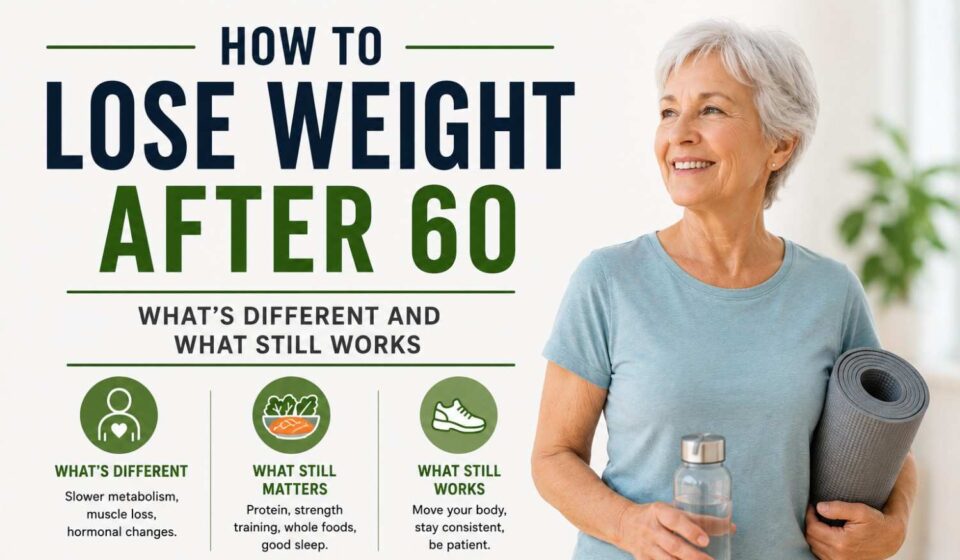

Your 60s bring real metabolic changes — but they don’t make weight loss impossible. Here’s the adapted approach.

Losing weight after 60 is genuinely more challenging than at earlier stages of life. The hormonal shifts, muscle loss, and metabolic slowdown that began in the 30s and 40s have had decades to accumulate. Sleep is often more disrupted. Recovery takes longer. And the lifestyle that supported a healthy weight at 45 may no longer be sufficient at 65.
But here’s what’s equally true: meaningful body composition improvement is absolutely achievable in the 60s and beyond. People build muscle in their 70s and 80s. Fat loss happens consistently in people who commit to the right approach. The timeline is longer and the strategy needs adjusting — but the fundamentals still work.
What Has Changed by 60
Significant Muscle Loss Has Accumulated
Sarcopenia — age-related muscle loss — has been progressing for 3 decades by the time most people reach 60. Without consistent resistance training throughout the adult years, a 60-year-old may have 20–30% less muscle mass than they did at 30.
Less muscle means a substantially lower resting metabolic rate — the same food intake that maintained weight at 40 produces consistent weight gain at 60.
Hormonal Environment Is Significantly Different
For women: Post-menopause means estrogen has been low for potentially a decade or more. The metabolic protective effects of estrogen are absent. Fat distribution has shifted toward the abdomen. Bone density is declining.
For men: Testosterone has been declining for 30+ years and may be significantly reduced. Reduced testosterone means reduced muscle maintenance, increased abdominal fat storage, lower energy, and reduced motivation to exercise.
As covered in our article on how to lose weight during menopause, these hormonal changes require specific strategy adjustments beyond standard weight loss advice.
Insulin Sensitivity Has Worsened
Decades of dietary patterns, reduced muscle mass, and hormonal changes have typically produced meaningful insulin resistance by 60. This makes carbohydrate management more important and fat storage easier than at younger ages.
Recovery Is Slower
The body’s ability to recover from exercise, illness, stress, and disrupted sleep declines significantly with age. The 60-year-old body needs more recovery time between intense exercise sessions and is more affected by poor sleep and high stress than at younger ages.
Sleep Is Often More Disrupted
Many people in their 60s experience changes in sleep architecture — less deep sleep, more nighttime waking, earlier morning waking. As covered in our article on why sleep is the most underrated weight loss tool, poor sleep has direct and significant effects on fat loss through cortisol, hunger hormones, and insulin sensitivity.
Strategy 1: Make Resistance Training the Non-Negotiable Priority
This is the most important recommendation for weight loss after 60 — more important than any dietary change, more important than cardio, more important than any supplement.
Resistance training after 60:
- Directly counters muscle loss — the primary driver of metabolic decline
- Builds new muscle even at advanced ages — the body remains responsive to training stimulus throughout life
- Improves insulin sensitivity significantly
- Reduces visceral fat independently of weight loss
- Supports bone density — critical as osteoporosis risk increases substantially after 60
- Improves balance and reduces fall risk — a major functional concern after 60
- Supports independence and quality of life
The research on resistance training in people over 60 is genuinely remarkable: meaningful muscle development, improved strength, and metabolic improvements occur even in people starting their first weight training program at 65, 70, or older.
Three sessions per week of compound movements is sufficient. Starting under appropriate guidance — a personal trainer, physiotherapist, or well-structured beginner program — reduces injury risk and ensures proper form.
Strategy 2: Prioritize Protein — More Than at Any Previous Age
Protein requirements increase with age because the body becomes less efficient at using dietary protein for muscle synthesis — a phenomenon called anabolic resistance. Older adults need more protein to achieve the same muscle-preserving effect as younger people.
Research in adults over 60 consistently supports protein intakes toward the higher end of recommendations. This isn’t about eating vast amounts of meat — it’s about ensuring adequate protein at every meal through diverse sources.
Spreading protein across meals matters particularly for older adults — muscle protein synthesis is optimized when adequate protein is consumed at each meal rather than concentrated at one meal.
As covered in our guide to how much protein you actually need per day, protein is the most important dietary variable for body composition — and this applies with even greater force after 60.
Strategy 3: Reduce Refined Carbohydrates for Worsened Insulin Sensitivity
The insulin resistance that accumulates with age means that the same carbohydrate-containing foods produce larger blood sugar spikes and insulin responses at 60 than they did at 30.
This doesn’t require eliminating carbohydrates — it means prioritizing quality:
- Lentils, beans, and legumes over white rice and pasta
- Berries and whole fruit over juice
- Oats and whole grains over refined cereals and white bread
- Vegetables as the dominant carbohydrate source
The blood sugar stability this produces — reduced spikes, reduced insulin, improved fat mobilization — has a more pronounced positive effect after 60 than at younger ages because insulin sensitivity is more impaired.
Strategy 4: Protect Sleep as a Medical Priority
Sleep disruption after 60 is both more common and more metabolically damaging than at younger ages. The combination of reduced deep sleep, hormonal changes, and higher medication use (some of which affects sleep quality) creates a sleep environment that needs active management.
Practical sleep priorities for the over-60 demographic:
- Consistent sleep and wake times — even on weekends
- Cool, dark bedroom environment
- Limiting alcohol — it disrupts sleep architecture even when it helps initiation
- Discussing any medications that affect sleep with a physician
- For women: managing menopausal symptoms that disrupt sleep (hot flashes, night sweats) — discuss treatment options with a doctor
Strategy 5: Keep Exercise Sustainable and Injury-Aware
Exercise after 60 needs to be sustainable over years and decades — not maximal in the short term. The injury risk from inappropriate exercise increases with age, and injuries that sideline exercise for weeks or months have larger cumulative effects on body composition at this age.
Principles for sustainable exercise after 60:
- Warm up thoroughly before every session — cold muscles and connective tissue need more preparation than at younger ages
- Progress gradually — increase intensity, weight, or volume by small increments over weeks
- Listen to pain — pain is not discomfort to push through; it’s a signal to address
- Include mobility and flexibility work alongside strength and cardio
- Allow adequate recovery between sessions — more recovery is often needed than at younger ages
- Walking remains one of the best exercises — low impact, daily-appropriate, metabolically valuable
Strategy 6: Consider Hormonal Evaluation
For people over 60 struggling with weight despite genuine lifestyle effort, hormonal evaluation is worthwhile:
For women: Hormone replacement therapy (HRT) — increasingly recognized as appropriate for many post-menopausal women — can improve metabolic health, sleep quality, bone density, and support weight management.
For men: Testosterone levels decline throughout the 60s and beyond. Men with confirmed low testosterone may benefit from testosterone replacement therapy — improving muscle mass, energy, fat distribution, and motivation to exercise.
For both: Thyroid function testing is important — hypothyroidism is increasingly common with age and significantly impairs metabolism. As covered in our article on how to lose weight with hypothyroidism, addressing thyroid function is foundational.
Strategy 7: Set Realistic and Meaningful Goals
This isn’t defeatist — it’s important context for sustaining motivation.
Fat loss after 60 is slower than at 30 or 40. Weight loss of 0.25–0.75 lbs per week represents excellent progress for this age group. Non-scale outcomes — energy levels, strength, mobility, independence, sleep quality, reduced joint pain, improved blood markers — are equally meaningful measures of success and often improve before scale weight does.
Comparing fat loss rate to younger people — or to your own rate at earlier ages — is neither useful nor fair. The timeline is different. The results are still real and meaningful.
What Not to Do After 60
Crash diet. Severe calorie restriction at this age causes disproportionate muscle loss, suppresses metabolism more dramatically, and is harder to sustain. A moderate deficit is more effective long-term.
Do only cardio. Cardio without resistance training accelerates muscle loss and produces the “skinny fat” outcome — lower weight, worse body composition, reduced metabolic rate.
Ignore new pain or symptoms. Exercise-related pain that persists deserves medical evaluation. Don’t push through new pain assuming it’s normal aging.
Give up because progress is slow. The compound effect of consistent effort over 6–12 months produces meaningful transformation even when weekly progress is modest.
The Bottom Line
Weight loss after 60 is harder than at 30 or 40 — the accumulated muscle loss, hormonal changes, and metabolic slowdown are real. But it remains entirely achievable with a strategy adjusted to the realities of this life stage.
The approach that works:
- Resistance training as the non-negotiable foundation — the most important single intervention
- Higher protein intake to counter anabolic resistance
- Reduced refined carbohydrates for worsened insulin sensitivity
- Sleep protection as a medical priority
- Sustainable, injury-aware exercise progression
- Hormonal evaluation if progress is elusive despite genuine effort
- Patience with a longer timeline and attention to non-scale victories
For the complete fat loss framework that applies across all life stages — with the approaches here representing the 60+ specific adaptations — our guide to how to get rid of belly fat covers everything in one place.
Are you over 60 and navigating weight loss? Share what’s working and what challenges you’re finding — this community has a lot of collective wisdom to offer.