
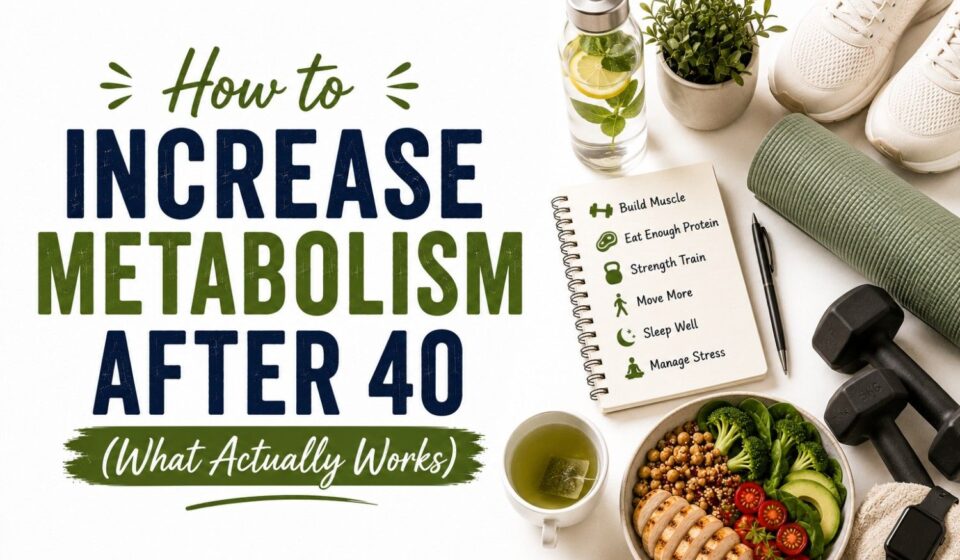

Your metabolism doesn’t have to slow down with age — here’s the science and the specific strategies that counteract it

“My metabolism has slowed down” is one of the most common explanations for weight gain after 40 — and it’s partly true. Metabolism does change with age. But the degree to which it’s inevitable, and the degree to which it can be counteracted, is dramatically more optimistic than most people believe.
Here’s the honest science — and the specific interventions that genuinely work.
What Actually Happens to Metabolism After 40
First, the honest picture of age-related metabolic change:
Muscle Loss (The Primary Driver)
This is the most significant factor. After age 30, people lose approximately 3–5% of muscle mass per decade without active intervention — with the rate accelerating after 40.
Muscle is metabolically expensive tissue — each pound burns approximately 6 calories per day at rest. Losing 10 lbs of muscle over a decade reduces resting metabolic rate by approximately 60 calories per day — which sounds small but accumulates to 6+ lbs of fat per year without any change in eating habits.
This muscle-loss-driven metabolic decline is largely preventable — and partially reversible — through resistance training. It’s the most important metabolic fact about aging.
Hormonal Changes
After 40, hormonal shifts directly affect metabolism:
Testosterone (in men): Begins declining approximately 1% per year after 30. Lower testosterone reduces muscle maintenance and fat mobilization. As covered in our article on why losing weight gets harder as you get older, testosterone decline is a significant driver of middle-age metabolic change.
Estrogen (in women): Perimenopause typically begins in the 40s, with estrogen fluctuating before declining. Lower estrogen promotes fat redistribution toward the abdomen and worsens insulin sensitivity — directly affecting metabolic rate and fat storage patterns.

Growth hormone: Declines significantly with age, impairing fat mobilization and muscle maintenance.
Thyroid hormones: Thyroid function sometimes declines with age — and subclinical hypothyroidism becomes more common after 40.
Reduced NEAT
Non-exercise activity thermogenesis — the unconscious movement of daily life — tends to decrease with age as lifestyle becomes more sedentary. Office jobs, longer commutes, more screen time, and reduced recreational activity all reduce daily calorie burn in ways that accumulate significantly over years.
The Real Numbers
A 2021 study in Science found that metabolic rate is actually remarkably stable from age 20 to 60 — declining only modestly in that period. The perceived dramatic slowdown is primarily driven by muscle loss and reduced activity rather than fundamental metabolic aging.
This is actually good news: the age-related metabolic slowdown is largely driven by controllable factors — muscle loss and activity reduction — not inevitable cellular aging.
How to Increase Metabolism After 40
1. Strength Training — The Most Important Intervention
This cannot be overstated: strength training is the single most impactful intervention for metabolism after 40.
Building and maintaining muscle after 40:
- Directly raises resting metabolic rate (more muscle = more calories burned at rest)
- Counteracts sarcopenia (age-related muscle loss)
- Improves insulin sensitivity — reducing the fat-storing hormonal environment
- Improves body composition even without significant scale weight change
- Supports bone density (increasingly important after 40)
The evidence: Studies consistently show that strength training in adults over 40, 50, and even 60+ produces meaningful muscle gains and metabolic rate improvements. It’s not too late — ever.
Target: 3 sessions per week of progressive resistance training using compound movements (squats, deadlifts, rows, presses). Progressive overload — consistently increasing resistance or volume — is what produces continued adaptation.
As covered in our article on how to lose weight after 40, strength training becomes more important with each passing decade — not less.
2. Eat Enough Protein — Higher Than Standard Recommendations
Protein requirements increase after 40 — not decrease. Two reasons:
Anabolic resistance: The efficiency of protein use for muscle synthesis decreases with age. Older adults need more protein per meal to achieve the same muscle protein synthesis response as younger adults.
Muscle preservation during calorie restriction: Without adequate protein, any calorie deficit produces significant muscle loss alongside fat loss — worsening the metabolic rate decline that drives the problem.
Target: 1–1.2g of protein per pound of bodyweight — higher than the general adult recommendation of 0.7g. As covered in our guide to how much protein you actually need per day, this is the most important dietary variable for body composition at any age.
Distribute across meals: 35–40g of protein per meal (particularly at breakfast, where most people are deficient) maximizes the muscle protein synthesis response in older adults.
3. Increase NEAT — Daily Movement Beyond Exercise
After 40, deliberate increases in daily movement compensate for the natural NEAT decline that drives much of the apparent metabolic slowdown.
The most impactful NEAT increase: Daily step count. Going from 4,000 to 10,000 steps daily adds 300–500 calories of daily expenditure — without any formal exercise.
As covered in our guide to how many steps a day to lose weight, consistent daily walking is one of the most powerful metabolic interventions available — and critically, it doesn’t trigger the compensatory hunger that intense exercise can.
Other NEAT increases: Standing desks, walking while on phone calls, taking stairs, parking further away — small habitual changes that compound significantly over weeks and months.
4. Don’t Eat Too Little — Protect Metabolic Rate
This is counterintuitive but critical: severe calorie restriction accelerates metabolic decline.
When calories drop too low, the body adapts by:
- Reducing resting metabolic rate
- Decreasing NEAT (unconscious activity reduction)
- Lowering thyroid hormone output
- Breaking down muscle for energy
After 40, protecting muscle and metabolic rate requires eating enough calories to support muscle maintenance — particularly when combined with strength training.
The floor: 1,200 calories (women), 1,400 calories (men) — below which metabolic damage accelerates. As covered in our article on what happens if you eat too few calories, aggressive restriction is counterproductive for long-term metabolic health.
The moderate deficit: 300–500 calories below maintenance — producing sustainable fat loss without the metabolic damage of aggressive restriction.
5. Prioritize Sleep — Growth Hormone and Metabolic Rate
Growth hormone — which supports muscle maintenance, fat mobilization, and metabolic rate — is primarily secreted during deep sleep. After 40, both growth hormone production and sleep quality decline.
Protecting sleep quality directly supports metabolic rate through:
- Maintaining growth hormone secretion
- Reducing cortisol (which promotes muscle breakdown and fat storage)
- Supporting insulin sensitivity
- Maintaining the muscle mass that underpins metabolic rate
7–9 hours of quality sleep is a metabolic intervention after 40 — not just a health recommendation. As covered in our article on why sleep is the most underrated weight loss tool, sleep quality directly affects body composition.
6. Manage Stress — Cortisol and Muscle Breakdown
Chronic cortisol elevation after 40 is particularly damaging:
- Promotes muscle breakdown (directly reducing metabolic rate)
- Promotes visceral fat accumulation
- Worsens insulin sensitivity
- Impairs sleep quality
Active daily cortisol management — walking, breathing exercises, social connection, reducing unnecessary stressors — directly protects metabolic rate by reducing muscle-catabolizing cortisol exposure.
7. Consider Creatine Supplementation
Creatine is one of the most studied and most evidence-backed supplements for maintaining muscle mass and metabolic rate after 40.
Evidence for creatine after 40:
- Increases muscle creatine stores, improving strength and power during resistance training
- Enhances the muscle-building response to strength training in older adults
- Some evidence for cognitive benefits in older adults (the brain uses creatine)
- Well-tolerated and safe for long-term use at standard doses
Dose: 3–5g creatine monohydrate daily (the most studied form). No loading phase necessary — consistent daily use is equally effective.
Creatine is particularly valuable after 40 because it amplifies the metabolic rate-preserving benefits of strength training — making each training session more effective at maintaining the muscle mass that underpins metabolic rate.
8. Address Hormonal Issues Medically
After 40, hormonal declines that significantly affect metabolism may warrant medical evaluation:
Thyroid function: Subclinical hypothyroidism (mildly elevated TSH with normal T4) becomes more common after 40 and significantly impairs metabolic rate. A full thyroid panel (TSH, free T3, free T4, anti-TPO antibodies) is worth having if metabolic rate seems disproportionately low.
Testosterone (men): Significant testosterone deficiency produces measurable metabolic effects — reduced muscle mass, increased fat mass, reduced energy. Testing and treatment where appropriate can meaningfully improve metabolic rate.
Perimenopause/menopause (women): The metabolic changes of hormonal transition are real and significant. As covered in our articles on how to lose weight during menopause and how to lose weight after menopause, specific strategies address the hormonal drivers of metabolic change in this period.
9. Increase Protein Thermogenesis
Protein burns 25–30% of its own calories through digestion — compared to 5–10% for carbohydrates and 0–3% for fat. This thermic effect of food is a meaningful metabolic contribution.
Increasing protein intake from 15% to 30% of calories (while reducing fat or carbohydrates proportionally) can increase daily calorie burn by 80–100 calories through thermic effect alone — without any other change.
This is another reason high protein intake is particularly valuable after 40 — it supports metabolism through both muscle preservation and thermic effect simultaneously.
10. Try High-Intensity Interval Training (HIIT)
HIIT produces significant EPOC (excess post-exercise oxygen consumption) — elevated metabolism for hours after the session. This post-exercise metabolic boost is more pronounced with high-intensity exercise than moderate exercise.
Additionally, HIIT improves insulin sensitivity and maintains cardiovascular fitness efficiently — providing metabolic benefits per time invested that moderate steady-state cardio doesn’t match.
As covered in our guide to HIIT for beginners, 2 sessions per week of 15–20 minutes provides meaningful metabolic benefits without excessive recovery demands.
The Realistic Expectation
Can you fully reverse metabolic slowdown after 40? Partially — with consistent effort.
What’s achievable:
- Preventing further muscle loss (immediately, with strength training)
- Building meaningful muscle and raising metabolic rate (over months of training)
- Restoring some of the metabolic rate lost to previous inactivity
- Significantly reducing the age-related metabolic decline trajectory
What isn’t achievable:
- Returning to the metabolic rate of a 25-year-old
- Eliminating the need for dietary management as you age
- Rapid metabolic restoration — muscle building takes months, not weeks
The honest position: consistent strength training, adequate protein, daily movement, and quality sleep can significantly mitigate age-related metabolic decline — producing a metabolic rate meaningfully higher than peers who don’t take these steps.
The Priority Order
- Strength training 3x per week — most impactful intervention
- Increase protein to 1–1.2g per pound of bodyweight
- Increase daily steps to 8,000–10,000
- Don’t eat too little — protect metabolic rate with moderate deficit
- Prioritize sleep — 7–9 hours quality sleep
- Manage stress — reduce cortisol-driven muscle breakdown
- Consider creatine — amplifies strength training benefits
- Address hormonal factors medically if suspected
- Add HIIT 1–2x per week for EPOC and insulin sensitivity
The Bottom Line
Metabolism after 40 slows primarily because of muscle loss and reduced activity — not inevitable cellular aging. Both are addressable.
The most impactful strategies: strength training 3x per week, adequate protein (1–1.2g per pound), consistent daily movement, and quality sleep. These four changes alone can significantly counteract age-related metabolic decline — producing a body that burns meaningfully more calories at rest than it would without them.
For the complete framework for weight loss specifically after 40, our article on how to lose weight after 40 covers everything in one place.
Have you found specific approaches that have measurably improved your metabolism after 40? Share in the comments — real experience from people navigating this is invaluable.