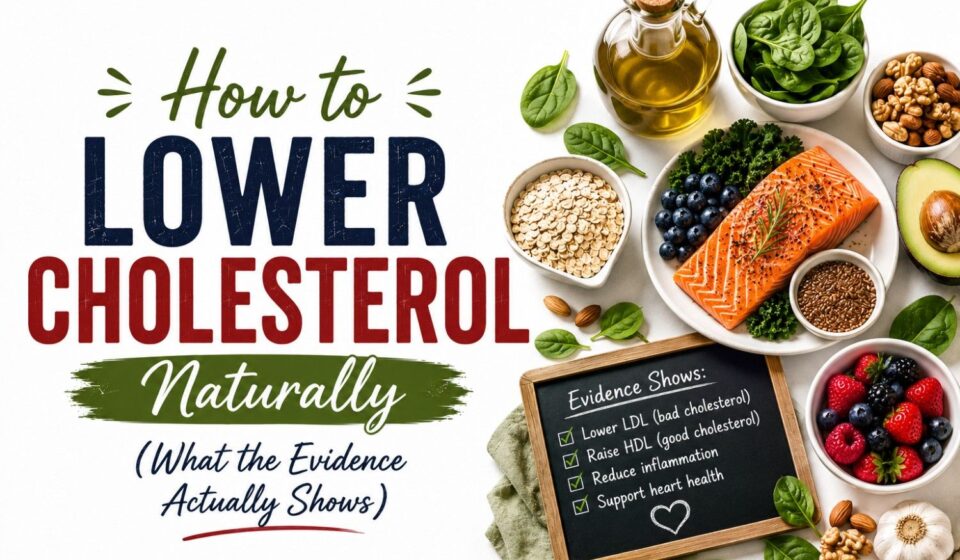
How to Lower Cholesterol Naturally (What the Evidence Actually Shows)

The most misunderstood blood marker in medicine — here’s the honest, evidence-based guide to improving your cholesterol naturally

Cholesterol advice has been through more reversals than almost any other area of nutrition science. Fat was demonized, then partially rehabilitated. Eggs were banned, then allowed back. Saturated fat was the villain, then the picture became more complicated.
Cutting through the confusion: here’s what the evidence actually shows about lowering cholesterol naturally — what works, what doesn’t, and what the numbers actually mean.
Understanding Cholesterol: What You’re Actually Measuring
“Cholesterol” on a blood test refers to several different measurements that have very different implications:
LDL cholesterol (“bad”): Low-density lipoprotein — carries cholesterol from the liver to cells. Elevated LDL is associated with increased cardiovascular risk, though the relationship is more nuanced than once thought.
HDL cholesterol (“good”): High-density lipoprotein — carries cholesterol back to the liver for processing. Higher HDL is associated with reduced cardiovascular risk.
Triglycerides: Not technically cholesterol but measured alongside it. High triglycerides are independently associated with cardiovascular risk. As covered in our guide to how to lower triglycerides naturally, these respond dramatically to dietary change.
Total cholesterol: The sum of all cholesterol fractions — a less useful number than the individual components.
LDL particle size: An important nuance not measured in standard lipid panels. Small, dense LDL particles are significantly more atherogenic (artery-clogging) than large, buoyant LDL particles. The same LDL number can represent very different cardiovascular risk depending on particle size.
Non-HDL cholesterol: Total cholesterol minus HDL — a better predictor of cardiovascular risk than LDL alone in some research.

What Actually Drives High LDL Cholesterol
Understanding causes points to solutions:
Dietary factors:
- Saturated fat raises LDL in most people (though the effect varies significantly by individual)
- Trans fats (partially hydrogenated oils) raise LDL and lower HDL — the worst dietary fat for cholesterol
- Refined carbohydrates and sugar raise triglycerides and lower HDL
- Lack of dietary fiber — soluble fiber specifically reduces LDL
Lifestyle factors:
- Sedentary lifestyle lowers HDL
- Smoking lowers HDL and damages blood vessels
- Obesity — particularly visceral fat — worsens all lipid markers
- Hypothyroidism can significantly raise LDL
Genetic factors:
- Familial hypercholesterolemia — genetic condition producing very high LDL regardless of lifestyle
- Individual variation in dietary cholesterol response (“hyper-responders”)
Dietary Strategies to Lower LDL Cholesterol
1. Increase Soluble Fiber — The Most Effective Dietary Intervention
Soluble fiber is the most evidence-backed dietary approach for lowering LDL — consistently producing 5–15% LDL reductions with adequate intake.
How it works: Soluble fiber binds bile acids in the digestive tract and prevents their reabsorption. The liver must then use cholesterol to produce new bile acids — drawing cholesterol from the bloodstream and lowering LDL.
Best sources:
- Oats (beta-glucan): 3g of beta-glucan daily (approximately 1.5 cups cooked oats) — FDA-approved health claim for cholesterol reduction. As covered in our article on is oatmeal good for weight loss, beta-glucan is one of the most evidence-backed dietary components available.
- Psyllium husk: 5–10g daily — produces 5–10% LDL reduction in consistent studies
- Legumes: Lentils, chickpeas, beans — 1–2 servings daily
- Barley: High beta-glucan content similar to oats
- Apples and pears: Pectin fiber with meaningful LDL-lowering effect
- Flaxseeds: Soluble fiber plus omega-3s
2. Reduce Trans Fats — Complete Elimination
Trans fats (partially hydrogenated oils) are the worst dietary fat for cholesterol — they simultaneously raise LDL and lower HDL. Fortunately, FDA restrictions have dramatically reduced their presence in the food supply, but they persist in some processed foods.
Check labels for: Partially hydrogenated oil, hydrogenated vegetable oil. Even products claiming “0g trans fat” can contain up to 0.5g per serving — which adds up.
Found in: Some commercial baked goods, microwave popcorn, fried fast food, some margarine products.
3. Increase Omega-3 Fatty Acids
Omega-3s from fatty fish (EPA and DHA) primarily lower triglycerides — with more modest effects on LDL. However, they improve HDL and significantly improve overall cardiovascular risk profile.
Additionally, replacing saturated fat in the diet with omega-3-rich fatty fish may lower LDL while providing cardiovascular protective benefits beyond lipid effects.
Target: 2–3 servings of fatty fish per week (salmon, sardines, mackerel, herring). Fish oil supplementation (2–3g EPA+DHA) for additional benefit.
4. Replace Saturated Fat With Unsaturated Fat
This remains one of the more nuanced areas of cholesterol science. The evidence:
Replacing saturated fat with polyunsaturated fat (omega-6 from nuts, seeds): Consistently lowers LDL in controlled trials.
Replacing saturated fat with monounsaturated fat (olive oil, avocado): Lowers LDL while maintaining or raising HDL — a favorable overall lipid effect.
Replacing saturated fat with refined carbohydrates: Does not reduce cardiovascular risk despite lowering LDL — because it raises triglycerides and lowers HDL.
Practical application:
- Use extra virgin olive oil as primary cooking and dressing fat
- Replace butter with olive oil where possible
- Include avocado regularly
- Choose fatty fish over red meat for protein several times per week
- Reduce (but not necessarily eliminate) high-saturated-fat foods
The nuance on saturated fat: The relationship between saturated fat and cardiovascular risk is more complex than once believed. The source of saturated fat matters — dairy saturated fat behaves differently from processed meat saturated fat. And replacing saturated fat with refined carbohydrates doesn’t improve outcomes. Focus on replacing saturated fat with unsaturated fats, not carbohydrates.
5. Add Plant Sterols and Stanols
Plant sterols and stanols (found naturally in small amounts in plants, added to some functional foods) block cholesterol absorption in the intestine — producing consistent LDL reductions of 5–15% with 2g daily.
Sources: Some margarine products (Benecol, Flora ProActiv), fortified orange juice, supplements.
Evidence: Very consistent — one of the most reliable dietary interventions for LDL specifically. Worth considering for people with elevated LDL who want additional dietary interventions.
6. Eat More Nuts (Particularly Walnuts and Almonds)
Regular nut consumption consistently improves lipid profiles in clinical trials:
- Reduces LDL cholesterol
- Raises HDL cholesterol
- Reduces triglycerides
- Reduces cardiovascular risk beyond lipid effects
A meta-analysis found approximately 5% LDL reduction from regular nut consumption. Walnuts specifically provide omega-3s alongside their lipid-improving effects.
Target: A small handful (28g) of mixed nuts or walnuts daily. Higher amounts and calorie density becomes a consideration.
7. Reduce Dietary Cholesterol (With Important Nuance)
Dietary cholesterol’s effect on blood cholesterol is highly individual:
Most people (approximately 75%): Dietary cholesterol has minimal effect on blood LDL — the liver regulates its own production in response to dietary intake.
Hyper-responders (approximately 25%): Dietary cholesterol does meaningfully raise LDL — these individuals benefit from limiting high-cholesterol foods.
For most people, moderate egg consumption (1–2 daily) does not significantly raise LDL. For hyper-responders, limiting dietary cholesterol is worth doing. If you’ve had lipid testing before and after periods of higher egg consumption, you have personal data on whether you’re a hyper-responder.
Lifestyle Strategies to Lower Cholesterol
8. Exercise Regularly — Particularly for HDL
Exercise has a more significant effect on HDL cholesterol than on LDL. Regular aerobic exercise consistently raises HDL (the “good” cholesterol) — with meaningful increases seen after 12+ weeks of consistent training.
Evidence: Regular aerobic exercise raises HDL by 3–9% and modestly reduces LDL and triglycerides.
Most effective: A combination of aerobic exercise (walking, cycling, swimming) and strength training produces the best overall lipid improvements. As covered in our guide to how many steps a day to lose weight, consistent daily walking is the most accessible starting point.
9. Lose Weight — Particularly Visceral Fat
Every 5–10% reduction in body weight consistently improves all lipid markers:
- LDL decreases
- HDL increases
- Triglycerides decrease (often dramatically)
Visceral fat reduction specifically improves the lipid profile beyond what total weight loss predicts — because visceral fat is a major driver of the metabolic dysfunction that worsens cholesterol.
As covered in our complete guide to how to get rid of belly fat, visceral fat reduction is both a weight loss goal and a direct lipid management strategy.
10. Quit Smoking
Smoking directly lowers HDL cholesterol and damages blood vessel walls — increasing cardiovascular risk independent of cholesterol levels. Quitting smoking raises HDL within weeks and progressively improves cardiovascular risk over time.
11. Reduce Alcohol
Moderate alcohol has complex effects on lipids — it raises HDL somewhat but also raises triglycerides. For people with high triglycerides, alcohol reduction is important. For people with isolated high LDL and low triglycerides, alcohol has less impact.
For overall cardiovascular health, the current evidence supports limiting alcohol to reduce overall risk.
Supplements With Evidence for Cholesterol Reduction
Red Yeast Rice
Contains monacolin K — essentially the same compound as lovastatin (a prescription statin). Produces significant LDL reductions (15–25%) comparable to low-dose statins.
Important: Because red yeast rice contains a statin-like compound, it carries similar side effect profiles (muscle pain, liver effects) and interactions. Should be discussed with a doctor — particularly if already on statins.
Berberine
As covered in our blood sugar article, berberine improves multiple metabolic markers including LDL cholesterol. 500mg 2–3 times daily produces modest but consistent LDL reductions in studies.
Niacin (Vitamin B3)
High-dose niacin dramatically raises HDL (25–35%) and reduces LDL and triglycerides. However, it causes significant flushing and requires medical supervision at therapeutic doses. Less commonly used than previously due to clinical trial results showing less cardiovascular benefit than expected.
Coenzyme Q10 (CoQ10)
CoQ10 doesn’t lower cholesterol but is often recommended alongside statin therapy — statins reduce CoQ10 production, and supplementation may reduce statin-related muscle side effects.
When Medication Is Necessary
For many people, particularly those with familial hypercholesterolemia, very high LDL, or established cardiovascular disease, lifestyle intervention alone is insufficient and statins or other lipid-lowering medications are necessary and appropriate.
Statins produce 30–50% LDL reductions — far exceeding what lifestyle alone achieves in most people. The decision to use statins should be based on overall cardiovascular risk (using tools like the ASCVD Risk Calculator) rather than LDL number alone.
For people with cardiovascular risk factors alongside obesity, Gala offers telehealth medical evaluations to assess overall cardiovascular risk and whether prescription treatment is appropriate.
[Check if you qualify at Gala →]
This is a paid partnership. Gala is a licensed telehealth provider. Medication is only prescribed following a medical consultation and is not guaranteed.
The Priority Order for Lowering Cholesterol Naturally
For lowering LDL specifically:
- Increase soluble fiber (oats, psyllium, legumes) — highest impact
- Eliminate trans fats completely
- Replace saturated fat with monounsaturated fat (olive oil, avocado)
- Add plant sterols/stanols (2g daily)
- Add nuts (particularly walnuts and almonds)
- Lose weight if overweight
- Exercise regularly
For raising HDL:
- Regular aerobic exercise
- Quit smoking
- Lose weight
- Reduce refined carbohydrates
- Moderate alcohol (if heavy drinking — reduction helps)
For improving overall lipid profile: The Mediterranean dietary pattern — as covered in our guide to how to lose weight with Mediterranean diet — incorporates virtually all of the above interventions simultaneously and has the strongest evidence base for cardiovascular risk reduction of any dietary approach.
The Bottom Line
Lowering cholesterol naturally requires a multi-pronged approach:
Most impactful: Increasing soluble fiber (oats, psyllium, legumes), eliminating trans fats, replacing saturated fat with olive oil and avocado, regular exercise, and weight loss.
Additional benefit: Plant sterols, nuts, omega-3s, and specific supplements like berberine and red yeast rice.
The honest caveat: For people with familial hypercholesterolemia or very high cardiovascular risk, lifestyle intervention is important but often insufficient without medication. Work with your doctor to assess overall cardiovascular risk rather than focusing on cholesterol numbers in isolation.
Have you successfully improved your cholesterol through lifestyle changes — and what made the biggest difference? Share in the comments.