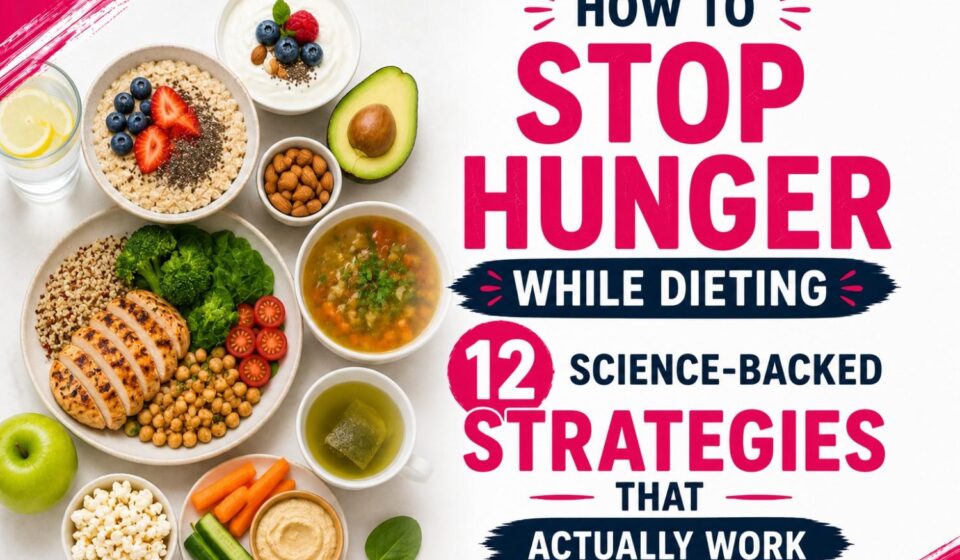
How to Stop Hunger While Dieting (12 Science-Backed Strategies That Actually Work)

Hunger is the reason most diets fail. Here’s how to manage it without willpower.

Hunger is the primary reason diets fail. Not lack of knowledge, not lack of motivation, not lack of discipline — hunger. The persistent, distracting, willpower-depleting experience of wanting to eat when you’ve decided not to is what eventually breaks most dietary efforts.
The good news: hunger during a calorie deficit is not inevitable. It’s manageable — not through willpower, but through specific, evidence-based strategies that reduce hunger signals at their source. This guide covers the 12 most effective of them.
Why You Get Hungry When Dieting
Before the solutions, understanding the mechanisms helps:
Ghrelin rises. Ghrelin is the primary hunger hormone — it signals the brain that it’s time to eat. When you’re in a calorie deficit, ghrelin increases. This is a biological response to perceived food scarcity.
Leptin falls. Leptin is the satiety hormone — it signals fullness and suppresses appetite. In a calorie deficit, leptin decreases, reducing the natural appetite suppression that maintained weight at a higher calorie intake.
Blood sugar fluctuates. Eating patterns that cause blood sugar spikes followed by crashes produce pronounced hunger during the crash phase — often within 1–2 hours of eating.
The body adapts. Over weeks of restriction, the body’s hunger signals intensify as part of the biological defense against weight loss.
Understanding these mechanisms points directly to the solutions: manage ghrelin, support leptin, stabilize blood sugar, and choose foods that address hunger biologically rather than relying on willpower to override it.
Strategy 1: Eat More Protein — The Single Most Effective Hunger Tool
If there’s one strategy with the most evidence for hunger reduction during dieting, it’s increasing protein intake.
Protein:
- Reduces ghrelin more powerfully than carbohydrates or fat
- Stimulates satiety hormones (PYY, GLP-1) more effectively than any other macronutrient
- Digests more slowly, maintaining fullness for longer
- Produces fewer calories per gram of actual effect than it appears, due to its thermic effect
Studies comparing high-protein and standard-protein diets at the same calorie intake consistently find that high-protein dieters report significantly less hunger — and consume fewer total calories even when eating ad libitum (without restriction).
Target: 0.7–1g of protein per pound of bodyweight per day, with protein present at every meal and most snacks.
As covered in our guide to how much protein you actually need per day, this is the most impactful single dietary change for managing hunger during a deficit.
Strategy 2: Eat High-Volume, Low-Calorie-Density Foods
Calorie density — the calories per gram of food — is one of the most powerful determinants of satiety. Foods with low calorie density provide the stomach volume that signals fullness while contributing few calories.
The physics of fullness: The stomach has stretch receptors that signal fullness based on volume, not calories. 500 calories of leafy greens fills the stomach far more than 500 calories of chocolate — producing far greater satiety at the same calorie cost.
Lowest calorie density foods:
- Leafy greens (spinach, romaine, arugula) — 5–10 calories per cup
- Cucumber — 16 calories per cup
- Zucchini — 20 calories per cup
- Celery — 16 calories per cup
- Broth-based soups — 50–150 calories per bowl
- Berries — 50–80 calories per cup
- Watermelon — 46 calories per cup
Strategy: Start every meal with a large salad or vegetable-based soup before the calorie-dense components. The volume of low-calorie food pre-fills the stomach, significantly reducing the hunger for higher-calorie foods.
Strategy 3: Eat Slowly and Without Distractions
Satiety hormones take 15–20 minutes to reach the brain after eating begins. People who eat quickly consume significantly more food before feeling full than slow eaters — because they finish eating before the satiety signal arrives.
Eating without screens removes the distraction that further delays satiety registration — studies find people eat 20–40% more when distracted by television or phones.
These two changes — eating slowly, without screens — reduce hunger after meals by allowing the full satiety response to develop before eating is completed. No willpower required, no food restriction — just a different way of eating the same food.
Strategy 4: Drink Water Before and During Meals
Drinking a large glass of water 15–20 minutes before meals provides mild gastric volume that primes satiety signals — reducing meal calorie intake by an average of 75–90 calories in controlled studies.
Additionally, thirst is frequently misinterpreted as hunger — particularly between meals. When hunger appears outside of normal mealtime, drinking a large glass of water and waiting 10 minutes resolves a proportion of apparent hunger without food.
Staying well-hydrated throughout the day reduces the baseline “hunger” that dehydration mimics.
Strategy 5: Eat Soluble Fiber at Every Meal
Soluble fiber (in oats, lentils, beans, apples, flaxseed, and psyllium) forms a gel in the digestive tract that:
- Slows gastric emptying — food stays in the stomach longer, maintaining fullness
- Blunts post-meal blood sugar spikes — preventing the crash that triggers hunger
- Feeds beneficial gut bacteria that produce short-chain fatty acids — which have direct appetite-suppressing effects
The research on soluble fiber and satiety is consistent: people who consume more soluble fiber eat less and report less hunger at equivalent calorie intakes.
Best practical sources:
- Oats at breakfast (3–4g soluble fiber) — strong evidence for appetite reduction throughout the morning
- Lentils and beans at lunch (5–7g per serving)
- Psyllium husk supplement (3–5g before meals with water)
- Apple or pear as a snack (2–3g soluble fiber)
Strategy 6: Don’t Skip Meals — Especially Breakfast
Skipping meals to “save calories” for later is one of the most counterproductive hunger management strategies available. It:
- Produces extreme hunger that drives overeating at the next meal
- Elevates ghrelin significantly — priming hunger hormones for hours
- Impairs decision-making capacity that makes resistance to food harder
- Often results in more total calorie consumption than the skipped meal would have contained
Regular meal timing — eating at consistent intervals — maintains more stable hunger hormone levels throughout the day. The classic recommendation of three meals per day (or smaller, more frequent meals) is not arbitrary — it manages ghrelin more effectively than irregular eating with skipped meals.
As covered in our guide to how much protein you actually need per day, a high-protein breakfast specifically reduces hunger for the entire day through effects that persist for hours.
Strategy 7: Prioritize Sleep — It’s a Hunger Management Tool
Sleep deprivation directly elevates ghrelin and reduces leptin — the precise hormonal combination that makes hunger feel overwhelming. Studies consistently find that people who sleep under 6 hours eat significantly more the next day, specifically craving high-calorie, high-fat, and sugary foods.
7–9 hours of quality sleep is not just a health recommendation — it’s a hunger management strategy that reduces baseline appetite and makes dietary adherence significantly easier. As covered in our article on why sleep is the most underrated weight loss tool, poor sleep can undermine even the most carefully planned diet.
Strategy 8: Reduce Refined Carbohydrates and Added Sugar
Refined carbohydrates (white bread, white rice, pasta, sugary cereals) and added sugar cause rapid blood sugar spikes followed by crashes — and the crash phase produces pronounced hunger within 1–2 hours of eating.
Replacing refined carbohydrates with:
- Whole grains (oats, brown rice, whole grain bread)
- Legumes (lentils, beans)
- Vegetables
…produces slower glucose absorption, gentler blood sugar curves, and sustained energy without the crash-hunger cycle.
This dietary shift reduces hunger not by eating less but by eating differently — stabilizing the blood sugar patterns that drive between-meal hunger.
Strategy 9: Manage Stress
Cortisol — the stress hormone — specifically increases appetite for calorie-dense, high-fat, high-sugar foods. Chronic stress maintains elevated cortisol that makes dietary management genuinely harder, not just psychologically but hormonally.
Active daily stress management — walking, breathing exercises, adequate sleep, reducing unnecessary obligations — directly reduces the cortisol-driven hunger that makes dieting harder under stress.
People under significant chronic stress find managing hunger more difficult than people who aren’t — and addressing the stress addresses the hunger.
Strategy 10: Use Hunger-Management Beverages
Certain beverages reduce hunger without significant calorie contribution:
Coffee: Caffeine suppresses appetite — meaningfully and reliably. Coffee before meals reduces meal calorie intake in controlled studies. Black coffee or coffee with a small amount of milk is a legitimate pre-meal hunger management tool.
Green tea: Contains catechins and a small amount of caffeine that together reduce appetite and improve fat oxidation. As covered in our article on green tea and weight loss, green tea provides modest but real appetite-suppressive effects.
Sparkling water: The carbonation provides mild gastric distension that reduces appetite. Sparkling water before or with meals extends satiety from the water effect.
Protein shakes: A low-calorie protein shake (25–30g protein, 150–200 calories) is one of the most effective between-meal snacks for managing hunger — providing the strong satiety effect of protein with modest calorie contribution.
Strategy 11: Adjust Your Deficit — Hunger May Be a Sign It’s Too Aggressive
If hunger is severe and persistent despite implementing the strategies above, the calorie deficit may simply be too large for comfortable management.
A 750-calorie deficit with manageable hunger produces better long-term fat loss than a 1,000-calorie deficit that collapses after 3 weeks due to unsustainable hunger.
Adjusting up by 150–200 calories and reassessing hunger after 1–2 weeks often produces a dramatically more manageable experience — with only modest reduction in weekly fat loss rate.
As covered in our guide to how to lose weight with a calorie deficit, sustainability matters more than maximum deficit size.
Strategy 12: Plan Your Meals in Advance
Hunger is most dangerous when you’re hungry and don’t have a plan. Decision-making under hunger is impaired — the brain seeks immediate caloric relief, and whatever is most accessible and palatable wins.
Planning meals the night before or at the start of each week removes food decisions from the moment of hunger. When hunger arrives, there’s already a specific, prepared response — not an open-ended question about what to eat answered by a depleted brain.
Meal prepping — covered in our article on 10 healthy meal prep ideas for weight loss — is perhaps the single most powerful system-level hunger management tool available. Having high-protein, filling food ready to eat eliminates the gap between “I’m hungry” and “I’m eating something appropriate.”
The Bottom Line
Managing hunger during a calorie deficit doesn’t require extraordinary willpower — it requires building the right conditions:
- High protein — the most powerful single hunger reduction tool
- High-volume, low-calorie-density foods — fill the stomach at low calorie cost
- Eat slowly, without screens — allow satiety signals to register before overeating
- Drink water — before meals and whenever hunger appears between meals
- Soluble fiber at every meal — slows digestion and stabilizes blood sugar
- Regular meals — don’t skip — maintains stable ghrelin levels
- 7–9 hours sleep — prevents the ghrelin/leptin dysregulation that makes hunger overwhelming
- Reduce refined carbohydrates — prevent the blood sugar crashes that drive between-meal hunger
- Manage stress — reduces cortisol-driven hunger
- Use hunger-management beverages — coffee, green tea, sparkling water, protein shakes
- Reduce the deficit if hunger is severe — sustainability matters more than maximum restriction
- Plan meals in advance — remove food decisions from moments of hunger
Implementing 4–6 of these simultaneously produces a dramatic reduction in diet-breaking hunger — making the calorie deficit maintainable for long enough to produce real results.
For the complete fat loss framework that builds hunger management into the dietary approach from the start, our guide to how to get rid of belly fat covers everything in one place.
Which hunger management strategy has made the biggest difference for you — and which one do you wish you’d started with? Share in the comments.