
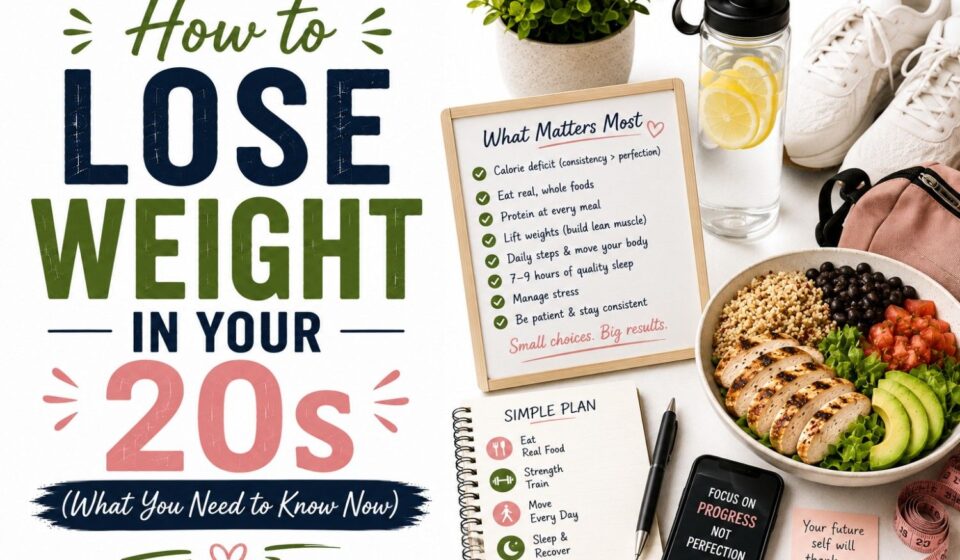

Your 20s are the best time to establish fat loss habits — here’s why, and exactly what to do

Your 20s are simultaneously the easiest and the most underutilized decade for weight loss. Metabolism is at or near its peak, muscle-building capacity is highest, recovery is fastest, and the habits established now will shape body composition for decades.
Yet weight gain in the 20s is extremely common — driven by the specific lifestyle factors of this decade: irregular schedules, frequent social eating and drinking, sedentary desk jobs post-graduation, reduced structured activity after school sports end, and the independence to eat whatever is convenient rather than whatever is nutritious.
Here’s the complete guide to weight loss in your 20s — the advantages to leverage, the specific challenges to navigate, and the habits that matter most at this stage.
The Metabolic Advantage of Your 20s
Your 20s represent peak metabolic capacity in several specific ways:
Highest natural muscle mass potential: Anabolic hormone levels (testosterone in men, growth hormone in both sexes) are at lifetime highs in the early-to-mid 20s. The capacity to build muscle — which directly raises resting metabolic rate — is greater now than it will ever be again.
Fastest recovery: Recovery from exercise is faster in your 20s than any subsequent decade — allowing higher training frequency and volume without the injury and recovery issues that complicate exercise in later decades.
Best insulin sensitivity: Unless already significantly overweight or metabolically compromised, insulin sensitivity in the 20s is generally excellent — the body handles carbohydrates efficiently, and dietary choices have not yet produced the metabolic damage that accumulates with decades of poor eating.
Most responsive to change: The body in the 20s responds faster to dietary and exercise intervention than in subsequent decades — fat loss starts relatively quickly when the right approach is applied.
The habits established in your 20s — particularly around muscle building, dietary patterns, and activity — create a metabolic foundation that either supports or undermines health for the next 50+ years. This isn’t alarmist, it’s physiologically real.

The Specific Weight Loss Challenges of Your 20s
Understanding the decade-specific obstacles helps navigate them:
Social Eating and Drinking Culture
The 20s involve more social eating and drinking than almost any other decade — house parties, bar nights, restaurant meals, work events, dating. The social calorie load of a typical 20-something’s social life is significant and often invisible in dietary tracking.
Beer and cocktails, late-night pizza, bottomless brunch, weekend restaurant meals — these social calories add up to hundreds or thousands of extra weekly calories that directly undermine any weekday dietary effort.
Irregular Sleep and Schedules
Late nights, irregular sleeping patterns, shift work in early career jobs, social commitments — sleep deprivation is common in the 20s. As covered in our article on why sleep is the most underrated weight loss tool, sleep deprivation directly elevates hunger hormones and impairs fat loss regardless of dietary effort.
Sedentary Post-Education Life
Many people in their 20s transition from the structured physical activity of school (PE, sports teams, walking between classes) to sedentary desk jobs — dramatically reducing daily calorie burn without any compensatory dietary adjustment.
Convenience Food Reliance
Living independently for the first time, with limited cooking skills and a busy schedule, often means heavy reliance on convenience food, takeout, and ultra-processed options. This dietary pattern adds significant calories while providing poor nutritional quality.
The “I’m Young, I Can Eat Anything” Mentality
Metabolism hasn’t noticeably slowed yet, so the consequences of poor dietary choices seem minimal in the short term. Weight gain in the 20s often creeps on gradually — 2–3 lbs per year — without triggering action until it becomes significantly harder to address in the 30s and 40s.
How to Lose Weight in Your 20s
1. Build Muscle Now — You’ll Never Have a Better Opportunity
This is the most important weight loss and long-term health investment available in your 20s — and the most commonly skipped.
Building significant muscle in your 20s:
- Raises resting metabolic rate permanently (more muscle = more calories burned at rest for life)
- Creates a metabolic buffer for the gradual muscle loss of subsequent decades
- Dramatically improves insulin sensitivity
- Produces body composition that makes fat loss easier for the next several decades
The window for maximum muscle building is genuinely time-limited — anabolic hormone levels decline from the late 20s onward. Building muscle now costs relatively little effort compared to building the same muscle in your 30s or 40s.
Target: 3–4 sessions per week of progressive strength training. As covered in our guide to how many steps a day to lose weight and multiple articles on exercise, strength training is the highest-return long-term investment in metabolic health.
2. Establish Sustainable Dietary Patterns — Not Crash Diets
The 20s are when eating patterns get established — the food choices, meal timing, and dietary frameworks that become habitual and carry forward for decades.
Crash dieting in your 20s establishes the restrict-binge cycle that produces yo-yo weight throughout life. Establishing moderate, sustainable dietary habits now — adequate protein, mostly whole foods, controlled portions — creates the foundation that makes weight management progressively easier rather than harder.
The most impactful dietary habits to establish in your 20s:
- Cooking most meals at home most of the time
- Eating adequate protein at every meal (0.7–1g per pound of bodyweight)
- Keeping ultra-processed food as an occasional rather than daily occurrence
- Drinking water as the primary beverage
3. Hit Protein Targets — The Foundation of Body Composition
As covered in our guide to how much protein you actually need per day, protein is the most important dietary variable for fat loss and body composition at every age — but establishing the protein habit in your 20s produces compounding benefits.
Adequate protein in your 20s:
- Supports muscle building (maximizing the anabolic window)
- Manages hunger on a modest calorie deficit
- Preserves muscle during any fat loss phase
- Supports recovery from higher-frequency training
Target: 0.8–1g per pound of bodyweight — requires intentional protein focus at every meal.
4. Manage the Social Calorie Problem Strategically
Eliminating social eating and drinking in your 20s is neither realistic nor desirable — social connection is a genuine health need. The goal is managing it strategically rather than ignoring it.
Practical approaches:
- Eat a protein-rich meal before social events — arriving hungry leads to poor choices
- Choose lower-calorie drink options (spirits with soda water, dry wine) rather than beer and cocktails
- Apply the “one drink, one water” rule — alternating alcoholic and non-alcoholic drinks halves consumption
- Eat mindfully at restaurant meals — choosing protein-centered options and being aware of portion sizes
- Reserve genuine dietary freedom for occasions that really matter rather than applying it to every social situation
As covered in our article on how to eat healthy at restaurants, navigating social eating without completely restricting is a skill that produces far better long-term outcomes than the all-or-nothing approach.
5. Prioritize Sleep Despite Social Pressure
Sleep is the easiest health behavior to sacrifice in your 20s — social life, streaming, late work deadlines, and FOMO all compete with it. The consequences aren’t immediately obvious but are metabolically significant.
The practical target: 7–9 hours consistently. This doesn’t mean never staying out late — it means making adequate sleep the default rather than the exception.
The 20-something who consistently gets 7–9 hours has dramatically better hunger hormone regulation, better insulin sensitivity, and easier dietary adherence than their sleep-deprived peers eating the same diet.
6. Stay Active Beyond Structured Exercise
The transition from student to worker often eliminates the incidental activity of student life (walking between classes, recreational sport, active social life) without replacement. Daily step count often drops from 8,000–12,000 during student years to 3,000–5,000 in early desk-job careers.
The fix: Build NEAT (non-exercise activity thermogenesis) into the work day:
- Walk or cycle to work where possible
- Take stairs instead of elevators
- Walk during lunch breaks
- Standing desk or regular standing breaks
- 10-minute walks after meals
As covered in our guide to how many steps to lose weight, 8,000–10,000 daily steps adds 300–500 calories of daily expenditure — without any formal exercise.
7. Learn to Cook — The Most Underrated Weight Loss Skill
Basic cooking competence is the single biggest predictor of dietary quality in your 20s. People who can cook eat fewer calories, less ultra-processed food, more protein, and more vegetables than those who rely on takeout and convenience food — without necessarily trying to eat healthily.
Learning 10–15 simple, high-protein recipes that take 20–30 minutes produces a dietary transformation that no amount of diet knowledge or willpower can replicate.
Essential recipes to learn in your 20s:
- Scrambled eggs and omelettes
- Grilled/baked chicken breast
- Simple stir-fries
- Batch-cooked grains and legumes
- Simple salads with protein
- Overnight oats
8. Don’t Use Your Metabolism as an Excuse to Not Establish Habits
The “I’m young, I’ll deal with it later” mentality is one of the most costly weight management mistakes of the 20s. Metabolic capacity does decline with age — but the primary driver is the accumulated loss of muscle mass and activity that happens when good habits aren’t established early.
People who build strong habits in their 20s tend to maintain better metabolic health through their 30s, 40s, and beyond — not because aging doesn’t affect them, but because they enter each decade with a better metabolic foundation.
Realistic Weight Loss Expectations in Your 20s
Rate of loss: 0.5–1.5 lbs per week with a 500–750 calorie daily deficit — faster than subsequent decades due to better metabolic responsiveness.
Body composition: Because muscle building is easier in your 20s, body recomposition (losing fat while gaining muscle simultaneously) is more achievable in your 20s than at any other age. The scale may not move dramatically while body composition improves significantly.
Timeline: Most 20-somethings who need to lose 20–30 lbs can achieve this in 4–6 months with consistent effort — significantly faster than the same goal in subsequent decades.
The Most Important Weight Loss Investment in Your 20s
If there’s one thing to prioritize above all others in your 20s for long-term weight management:
Build muscle through consistent strength training.
The metabolic rate advantage of maintaining muscle mass through your 30s, 40s, 50s, and beyond is enormous. The muscle built in your 20s — when anabolic hormones are highest and recovery is fastest — provides a metabolic foundation that makes every subsequent decade of weight management significantly easier.
Everything else is important. This is essential.
The Bottom Line
Your 20s offer the best metabolic conditions for fat loss and muscle building you’ll ever have. The specific challenges — social eating and drinking, irregular sleep, sedentary work, convenience food reliance — are real but navigable.
The most impactful habits to establish now:
- Consistent strength training (3–4x per week)
- Adequate protein at every meal
- Cooking most meals at home
- Managing social calories strategically rather than ignoring them
- Prioritizing sleep despite social pressure
- Staying active through daily movement beyond exercise
The habits you establish in your 20s compound across decades. The effort required to lose weight at 25 is significantly less than the same effort at 35, 45, or 55 — because the metabolic foundation built now makes everything easier later.
For the complete weight loss framework, our guide to how to get rid of belly fat covers everything in one place.
What’s been your biggest weight loss challenge in your 20s — and what’s worked for you? Share in the comments.