
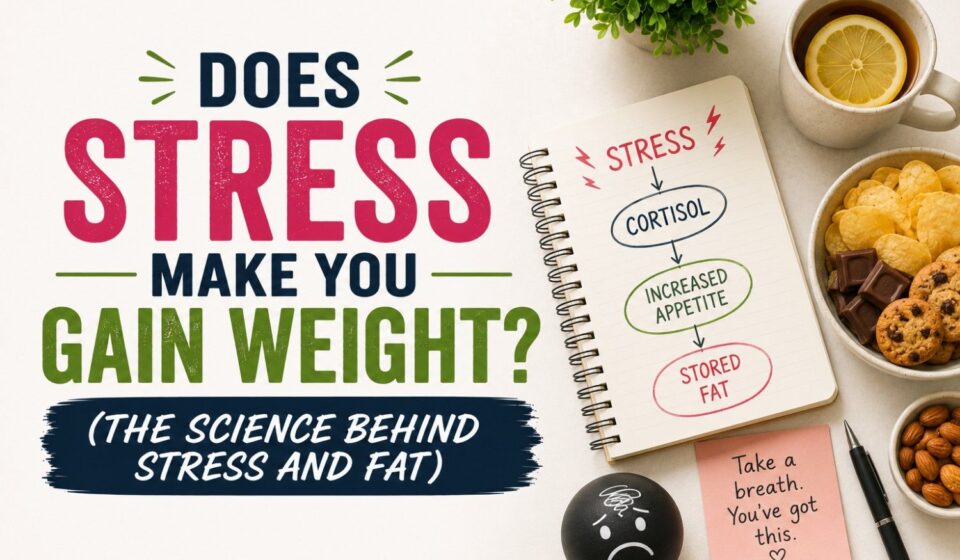

The relationship between stress and weight is real, direct, and more biological than most people realize

“I’ve been so stressed lately — I think that’s why I’m gaining weight.” Most people say this as a half-explanation, half-excuse. But the relationship between stress and weight gain is genuinely biological — not imaginary, not an excuse, and more direct than most people realize.
Yes, stress makes weight gain more likely. Here’s exactly how, and what to do about it.
The Cortisol Connection
When you experience stress — physical or psychological — your brain activates the HPA axis (hypothalamic-pituitary-adrenal axis), triggering the release of cortisol from the adrenal glands.
Cortisol is the primary stress hormone. Its evolutionary purpose was to prepare the body for immediate physical threat — mobilizing energy stores for fight or flight. In short bursts, this is adaptive and healthy.
The problem: modern stress is chronic rather than acute. Work deadlines, financial pressure, relationship strain, and the constant low-level anxiety of modern life maintain cortisol at elevated levels for days, weeks, or months — and chronically elevated cortisol has profound effects on body weight and fat storage.
How Cortisol Directly Promotes Fat Gain
Cortisol Promotes Visceral Fat Storage Specifically
This is one of the most important and most specific findings in stress-weight research: cortisol doesn’t just cause general weight gain — it specifically promotes visceral fat accumulation (the deep belly fat surrounding organs).
Visceral fat cells have more cortisol receptors than subcutaneous fat cells elsewhere in the body. When cortisol is elevated, visceral fat is preferentially expanded — storing energy centrally as a reserve for anticipated continued stress.
This is why people under chronic stress develop abdominal weight gain even without significant dietary changes — the cortisol is directing fat preferentially to the belly.
Cortisol Increases Appetite — Specifically for Calorie-Dense Foods
Cortisol directly stimulates appetite, particularly for high-fat, high-sugar, high-calorie foods — the evolutionary logic being that stress anticipated energy expenditure and prepared the body to replenish.
The specific craving for “comfort food” under stress is not just psychological — it’s a cortisol-driven biological drive toward calorie-dense foods that provide immediate energy.
Studies have found that people under acute stress consume significantly more high-calorie food in subsequent meals than people in low-stress conditions — not because they decided to eat more, but because cortisol-driven appetite changes made those foods more rewarding.
Cortisol Impairs Insulin Sensitivity
Cortisol directly worsens insulin sensitivity — meaning carbohydrates and sugars produce larger insulin spikes and greater fat storage tendency. This compounds the direct fat storage effect: not only does cortisol direct fat to visceral stores, it also impairs the insulin signaling that would otherwise use dietary carbohydrates efficiently.
Cortisol Disrupts Sleep — Which Worsens Weight Further
Cortisol follows a natural diurnal pattern — highest in the morning (wake-up signal), lowest at night. Chronically elevated cortisol disrupts this pattern, producing elevated cortisol in the evening and overnight — impairing sleep quality.
Poor sleep then worsens everything: ghrelin rises, leptin falls, food choices deteriorate, and fat loss is directly impaired. As covered in our article on why sleep is the most underrated weight loss tool, the sleep-cortisol cycle is one of the most powerful and least appreciated fat gain mechanisms.
Cortisol Reduces Motivation for Exercise and Healthy Behaviors
Chronic stress impairs prefrontal cortex function — the brain region responsible for planning, impulse control, and long-term thinking. Under chronic stress, the immediate comfort of calorie-dense food becomes more compelling relative to the long-term benefit of dietary restraint or exercise.
This isn’t weakness — it’s neurobiology. The stressed brain genuinely functions differently in ways that make healthy behaviors harder to choose and maintain.
Stress Eating — The Behavioral Layer
Beyond the direct hormonal effects, stress produces emotional eating patterns that add calories independently of cortisol’s metabolic effects.
As covered in our article on how to lose weight with emotional eating, using food to manage emotional states — stress, anxiety, frustration — is one of the most common and most powerful dietary behavior patterns. Stress is the most common trigger.
The combination of cortisol-driven physiological hunger for calorie-dense food AND emotional eating-driven behavioral response to stress is particularly potent — biology and behavior pushing in the same direction simultaneously.
Does Everyone Gain Weight From Stress?
Interestingly, no — about 40% of people respond to stress by eating more (the “stress eater” pattern), while approximately 40% eat less under acute stress, and 20% show no significant change.
The difference appears to relate to baseline cortisol reactivity, food relationship history, and the nature of the stress. Acute severe stress (bereavement, acute trauma) often suppresses appetite initially. Chronic moderate stress (work pressure, financial strain) more consistently increases appetite and promotes fat storage.
People who are already dieters — who maintain dietary restraint under normal conditions — are particularly likely to “abandon” dietary restraint under stress, often overcorrecting.
The Evidence: Does Stress Actually Cause Weight Gain?
Multiple lines of evidence support the stress-weight connection:
Longitudinal studies: People reporting higher chronic stress gain more weight over time than those with lower stress, even when controlling for diet and exercise.
Cortisol measurements: Higher cortisol levels are consistently associated with higher visceral fat, regardless of total body weight.
Intervention studies: Stress reduction interventions — mindfulness-based stress reduction, yoga, and other programs — produce modest but measurable reductions in cortisol and associated reductions in visceral fat, even without dietary changes.
The COVID-19 natural experiment: Population-wide chronic stress combined with disrupted routines produced significant weight gain in large proportions of the population — with cortisol disruption and stress eating among the proposed mechanisms.
What to Do: Managing Stress for Weight Control
The practical implication of stress-weight research is that stress management is a weight management strategy — not just a wellness recommendation.
Daily Cortisol Reduction
Walking is one of the most effective and accessible cortisol reduction tools available. Even 20–30 minutes of moderate walking reduces cortisol meaningfully — this is part of why daily walking is so consistently associated with better weight management outcomes beyond its direct calorie burn.
Breathing exercises activate the parasympathetic nervous system rapidly. Slow, controlled breathing (4 counts in, hold 4, out 4) reduces cortisol within minutes — and can be practiced anywhere stress is experienced.
Social connection reduces cortisol through oxytocin release. Genuinely connecting with people you trust — not just being around people, but meaningful interaction — is one of the most powerful cortisol buffers available.
Nature exposure — even brief time in green outdoor environments — consistently reduces cortisol in research. A 20-minute walk in a park produces greater cortisol reduction than an equivalent walk in an urban environment.
Sleep Protection
Protecting sleep quality directly manages the cortisol disruption that worsens stress-driven weight gain. Consistent sleep and wake times, limiting screen exposure before bed, and addressing sleep apnea if present all reduce the cortisol burden of sleep deprivation.
Reducing the Stress Load
Some stress is unavoidable. Much isn’t. Reducing unnecessary obligations, saying no more consistently, delegating where possible, and addressing fixable sources of chronic stress directly reduces the cortisol burden — more effectively than any stress management technique applied on top of unchanged stressors.
Managing Stress Eating Specifically
The behavioral response to stress — emotional eating — requires its own strategies alongside cortisol management. Building alternative stress management tools (walking, breathing, calling a friend) that provide genuine stress relief reduces food’s role as the primary cortisol management strategy.
As covered in our guide to how to stop stress eating, the goal is building a toolkit of alternatives — not eliminating the stress response, but having responses that don’t involve food.
The Stress-Weight Cycle and How to Break It
One of the most insidious aspects of stress and weight gain is the cycle it creates:
Stress → cortisol → visceral fat → poor sleep → more cortisol → more fat → weight gain → stress about weight → more cortisol
Excess visceral fat itself produces inflammatory cytokines that dysregulate the HPA axis — meaning excess fat directly increases cortisol, which promotes more fat. Weight gain from stress causes stress about the weight, which causes more cortisol-driven weight gain.
Breaking this cycle requires intervention at multiple points simultaneously:
- Addressing the external stress where possible
- Daily cortisol reduction practices
- Adequate sleep protection
- Dietary management that accounts for cortisol-driven appetite
- Gradual fat loss that reduces the visceral fat contributing to cortisol dysregulation
The Bottom Line
Yes — stress makes weight gain more likely and fat loss harder, through:
- Cortisol-driven visceral fat storage specifically in the abdomen
- Cortisol-driven appetite increase, particularly for calorie-dense foods
- Worsened insulin sensitivity that promotes fat storage
- Sleep disruption that compounds every metabolic effect
- Behavioral emotional eating on top of the physiological effects
Stress management is therefore a legitimate weight management strategy — daily walking, breathing exercises, social connection, nature exposure, sleep protection, and reducing unnecessary stressors all directly address the cortisol environment that drives stress-related weight gain.
For the complete fat loss framework that addresses cortisol alongside diet and exercise, our guide to how to get rid of belly fat covers everything in one place.
Have you noticed a direct connection between stressful periods in your life and weight changes? Share in the comments — the stress-weight connection is something most people experience but few talk about openly.