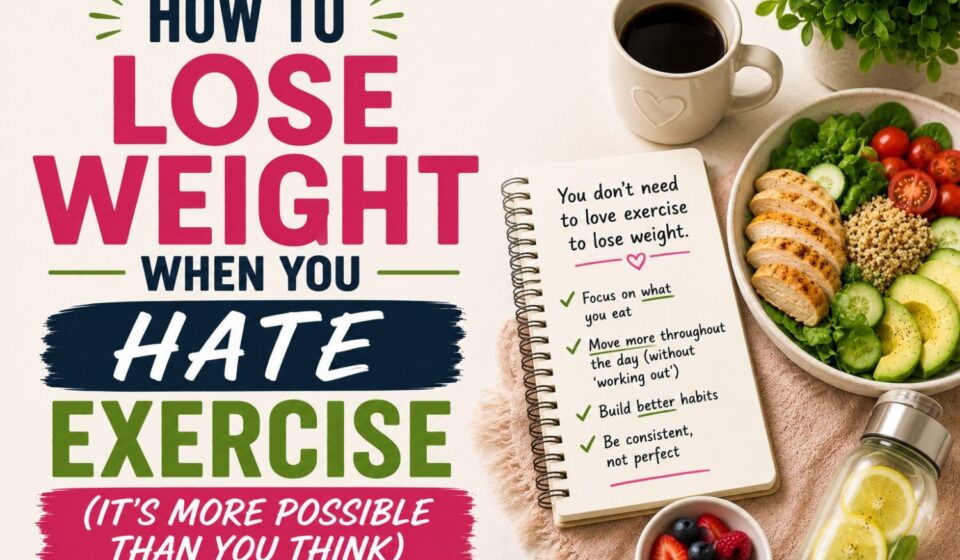
How to Lose Weight When You Hate Exercise (It’s More Possible Than You Think)

Good news: exercise is not required to lose weight. Here’s how to do it without it — and a few movement options even exercise-haters can tolerate.
Exercise hate is real. Not just “I’d rather not” but genuine, visceral aversion to gyms, running, group fitness classes, and anything that looks like a workout. If this is you, you’ve probably been told you just need to push through it, find something you love, or try harder.
This guide takes a different approach: acknowledging that exercise aversion is legitimate, that weight loss without exercise is entirely possible, and that there are movement options that don’t feel like exercise that might work even for the most committed exercise-hater.
The Most Important Thing to Know First
Diet drives 70–80% of fat loss. Exercise drives 20–30%.
This is not a minor technicality. It means that someone who manages their diet well but does zero formal exercise loses significantly more weight than someone who exercises consistently but eats without attention.
As covered in our article on does exercise actually help you lose weight, exercise alone produces an average of only 2–3 lbs of weight loss without dietary changes — because hunger often compensates for calories burned.
If you hate exercise, you are not at a fatal disadvantage for weight loss. You are at a modest disadvantage that diet can largely compensate for.
The Diet-First Strategy for Exercise-Haters
For people who genuinely aren’t going to exercise, diet does the full job. Here’s what matters most:
Create a Real Calorie Deficit
A 500-calorie daily deficit produces 1 lb of fat loss per week — entirely through dietary means, without any exercise. As covered in our guide to how many calories should I eat to lose weight, calculating your TDEE and subtracting 500 gives you a target that produces real fat loss without moving a muscle.
Eat Very High Protein
Without exercise stimulus, muscle preservation during a calorie deficit depends almost entirely on dietary protein. High protein is also the most powerful dietary tool for managing hunger — which matters more when you’re relying on diet alone.
Target 0.7–1g per pound of bodyweight. As covered in our guide to how much protein you actually need per day, this is non-negotiable for fat loss quality without exercise.
Focus on High-Volume, Low-Calorie Foods
Without exercise increasing your daily calorie expenditure, the calorie target is fixed and relatively low. Making that target as filling as possible requires prioritizing foods with low calorie density:
- Non-starchy vegetables at every meal
- Broth-based soups as starters
- Lean protein that provides satiety per calorie
- Fruit over calorie-dense snacks
Eliminate Liquid Calories Completely
Liquid calories — soda, juice, sweetened coffee, alcohol — provide almost no satiety while contributing hundreds of daily calories. For exercise-haters relying entirely on diet, eliminating these is the single highest-impact change available.
Movement That Doesn’t Feel Like Exercise
Here’s the thing about exercise-hating: most people who hate exercise hate formal exercise — gyms, classes, running, structured workouts. They don’t necessarily hate all movement.
The good news: the movement that contributes most to fat loss isn’t the formal exercise type anyway. It’s NEAT — non-exercise activity thermogenesis — the incidental daily movement of a reasonably active life.
Walking That Doesn’t Feel Like Exercise
Walking is the most effective fat loss movement available for exercise-haters — because it doesn’t feel like exercise. Nobody describes their evening walk with the dog, their stroll around a farmer’s market, or their wander through a city as “exercise.”
The reframe: don’t think of walking as exercise. Think of it as transport, exploration, socializing, listening to podcasts, or simply existing outdoors.
Walking as lifestyle, not workout:
- Walk to destinations within 20 minutes instead of driving or taking transit
- Take phone calls while walking instead of sitting
- Walk with a friend or family member — it’s socializing, not exercise
- Walk while listening to a podcast or audiobook you genuinely enjoy — the walk becomes the vehicle for entertainment, not the point
- Explore neighborhoods, parks, or trails that interest you
10,000 steps sounds like a fitness goal. An hour of walking around an interesting place while listening to something you love sounds like a pleasant afternoon. Both can be the same thing.
As covered in our guide to how to lose weight by walking, consistent daily walking produces meaningful fat loss without any gym, equipment, or exercise mentality.
Activities That Involve Movement Without Being “Exercise”
Gardening: One hour of gardening burns 200–400 calories — comparable to a moderate workout. It produces something tangible, involves fresh air, and never requires a gym.
Dancing: At home, alone, to music you love. Counts as movement. Nobody needs to know.
Swimming recreationally: Not lap swimming as training — swimming as floating around a pool on a warm day. Still burns 200–350 calories per hour.
Walking a dog: If you have one, this forces daily walks. If you don’t, dog-walking services pay people to do exactly this.
Active hobbies: Hiking, cycling for transport, kayaking, playing with children, bowling, mini-golf — any activity that involves movement without the label of “exercise” counts metabolically.
Housework and errands: Vigorously cleaning a house, carrying groceries, tidying up — all burn calories that add to daily NEAT.
Why You Might Hate Exercise (And What Might Change That)
This isn’t a lecture — but understanding why can occasionally point to solutions:
You hate how exercise feels: High-intensity exercise feels terrible for many people, particularly at the beginning of a fitness journey. Low-intensity movement (walking, gentle cycling, swimming) often feels nothing like “exercise” at all.
You hate the environment: Gyms are uncomfortable for many people — the culture, the crowds, the mirrors. Outdoor movement, home exercise, or non-gym activities entirely sidestep this.
You have bad associations: Years of gym class trauma, being made to feel inadequate about fitness, or previous painful experiences with exercise create genuine aversion. None of this makes you morally deficient.
You’ve only tried things you hate: Most people who “hate exercise” have primarily tried running and gyms. There are hundreds of forms of movement — rock climbing, dancing, martial arts, swimming, cycling, team sports, yoga, circus arts — most of which don’t feel like conventional exercise.
Exercise makes you feel sick: Some people feel nauseated or genuinely unwell during exercise, particularly at the beginning. This is common, real, and usually improves with gradual adaptation — but can make the entire exercise proposition feel aversive and irrational.
The Minimum Effective Dose (For Those Willing to Try Just a Little)
If you’re willing to do the minimum — just enough to capture the most important benefits without full exercise commitment:
Daily walking (the most valuable thing): Even 20–30 minutes of comfortable walking per day provides meaningful calorie burn, cortisol reduction, cardiovascular benefit, and mood improvement. This is the floor of movement that produces real fat loss and health benefits with virtually zero exercise feel.
Twice-weekly strength training: The most important exercise for body composition — but only two sessions per week, each 30 minutes, at home with dumbbells or resistance bands. Not a gym, not a class, not five days per week. As covered in our guides to how to lose weight with dumbbells at home and how to lose weight with resistance bands, effective home strength training requires no gym and minimal time.
This minimal combination — daily walks + two strength sessions per week — produces better fat loss and body composition outcomes than any amount of diet-only effort, while remaining genuinely minimal in time and intensity commitment.
What You’re Missing Without Exercise (Being Honest)
Being honest about what exercise-free weight loss doesn’t provide:
Muscle preservation is harder. Without strength training stimulus, more of the weight lost during a calorie deficit will include muscle — producing a “softer” appearance at a lower weight and a lower resting metabolic rate.
The calorie target is fixed lower. Without exercise adding to daily expenditure, you’re working with a smaller calorie allowance — which leaves less room for dietary variation and makes adherence more demanding.
Long-term maintenance is harder. As covered in our article on how to lose weight and keep it off, exercise is the single most consistent behavior among people who maintain weight loss long-term. Not because it burns many calories, but because it partially compensates for the metabolic rate reduction that follows weight loss.
Cardiovascular health improvements are reduced. Exercise provides health benefits beyond fat loss — heart health, insulin sensitivity, bone density, mood, cognitive function — that diet alone doesn’t provide.
These aren’t reasons to feel guilty for hating exercise. They’re practical considerations that might make a minimum dose of movement worth exploring even for confirmed exercise-haters.
The Bottom Line
You can lose weight without exercising — diet does 70–80% of the work, and a well-managed calorie deficit with high protein produces real fat loss regardless of exercise status.
For exercise-haters, the hierarchy:
- Diet-first approach — calorie deficit, high protein, high volume whole foods, zero liquid calories
- Daily walking reframed as lifestyle — not exercise, just movement as part of daily life
- Minimum dose strength training — twice per week, 30 minutes, at home, if willing
- Any enjoyable activity involving movement — gardening, dancing, swimming recreationally, active hobbies
The goal isn’t to love exercise. It’s to lose the weight. Diet gets you most of the way there — and some version of movement that doesn’t feel like a workout covers most of the rest.
For the complete dietary framework that drives fat loss without exercise dependency, our guide to how to get rid of belly fat covers everything in one place.
If you hate exercise — what movement, if any, have you found tolerable or even enjoyable? Share in the comments. Exercise-haters helping exercise-haters is genuinely valuable.
Stop Wondering What to Eat This Week
Get my free 7-Day High-Protein Weight Loss Meal Plan delivered straight to your inbox — a simple week of satisfying, protein-focused meals designed to make healthy eating easier without complicated calorie tracking.
- 7 full days of breakfast, lunch, dinner & snacks
- One complete shopping list for the whole week
- A quick high-protein food cheat sheet
- Simple daily tips to help you stay on track
Free PDF • Delivered by email • Unsubscribe anytime
Check your inbox 💜
Your free 7-day high-protein meal plan is on its way.