The Best Protein Powders for Weight Loss (What Actually Works and What’s Hype)

A practical guide to choosing the right protein powder — without the marketing nonsense
The protein powder market is enormous, confusing, and full of marketing claims that range from exaggerated to completely fabricated. “Thermogenic,” “fat-burning,” “metabolism-boosting” — most of these claims are meaningless.
The good news: protein powder itself is genuinely useful for weight loss. The bad news: most people are choosing based on marketing rather than what actually matters.
This guide cuts through the noise.
Why Protein Powder Helps With Weight Loss
Protein powder isn’t magic — it’s a convenient way to increase dietary protein intake. And as covered extensively in our guide to how much protein you actually need per day, adequate protein is the single most important dietary variable for fat loss quality.
High protein intake:
- Reduces hunger more powerfully than any other macronutrient
- Preserves muscle during a calorie deficit
- Burns 25–30% of its own calories through digestion (thermic effect)
- Reduces cravings and late-night snacking
Protein powder is simply a convenient, concentrated protein source — useful when whole food protein is impractical or insufficient.
What to Look for in a Protein Powder for Weight Loss
Before brand recommendations, the criteria that actually matter:
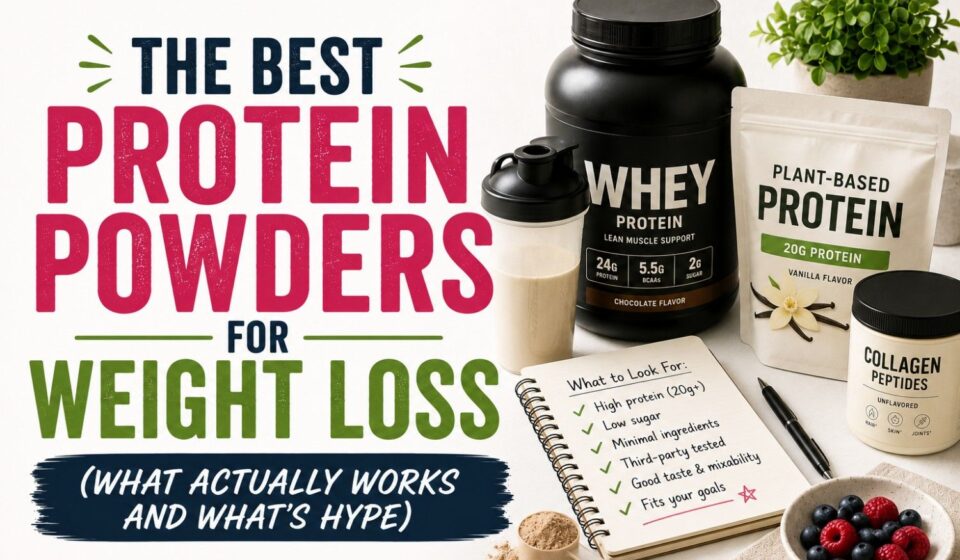
Protein per serving: Look for 20–30g protein per serving. Less than 20g provides inadequate muscle-supporting stimulus per serving.
Calories per serving: For weight loss, target under 150 calories per serving (ideally 100–130 for whey). Higher calorie powders contain significant fat and carbohydrates that reduce the protein-to-calorie efficiency.
Protein-to-calorie ratio: Divide protein grams by total calories. A good weight loss protein powder scores 0.15 or higher (e.g., 25g protein / 120 calories = 0.21).
Minimal added sugar: Under 3g sugar per serving. Flavored powders often contain 5–15g added sugar — negating much of the dietary benefit.
Ingredient list length: Shorter is generally better. A good protein powder needs protein, flavoring, and minimal additives. Proprietary blends with dozens of ingredients often sacrifice protein quality for marketing appeal.
Third-party testing: Look for NSF Certified for Sport, Informed Sport, or Informed Choice certifications — these verify that what’s on the label is actually in the product and that there are no undisclosed additives.
The Main Types of Protein Powder
Whey Protein
What it is: Derived from milk during cheese production. The most studied and most popular protein powder.
Why it’s good for weight loss:
- Fastest-digesting protein — ideal post-workout
- Highest leucine content of any protein source — the amino acid most responsible for triggering muscle protein synthesis
- Most extensively researched for weight loss and muscle preservation outcomes
- Generally the most affordable per gram of protein
Best for: Most people. Post-workout, breakfast shakes, anytime protein needs a boost.
Subtypes:
- Whey concentrate: 70–80% protein, some lactose and fat. Cheaper, slightly less pure.
- Whey isolate: 90%+ protein, minimal lactose. Better for lactose-sensitive people, slightly more expensive.
Not suitable for: People with dairy allergies or strict vegans.
Casein Protein
What it is: Also derived from milk — but digests much more slowly than whey (6–8 hours vs. 30–90 minutes).
Why it’s good for weight loss:
- The slow digestion produces sustained satiety — keeps you full for significantly longer than whey
- Particularly useful before bed — provides amino acids overnight, supporting muscle preservation during sleep
- Multiple studies have found casein superior to whey for hunger management
Best for: Before bed. As a meal replacement or substantial snack where sustained satiety matters more than post-workout protein delivery.
Not suitable for: Dairy allergies, strict vegans.
Pea Protein
What it is: Derived from yellow split peas. The best plant-based option for weight loss.
Why it’s good for weight loss:
- 20–25g protein per serving
- High in arginine, good overall amino acid profile
- Studies comparing pea protein to whey find similar muscle-building and satiety outcomes
- Allergen-friendly — dairy-free, gluten-free, soy-free
- More sustainable than dairy-based proteins
Best for: People avoiding dairy, vegans and vegetarians, anyone with dairy intolerance.
Limitation: Lower leucine content than whey — slightly less optimal for muscle protein synthesis, though the difference is modest.
Soy Protein
What it is: Derived from soybeans. A complete plant protein.
Why it’s decent for weight loss:
- Complete protein (all essential amino acids)
- 20–25g protein per serving
- Well-researched for both weight loss and cardiovascular health
Controversy: Soy contains phytoestrogens (isoflavones) — compounds that weakly mimic estrogen. The evidence that these affect hormones in adults at normal supplement doses is very weak — but the concern persists in some communities. People with thyroid conditions should discuss soy with their doctor.
Best for: Vegans and vegetarians who want an established plant protein option.
Hemp Protein
What it is: Derived from hemp seeds. A plant-based option.
Why it’s less ideal for weight loss: Lower protein percentage (50–60% vs. 90%+ for isolates) and higher fat and fiber content means more calories per gram of protein. Good nutritional profile but not the most efficient for fat loss goals.
Best for: People who want the additional omega-3 fatty acids and fiber alongside protein, and who aren’t optimizing primarily for protein-to-calorie efficiency.
Collagen Protein
What it is: Derived from animal connective tissue. High in glycine, proline, and hydroxyproline.
Important caveat for weight loss: Collagen is an incomplete protein — it lacks the essential amino acid tryptophan and has an amino acid profile that is not optimized for muscle protein synthesis. It should not be used as a primary protein powder for fat loss goals.
What collagen is good for: Skin elasticity during weight loss, joint health, gut lining support. A useful supplement — but not a replacement for complete protein powders.
Protein Powder Red Flags — What to Avoid
“Proprietary blends” — when the label lists a “blend” with multiple ingredients but only shows the total weight rather than individual amounts. This often hides underdosed ingredients behind impressive ingredient lists.
Amino acid spiking — some cheaper proteins are “spiked” with cheap amino acids (glycine, taurine, creatine) to inflate nitrogen content and make the protein content appear higher than it is. Third-party testing is the best protection.
Excessive added sugar — flavored powders with 10–20g sugar per serving essentially become desserts. Check the label.
“Weight loss specific” claims — most powders marketed specifically for fat loss charge a premium for additions (green tea extract, CLA, L-carnitine) that have minimal evidence for meaningful fat loss benefit. A plain high-quality whey or pea protein produces the same fat loss outcomes at lower cost.
Very cheap protein from unknown brands — protein quality varies significantly and unregulated products occasionally contain contaminants. A moderate price point from a reputable brand with third-party testing is worth the modest premium.
Practical Recommendations
Best overall for weight loss: Whey isolate — highest protein per calorie, best studied, most effective for muscle preservation.
Best for satiety/meal replacement: Casein — the slow digestion produces the most sustained fullness of any protein powder type.
Best plant-based: Pea protein — comparable to whey in studies, allergen-friendly, good amino acid profile.
Best budget option: Whey concentrate — slightly less pure than isolate but dramatically cheaper and adequate for most people.
Best before bed: Casein or a casein/whey blend.
How to Use Protein Powder for Weight Loss
As a meal supplement, not a meal replacement: Protein powder works best as a convenient addition to food — blended with Greek yogurt, mixed into oatmeal, or made into a shake alongside a piece of fruit. Replacing entire meals with shakes removes the fiber, micronutrients, and food satisfaction that whole foods provide.
Post-workout: Whey protein within 30–60 minutes after strength training maximizes the muscle protein synthesis window.
Before bed: Casein protein before sleep supports overnight muscle preservation — particularly relevant on days with significant training.
When whole food protein is impractical: Travel, busy mornings, days when cooking is impossible — protein powder as a convenience protein source prevents the protein gaps that undermine fat loss quality.
Target: Protein powder should help you hit 0.7–1g per pound of bodyweight — it shouldn’t be the primary protein source. Whole food protein (eggs, Greek yogurt, chicken, fish, legumes) should form the foundation.
Does Protein Powder Cause Weight Gain?
A common concern — and easily answered: protein powder doesn’t inherently cause weight gain. Excess calories cause weight gain.
If protein powder replaces lower-protein foods at similar or lower calories — it supports fat loss. If it’s added on top of an already adequate calorie intake — it contributes to a surplus. The powder is neutral; the context determines the outcome.
The Bottom Line
The best protein powder for weight loss:
- Provides 20–30g protein per serving
- Contains under 150 calories per serving
- Has minimal added sugar (under 3g)
- Is third-party tested
- Is either whey isolate (best overall), casein (best for satiety), or pea protein (best plant-based)
It doesn’t need to be “fat-burning,” “thermogenic,” or “metabolism-boosting” — these claims are marketing. It needs to be high quality protein at a good calorie cost, taken consistently to hit daily protein targets.
For the complete dietary framework that protein powder supports, our guide to how to get rid of belly fat covers everything in one place.
Which protein powder have you found works best for you — and did it make a noticeable difference to hunger and fat loss? Share in the comments.
Stop Wondering What to Eat This Week
Get my free 7-Day High-Protein Weight Loss Meal Plan delivered straight to your inbox — a simple week of satisfying, protein-focused meals designed to make healthy eating easier without complicated calorie tracking.
- 7 full days of breakfast, lunch, dinner & snacks
- One complete shopping list for the whole week
- A quick high-protein food cheat sheet
- Simple daily tips to help you stay on track
Free PDF • Delivered by email • Unsubscribe anytime
Check your inbox 💜
Your free 7-day high-protein meal plan is on its way.