
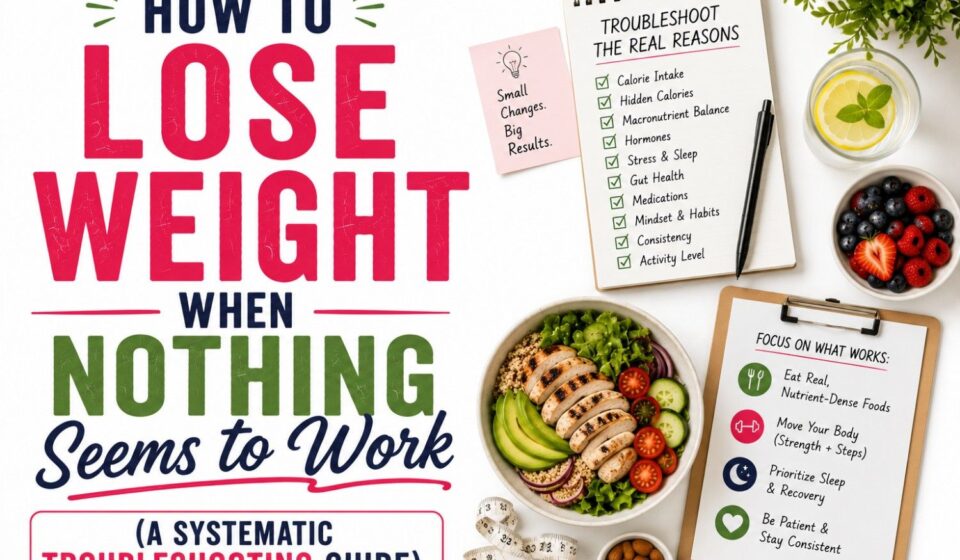

If you’ve tried everything and nothing has worked — here’s how to find what’s actually stopping you

“I’ve tried everything. Nothing works for me.”
This is one of the most common and most heartfelt statements in weight loss — and it deserves a serious, respectful response rather than more generic advice you’ve already tried.
Here’s the truth: if genuine effort has produced zero results over an extended period, something specific is preventing fat loss. The goal of this guide is to help you find what that something is — systematically, without dismissing your experience or defaulting to “try harder.”
First: What “Nothing Works” Usually Actually Means
Before troubleshooting, it’s worth being precise about what “not working” means:
Scenario A: You’ve tried multiple approaches for 2–4 weeks each, seen minimal results, and concluded nothing works. → Most approaches need 6–12 weeks of consistent application to show meaningful results. Short trials often fail before the approach has had time to work.
Scenario B: You’ve been consistent for 2–3 months and the scale hasn’t moved at all. → This is a genuine stall that warrants systematic investigation.
Scenario C: You’ve lost weight before but always regain it. → This is a maintenance problem, not a loss problem — different solutions apply.
Scenario D: You’ve been genuinely consistent for 6+ months with zero results. → This strongly suggests an underlying medical factor that lifestyle changes alone can’t overcome.
Knowing which scenario you’re in points toward the right solution.
The Systematic Troubleshooting Approach
Check 1: Is There Actually a Calorie Deficit?
This is the most important check — and the one most people skip because they’re certain they’re already in a deficit.
The hard truth: most people who believe they’re in a significant calorie deficit aren’t. Research consistently finds people underestimate intake by 20–40%. Hidden calories from cooking oils, drinks, condiments, tastes while cooking, and underestimated portion sizes routinely add 300–600 calories per day to people’s actual intake without their awareness.
How to verify: Track everything you eat for 2 weeks — every oil used in cooking, every drink, every sauce, every taste, with portions measured on a food scale rather than estimated. Compare to your calculated TDEE.
If honest tracking reveals you’re actually eating 200–400 more calories than you thought: the approach wasn’t wrong, the execution wasn’t matching the intention.
As covered in our guide to how many calories should I eat to lose weight, the deficit needs to be real — not theoretical.
Check 2: Is Protein Adequate?
Low protein intake during a calorie deficit produces the worst fat loss outcomes — more muscle loss, more hunger, lower metabolic rate, and worse body composition at any given weight.
If you’ve been restricting calories without prioritizing protein, you may have lost significant muscle alongside fat — lowering your resting metabolic rate to the point where the same calorie intake that once produced a deficit now doesn’t.
Target: 0.7–1g of protein per pound of bodyweight per day.
As covered in our guide to how much protein you actually need per day, this is the most important single dietary variable for fat loss quality — and many people eating “very little” are eating far too little protein specifically.
Check 3: Is Weekend Eating Eliminating the Weekday Deficit?
Five days of excellent eating can be completely undone by two days of significant surplus. At a 500-calorie weekday deficit for 5 days (−2,500) plus a 1,000-calorie surplus each weekend day (+2,000): the weekly net deficit is only 500 calories — producing approximately 0.14 lbs of fat loss per week. Scale noise would hide this entirely.
How to check: Track food on weekends with the same rigor as weekdays for 2 weeks. Many people are genuinely surprised by how much the weekend pattern differs from the weekday one.
Check 4: Is Sleep Affecting Results?
Sleep deprivation is one of the most powerful fat loss obstacles — and one of the most commonly overlooked. Chronic poor sleep elevates hunger hormones, worsens insulin sensitivity, raises cortisol, and produces food choices that undermine dietary intentions.
People sleeping under 6 hours can eat significantly more than they intend — and gain weight despite genuine efforts to eat less.
The check: Have you been sleeping 7–9 hours consistently? If not, improving sleep may unlock results that dietary changes alone haven’t produced.
As covered in our article on why sleep is the most underrated weight loss tool, sleep quality can determine whether fat loss happens at all.
Check 5: Is Chronic Stress Blocking Progress?
Cortisol — the stress hormone — directly promotes visceral fat storage and impairs fat mobilization. People under significant chronic stress can do everything else right and still see minimal fat loss because the hormonal environment is working against them.
Signs cortisol may be the issue:
- Weight concentrating in the belly specifically
- Poor sleep despite adequate time in bed
- Constant fatigue
- High life stress (work, relationships, financial, health)
- Difficulty losing weight despite genuine dietary effort
As covered in our article on does stress cause weight gain, this is a real biological mechanism that requires direct attention — not just dietary optimization.
Check 6: Has the Calorie Target Been Recalculated?
As you lose weight, your TDEE decreases — a lighter body burns fewer calories. The calorie target that produced a deficit at 200 lbs may produce no deficit at 180 lbs.
Additionally, metabolic adaptation from sustained restriction reduces calorie burn beyond what weight loss alone would predict.
The check: Recalculate your TDEE based on your current weight (not your starting weight) and adjust your calorie target accordingly. Many people who “stopped losing” are simply eating at their new maintenance rather than their new deficit.
Check 7: Are You Moving Enough Outside of Exercise?
NEAT — non-exercise activity thermogenesis — varies by thousands of calories per day between individuals and is significantly affected by sedentary jobs, lifestyle habits, and unconscious compensatory rest after exercise.
Someone who exercises for an hour but then sits completely for the other 15 waking hours may have lower total daily calorie burn than someone who doesn’t exercise but stays consistently active throughout the day.
The check: How many steps per day are you averaging? Under 5,000 steps is very sedentary. Increasing to 8,000–10,000 steps daily adds 300–500 calories of daily expenditure without the compensatory hunger that intense exercise sometimes produces.
Check 8: Is There a Medical Factor?
If you’ve honestly addressed all of the above — genuine deficit confirmed by tracking, adequate protein, consistent weekday and weekend adherence, adequate sleep, managed stress, recalculated calorie target, adequate daily movement — and still see zero results over 8+ weeks: a medical evaluation is the appropriate next step.
Medical conditions that directly prevent weight loss:
Hypothyroidism: Reduces metabolic rate, causes fatigue, promotes weight gain. Very common — particularly in women. Basic screening: TSH blood test.
Insulin resistance / PCOS: Chronically elevated insulin prevents fat release. As covered in our articles on how to lose weight with insulin resistance and how to lose weight with PCOS, these conditions require specific dietary approaches and sometimes medication.
Cushing’s syndrome: Excess cortisol production causes weight gain that doesn’t respond to dietary restriction.
Sleep apnea: Produces severe sleep disruption and cortisol elevation that impairs fat loss. Often undiagnosed.
Medications: Antidepressants, corticosteroids, antipsychotics, beta-blockers, insulin, antihistamines, certain contraceptives — all can cause weight gain that overrides dietary effort.
What to Do If You’ve Checked Everything
If you’ve systematically worked through all checks above and still can’t identify the obstacle — or if a medical condition has been identified but lifestyle changes haven’t been sufficient — medical support is the appropriate next step.
GLP-1 medications (Ozempic, Wegovy, Mounjaro) address the biological drivers of weight loss resistance — appetite dysregulation, insulin resistance, and the hormonal environment that makes conventional approaches insufficient for some people.
ClinicSecret offers telehealth medical evaluations to assess both the underlying factors preventing weight loss and whether prescription treatment is appropriate for your specific situation.
[Check if you qualify at ClinicSecret →]
This is a paid partnership. ClinicSecret is a licensed telehealth provider. Medication is only prescribed following a medical consultation and is not guaranteed.
The Mindset Piece
One more important thing: “nothing works for me” is almost never permanently true. It’s a statement about what you’ve tried so far — not about what’s possible for your body.
Every person who has lost significant weight went through a period where nothing seemed to work. The difference between people who eventually succeed and those who don’t isn’t genetics or metabolism — it’s finding and addressing the specific obstacle that was blocking progress.
Your obstacle exists. It’s findable. And once found, it’s almost certainly addressable.
The Systematic Checklist
Work through these in order:
- Track everything honestly for 2 weeks — is the deficit real?
- Is protein 0.7–1g per pound of bodyweight per day?
- Track weekends — is the weekend pattern eliminating the weekday deficit?
- Is sleep consistently 7–9 hours?
- Is chronic stress being actively managed?
- Has the calorie target been recalculated based on current weight?
- Are you getting 8,000+ daily steps beyond formal exercise?
- Has a medical evaluation been done (thyroid, insulin, medications)?
Most people find their answer in the first 3–4 checks. The answer is there — it just requires honest, systematic investigation to find it.
For the complete fat loss framework that works once the obstacle is removed, our guide to how to get rid of belly fat covers everything in one place.
Have you been through the “nothing works” experience and eventually found what was blocking you? Share in the comments — your experience could be exactly what someone else needs to read right now.