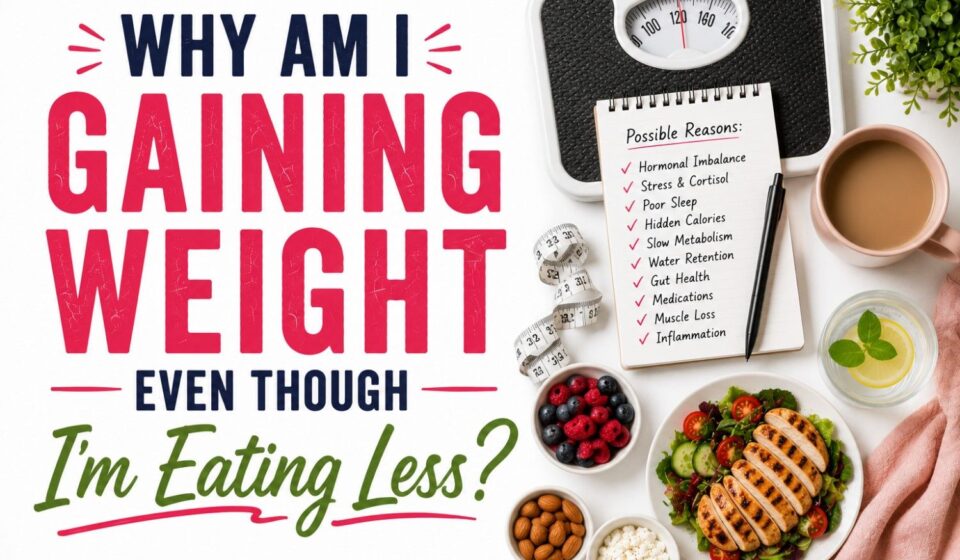

This frustrating experience has specific, explainable causes — here’s what’s actually happening

Few weight loss experiences are more demoralizing: you’re eating less than you ever have. The scale is going up. Nothing makes sense.
Before concluding that your metabolism is broken or that weight loss is impossible for you specifically — there are specific, identifiable reasons this happens. Most of them are fixable. All of them are explainable.
First: Is the Scale Actually Showing Fat Gain?
The scale measures everything — fat, muscle, water, glycogen, bone, and the contents of your digestive tract. When it goes up, it doesn’t necessarily mean fat increased.
Reasons the scale rises that have nothing to do with fat gain:
Fluid retention: Increased sodium, hormonal fluctuations, stress, new exercise, or certain medications cause the body to hold significantly more water. This can add 2–5 lbs to the scale within days — without a single gram of new fat.
Glycogen restoration: If you recently increased carbohydrate intake after a period of low-carb eating, glycogen stores rebuild — each gram of glycogen brings 3–4 grams of water with it. This can add 2–4 lbs rapidly without fat gain.
Muscle gain: If you recently started strength training, muscle tissue weighs more than fat per unit of volume. Gaining muscle while losing fat can keep the scale flat or push it slightly higher while body composition is actually improving dramatically.
Constipation: Several days of reduced bowel movements can add 1–3 lbs on the scale that disappear when regularity resumes.
Menstrual cycle: Women commonly gain 2–5 lbs of fluid in the days before menstruation. If you weighed yourself at different points in your cycle, this could explain an apparent increase.
The question to ask: Are your clothes fitting differently? Are measurements changing? Are you feeling different physically? If yes — the scale may be misleading you about what’s actually happening to your body composition.
If It Is Actual Weight Gain: The Real Reasons
If the scale increase is sustained over weeks and not explained by the above, something is genuinely going on. Here are the most common causes:
1. You’re Eating More Than You Think
This is the most common explanation — and the hardest to accept.
Research consistently finds that people underestimate their calorie intake by 20–40%. The gap between “I’m barely eating anything” and what’s actually being consumed can be several hundred calories per day.
The most common hidden calories:
- Cooking oils (2 tablespoons of olive oil = 240 calories — easy to pour generously without tracking)
- “Tastes” while cooking that never get counted
- Drinks — sweetened coffee, juice, alcohol — often not considered “food”
- Condiments and sauces — mayo, dressings, ketchup add up quickly
- “Healthy” snacks — nuts, nut butter, granola, avocado are nutritious but very calorie-dense
- Portions that feel small but are larger than estimated
The test: Track everything you eat for one week — every oil, every drink, every taste, every condiment, with portions measured rather than estimated. Most people who do this discover 300–600 calories of untracked daily intake.
As covered in our article on why you’re not losing weight, hidden calories are the most common reason people don’t lose weight despite genuine effort.
2. Your Metabolism Has Adapted
When you eat less, the body adapts by burning fewer calories — metabolic adaptation. This is the body’s evolutionary response to perceived food scarcity.
What metabolic adaptation looks like:
- You reduced calories significantly several weeks or months ago and lost weight initially
- Now you’re eating the same reduced amount but weight loss has stalled — or reversed
- You feel cold, tired, and hungry more than before
The adaptation is real. The body reduces resting metabolic rate, decreases NEAT (unconscious movement), and lowers thyroid hormone output to match the reduced intake.
The solution: Strength training to maintain muscle mass (which supports metabolic rate), and potentially a brief diet break at maintenance calories before resuming a smaller deficit.
3. You’ve Lost Muscle — Which Slowed Your Metabolism
If you’ve been eating very little without adequate protein and strength training, you may have lost significant muscle alongside fat. Less muscle means lower resting metabolic rate — meaning the same intake that once produced a deficit now maintains or even gains weight.
This is particularly common with crash dieting, very low calorie approaches, or long periods of calorie restriction without protein focus.
As covered in our article on what happens if you eat too few calories, aggressive restriction produces muscle loss that creates exactly this paradox — eating less but gaining weight because metabolic rate has dropped.
4. Stress Is Elevating Cortisol
Chronic stress elevates cortisol — which directly promotes fat storage (particularly visceral belly fat) and increases appetite for calorie-dense foods.
If you’ve recently increased life stress — work, relationships, finances, health concerns — cortisol may be working directly against your fat loss efforts regardless of dietary changes.
The cruel irony: the stress of trying to lose weight and failing can itself elevate cortisol enough to promote the weight gain you’re trying to prevent.
As covered in our article on does stress cause weight gain, this is a real, biological mechanism — not an excuse.
5. Sleep Deprivation
Poor sleep directly causes weight gain through multiple mechanisms:
- Ghrelin (hunger hormone) increases
- Leptin (fullness hormone) decreases
- Cortisol rises
- Food choices deteriorate (the tired brain craves calorie-dense food)
- Insulin sensitivity worsens
People who are sleep-deprived consistently eat more — even when trying to eat less — because the biological drives overpower dietary intentions. If your sleep has worsened recently, this could explain apparent weight gain despite reduced eating.
6. A Medical Condition Is Working Against You
Several medical conditions directly cause weight gain or make weight loss nearly impossible without treatment:
Hypothyroidism: An underactive thyroid reduces metabolic rate, causes fatigue, and promotes weight gain. Often underdiagnosed — particularly in women. A TSH test is the basic screening.
Insulin resistance / PCOS: Chronically elevated insulin promotes fat storage and prevents fat release. Eating less may not be sufficient without addressing the insulin component.
Cushing’s syndrome: Excess cortisol production from adrenal or pituitary issues produces significant weight gain that doesn’t respond to dietary restriction.
Medications: Antidepressants, corticosteroids, antipsychotics, beta-blockers, insulin, antihistamines, and contraceptives can all cause weight gain independently of dietary changes. If you started a new medication around the time the weight gain began, this may not be a coincidence.
If you’ve been genuinely consistent with reduced intake for 2+ months and are gaining weight, a medical evaluation is warranted.
7. You’re Eating Less — But More of the Wrong Things
Reducing overall food intake doesn’t automatically create the hormonal environment for fat loss. If the reduced intake is primarily refined carbohydrates and sugar (small portions of high-glycemic food), insulin spikes can remain high enough to promote fat storage despite fewer total calories.
The quality of the reduced intake matters alongside the quantity.
8. Weekend Eating is Eliminating the Weekday Deficit
You may genuinely be eating less Monday through Friday — but if Saturday and Sunday involve significant surplus, the weekly net may still be zero or positive.
As covered in our article on how to stop ruining your diet on weekends, weekend eating is the most commonly overlooked variable in weight management.
What to Do About It
Step 1: Track everything honestly for 2 weeks. Before concluding there’s a medical problem, eliminate the “hidden calories” explanation with honest, measured tracking.
Step 2: Check sleep. If sleeping under 7 hours, improving this may be the highest-leverage intervention.
Step 3: Assess stress levels. If chronically stressed, cortisol management needs to be part of the approach.
Step 4: Check protein intake. Low protein during calorie restriction produces muscle loss that lowers metabolic rate — the paradox of eating less and gaining weight.
Step 5: See a doctor. If genuine consistent effort produces no results or active weight gain over 6–8 weeks, thyroid function, insulin resistance, and medication effects are worth investigating.
When to Seek Medical Support
For people who have genuinely tracked carefully, maintained consistent dietary effort, addressed sleep and stress, and still experience weight gain or zero weight loss — ClinicSecret offers telehealth medical evaluations to assess underlying metabolic factors and whether prescription weight loss treatment is appropriate.
[Check if you qualify at ClinicSecret →]
This is a paid partnership. ClinicSecret is a licensed telehealth provider. Medication is only prescribed following a medical consultation and is not guaranteed.
The Bottom Line
Gaining weight while eating less has specific, explainable causes:
- The scale increase may not be fat (fluid, glycogen, muscle, hormonal fluctuation)
- Hidden calories producing more intake than believed
- Metabolic adaptation from sustained restriction
- Muscle loss reducing resting metabolic rate
- Cortisol from stress promoting fat storage
- Sleep deprivation driving hunger and poor choices
- An underlying medical condition
- Weekend eating eliminating weekday deficit
Work through these systematically. The answer is almost always findable — and once found, addressable.
For the complete framework that addresses these factors from the foundation up, our guide to how to get rid of belly fat covers everything in one place.
Have you experienced gaining weight while eating less — and what turned out to be the cause? Share in the comments. This is one of the most frustrating weight loss experiences and real answers from real people are invaluable.