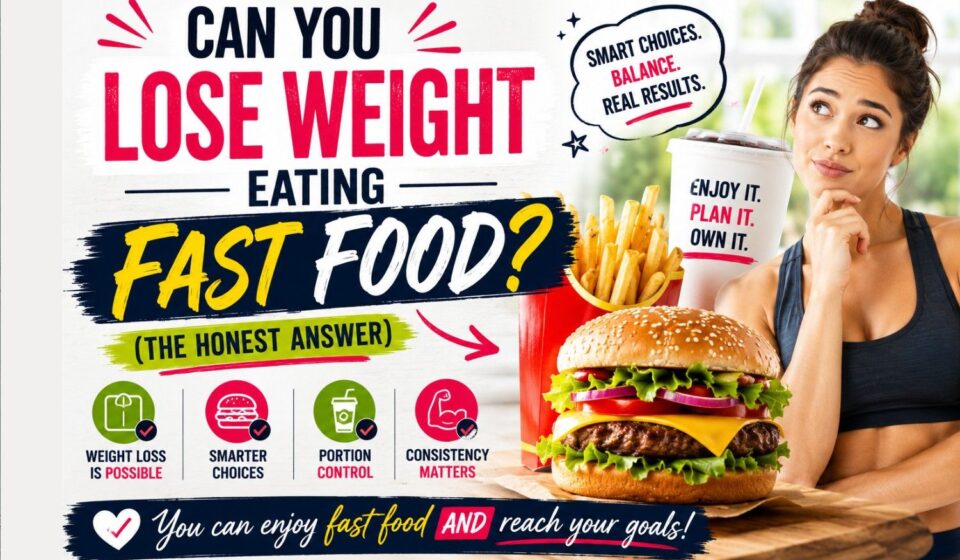

Yes — but there’s a catch. Here’s exactly how to make it work.
In 2004, Morgan Spurlock ate McDonald’s three times a day for 30 days and gained 24 lbs. His documentary “Super Size Me” became synonymous with the idea that fast food is inherently incompatible with weight loss.
Then in 2010, a nutrition professor named Mark Haub lost 27 lbs in 10 weeks eating primarily Twinkies, Oreos, and Doritos — while staying within a calorie deficit. His “Twinkie diet” experiment made international news.
Both stories contain truth. Neither tells the whole story.
The honest answer to whether you can lose weight eating fast food is: yes, technically — but it’s significantly harder than losing weight on whole foods, and most people shouldn’t try. Here’s why.
The Calories-In, Calories-Out Reality
Fat loss requires a calorie deficit. This is true regardless of where the calories come from. A Big Mac contains approximately 550 calories. If that Big Mac fits within your daily calorie target while maintaining a deficit, you will lose fat — just as you would eating 550 calories of chicken and salad.
This is the technical truth that “you can eat anything and lose weight if it fits your macros” proponents point to. And it’s correct as far as it goes.
The problem is what “fitting it into your macros” actually requires — and how difficult fast food makes that task.
Why Fast Food Makes Weight Loss So Much Harder
Calorie Density Is Extreme
Fast food is among the most calorie-dense food available. Common items:
- Big Mac: 550 calories
- Large fries: 490 calories
- Large soda: 310 calories
- Big Mac meal (large): 1,350 calories
A single fast food meal can contain 50–75% of a typical person’s daily calorie target. Eating fast food twice a day leaves almost no caloric room for anything else — making the deficit essentially impossible to maintain without extreme restriction at other meals.
Portion Sizes Overwhelm Satiety Signals
Fast food portions are engineered for palatability and volume — not satiety. The combination of high fat, high sugar, high salt, and high calorie density overrides normal fullness signals. Studies consistently find that people consume more total calories when eating fast food than when eating equivalent-calorie whole food meals — because the fast food doesn’t trigger adequate satiety.
Protein Is Often Inadequate
The macronutrient composition of most fast food is high fat and high carbohydrate, with relatively low protein per calorie. Low protein reduces satiety and impairs muscle preservation during fat loss — making the quality of weight lost worse.
Sodium Is Extremely High
A typical fast food meal contains 1,000–2,000mg of sodium — often the entire recommended daily limit or more, in one sitting. High sodium causes significant fluid retention that masks fat loss on the scale and creates the uncomfortable bloated feeling that discourages continued effort.
It Doesn’t Satisfy Real Hunger
The refined carbohydrates, sugar, and engineered palatability of fast food produce a blood sugar spike followed by a crash — leaving people hungry again within 1–2 hours of eating. This drives additional eating that compounds the calorie problem.
When Fast Food Is Unavoidable — How to Minimize the Damage
For people who genuinely cannot avoid fast food regularly — truck drivers, travelers, people with limited food access, those on tight schedules — here’s how to make the best of a difficult situation:
Best Fast Food Options by Chain
McDonald’s:
- Grilled chicken sandwich (without sauce): ~380 calories, 37g protein
- Side salad with light dressing: ~60 calories
- Egg McMuffin (breakfast): 300 calories, 17g protein
- Black coffee
Avoid: Big Mac meals, McFlurries, large fries, sweetened beverages
Subway:
- 6-inch sub on whole wheat with turkey or chicken, loaded with vegetables, light or no sauce: ~300–400 calories, 25–30g protein
- This is one of the most customizable fast food options and can be made reasonably nutritious
Chipotle:
- Burrito bowl (not burrito) with chicken or steak, black beans, salsa, and vegetables — skip the sour cream and cheese: ~450–550 calories, 35–45g protein
- Add guacamole for healthy fat but note the calorie contribution (~150 calories)
Avoid: The tortilla (adds 300 calories), large amounts of cheese and sour cream
Chick-fil-A:
- Grilled chicken sandwich: 320 calories, 28g protein
- Grilled nuggets: 140 calories per 8 pieces, 25g protein
Avoid: Fried options, milkshakes, large waffle fries
Wendy’s:
- Grilled chicken sandwich: 360 calories, 34g protein
- Plain baked potato: 270 calories
- Side salad
KFC:
- Grilled chicken pieces are significantly lower calorie than fried
- 2 pieces grilled chicken (breast + wing): ~300 calories, 45g protein
General fast food ordering strategy:
- Grilled instead of fried — always
- Skip or halve the fries — the biggest single calorie reduction available
- Water or unsweetened tea instead of soda — saves 200–400 calories instantly
- No or minimal sauces — mayo, special sauces, and dressings add 100–300 calories invisibly
- Single burger instead of double
- Skip the combo — order individual items to control portions
The Strategies That Make Fast Food Weight Loss Possible
Compensate at Other Meals
If you know you’re having fast food for lunch, make breakfast and dinner protein-rich and low-calorie to compensate. The daily total is what matters.
Example day:
- Breakfast: Greek yogurt + berries (200 calories, 18g protein)
- Lunch: Grilled chicken sandwich + side salad + water (450 calories, 35g protein)
- Dinner: Salmon + vegetables (450 calories, 40g protein)
- Total: 1,100 calories — a genuine deficit for most people
This works — but requires discipline at other meals that most people find unsustainable when fast food is a daily pattern.
Track Everything
Without tracking, fast food calorie intake is almost impossible to estimate accurately. The gap between “I had a salad and a small burger” and the actual calorie content of restaurant food is often 300–500 calories.
Tracking apps (MyFitnessPal, Cronometer) have calorie counts for major fast food chains that allow reasonably accurate logging.
Hydrate Heavily
The extreme sodium of fast food causes fluid retention. Drinking 3+ liters of water on days with fast food helps flush the sodium and reduces the scale impact of the fluid retention.
The Honest Assessment
Can you lose weight eating fast food? Yes — if you stay within your calorie target.
Is it a good strategy? No — for most people, for most goals. The combination of extreme calorie density, poor satiety, high sodium, low protein, and blood sugar instability makes maintaining a calorie deficit significantly harder than it needs to be.
When is it acceptable? As an occasional meal within an otherwise whole-food diet — or when genuinely no other option exists, using the strategies above to minimize damage.
When should you avoid it? As a regular dietary pattern when trying to lose weight. The deck is stacked against you.
What Works Better — And Isn’t Much Harder
The same time it takes to go through a drive-through is roughly the time it takes to assemble a genuinely nutritious meal at home — if the ingredients are prepared in advance.
Rotisserie chicken from a grocery store deli + a pre-washed salad bag + olive oil and lemon = 400 calories, 45g protein, minimal sodium, genuinely filling. It takes 3 minutes to assemble and costs less than most fast food meals.
As covered in our guide to how to lose weight without a kitchen, even people with severely limited cooking facilities can assemble nutritious, low-calorie meals without a stove — making fast food less necessary than most people assume.
The Bottom Line
Yes, you can lose weight eating fast food — if you choose carefully, track accurately, compensate at other meals, and stay within your calorie target.
But fast food makes weight loss significantly harder through calorie density, poor satiety, extreme sodium, blood sugar instability, and inadequate protein. Most people attempting to lose weight while eating fast food regularly will struggle far more than those eating primarily whole foods.
The practical hierarchy:
- Whole foods at home — easiest fat loss
- Grocery store ready-to-eat foods (rotisserie chicken, salad bags, Greek yogurt) — nearly as easy
- Fast food with careful ordering and tracking — significantly harder but possible
- Fast food without tracking or strategy — very unlikely to produce fat loss
For the complete dietary framework that makes fat loss achievable regardless of how much cooking you do, our guide to how to get rid of belly fat covers everything in one place.
Have you managed to lose weight while eating fast food regularly — and what strategies made it work? Share in the comments.
Stop Wondering What to Eat This Week
Get my free 7-Day High-Protein Weight Loss Meal Plan delivered straight to your inbox — a simple week of satisfying, protein-focused meals designed to make healthy eating easier without complicated calorie tracking.
- 7 full days of breakfast, lunch, dinner & snacks
- One complete shopping list for the whole week
- A quick high-protein food cheat sheet
- Simple daily tips to help you stay on track
Free PDF • Delivered by email • Unsubscribe anytime
Check your inbox 💜
Your free 7-day high-protein meal plan is on its way.