
The honest answer — minimum effective doses, optimal ranges, and when more stops helping
“How long do I need to work out to lose weight?” is one of the most practical weight loss questions — and one where the answer varies dramatically depending on what type of exercise you’re doing, what your goals are, and how your diet is managed.
The short answer: probably less than you think for fat loss, and more than you think for long-term maintenance. Here’s the full breakdown.

First: Exercise Duration Matters Less Than You Think
Before getting into specific time recommendations, the most important context: as covered in our article on does exercise actually help you lose weight, diet drives 70–80% of fat loss results. Exercise contributes 20–30%.
This means workout duration, while relevant, is not the primary determinant of fat loss outcomes. Someone who works out 20 minutes per day with a well-managed diet loses significantly more fat than someone who works out 90 minutes per day without dietary management.
Workout duration matters — but in the context of diet doing most of the work.
The Minimum Effective Doses by Exercise Type
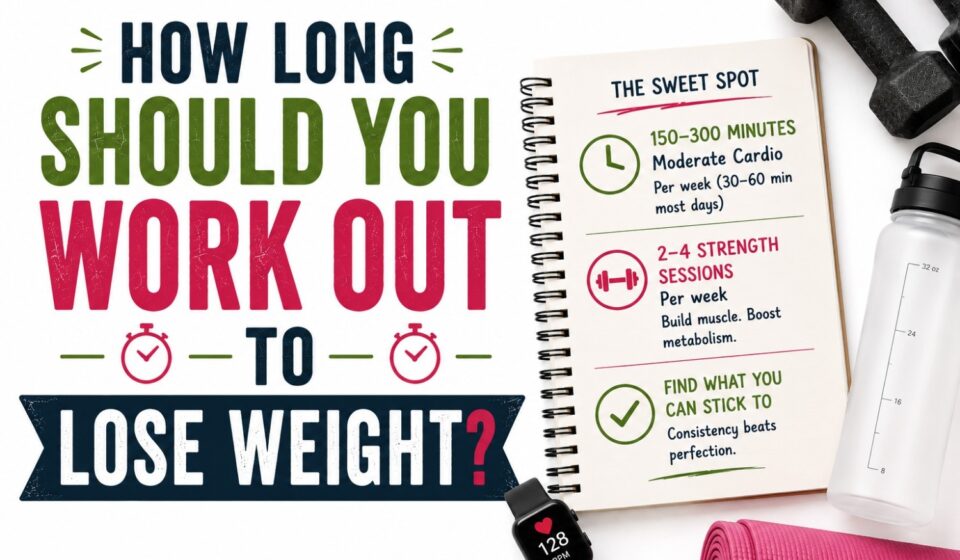
Strength Training: 30–45 Minutes, 3x Per Week
For body composition improvement — building muscle while losing fat — this is the minimum effective dose:
- Session length: 30–45 minutes
- Frequency: 3 times per week
- Weekly total: 90–135 minutes
This is enough time to complete 4–5 compound exercises (squats, deadlifts, rows, presses, hip hinges) with adequate sets and rest periods. It’s not optimal for maximizing muscle development — but it’s sufficient for meaningful body composition improvement alongside fat loss.
The research: Studies on resistance training frequency consistently find that 3 sessions per week produces comparable muscle development to 4–5 sessions per week in most people — with the same or better fat loss outcomes due to better recovery.
Going longer: Sessions beyond 60 minutes rarely produce proportionally better outcomes and increase recovery demands. 45–60 minutes is the sweet spot for most people.
Walking: At Least 30 Minutes Daily (More Is Better)
Walking is different from formal exercise — it doesn’t have a minimum session threshold in the same way because it can be accumulated throughout the day.
For fat loss support: 8,000–10,000 daily steps, which typically corresponds to 60–90 minutes of walking spread across the day.
For deliberate walking sessions: 30 minutes at a moderate pace produces meaningful cardiovascular and metabolic benefits. Longer sessions (45–60 minutes) produce proportionally more calorie burn.
The key distinction: Walk more in total — whether through deliberate sessions or accumulated daily movement — rather than worrying about a specific session length.
As covered in our guide to how to lose weight by walking, consistency matters more than duration for any individual session.
HIIT: 15–25 Minutes, 1–3x Per Week
HIIT is the most time-efficient fat loss exercise available. The high intensity produces:
- Large calorie burn during the session
- Significant EPOC (elevated metabolism for hours afterward)
- Insulin sensitivity improvements
- Cardiovascular adaptations
Session length: 15–25 minutes of actual work (not counting warm-up and cool-down) Frequency: 1–3 times per week maximum — more than this impairs recovery without proportional benefit
Important: HIIT is genuinely demanding and requires adequate recovery time. Two sessions per week is appropriate for most people; three is the upper limit before recovery becomes an issue.
Going longer: Sessions beyond 25–30 minutes at genuine high intensity are not possible — you’re either not working at true high intensity, or you’re accumulating fatigue that impairs recovery and subsequent training.
As covered in our guide to HIIT for beginners, the intensity matters more than the duration for HIIT.
Moderate Cardio (Running, Cycling, Swimming): 30–60 Minutes, 2–4x Per Week
Traditional steady-state cardio — moderate intensity sustained for a continuous period:
For fat loss contribution: 30 minutes produces meaningful calorie burn. 45–60 minutes produces more, without significantly increasing recovery demands.
Beyond 60 minutes: Long cardio sessions (60+ minutes) begin producing cortisol responses that can promote fat storage and impair muscle preservation — diminishing returns that become counterproductive for fat loss at excessive durations.
For weight management maintenance: Research on long-term weight maintenance finds that successful maintainers exercise approximately 60 minutes per day — most of this through walking and moderate activity rather than intense sessions.
The Optimal Weekly Exercise Structure for Fat Loss
Combining the above into a practical weekly plan:

Minimum effective weekly exercise for fat loss:
- Strength training: 3 × 30–45 minutes = 90–135 minutes
- Daily walking: 7 × 30–60 minutes = 210–420 minutes (accumulated throughout day)
- Total structured exercise: 90–135 minutes per week
Optimal weekly exercise for fat loss:
- Strength training: 3 × 45 minutes = 135 minutes
- HIIT: 1–2 × 20 minutes = 20–40 minutes
- Moderate cardio: 2 × 30–45 minutes = 60–90 minutes
- Daily walking: 60–90 minutes accumulated = 420–630 minutes
- Total structured exercise: 215–265 minutes per week (3.5–4.5 hours)
The difference in fat loss outcomes between minimum and optimal: Approximately 0.3–0.5 lbs per week additional fat loss at the optimal level — meaningful over months, but not dramatic week-to-week.
Does Longer = More Fat Loss?
Up to a point — yes. Beyond that point — no, and sometimes the reverse.
The diminishing returns curve:
- 0 → 30 minutes of exercise: Large additional fat loss benefit
- 30 → 60 minutes: Moderate additional benefit
- 60 → 90 minutes: Small additional benefit
- 90+ minutes: Negligible additional fat loss benefit, increasing recovery cost
When more exercise actually reduces fat loss:
- Excessive cardio volume increases cortisol chronically — promoting fat storage
- Inadequate recovery between sessions reduces training quality — less muscle stimulus
- Excessive exercise with insufficient food intake produces muscle loss rather than fat loss
- Exercise fatigue impairs the daily walking and NEAT that contribute to total calorie burn
The sweet spot for most people: 45–60 minutes of structured exercise per session, 4–5 times per week, alongside consistent daily walking.
The Frequency Question: Is It Better to Work Out Longer Less Often or Shorter More Often?
Research on this is relatively clear: frequency beats duration for both cardiovascular fitness and muscle development.
Three 30-minute sessions produce better outcomes than one 90-minute session at equivalent total volume — because frequency provides more regular stimulus for adaptation and more opportunities for calorie burn.
The practical implication: if time is limited, more frequent shorter sessions are more effective than fewer longer sessions.
What About “Fat Burning Zone” Duration?
The “fat burning zone” — moderate intensity exercise where a higher proportion of fuel comes from fat — is a real but often misapplied concept.
At low-to-moderate intensity (50–65% of max heart rate), a higher proportion of energy comes from fat than at high intensity. This leads to the recommendation to do long moderate-intensity cardio for fat loss.
The problem: the proportion of fat burned during exercise has minimal relevance to total fat loss. What matters is total calorie deficit across the day — and high-intensity exercise burns more total calories in less time, despite a lower fat proportion during the session.
For time-efficient fat loss: higher intensity exercise burns more calories per minute. For very long sessions (60+ minutes): moderate intensity is more sustainable and burns more total calories.
How Long Before You See Results From Exercise?
This is a common source of discouragement — people exercise for a month and see minimal scale change.
Why scale change from exercise is slow: As covered in our article on does exercise actually help you lose weight, exercise contributes 20–30% of fat loss outcomes. At 0.5 lbs per week total fat loss (from diet + exercise), exercise’s contribution is approximately 0.1–0.15 lbs per week — nearly invisible on the scale.
What exercise does change quickly (within weeks):
- Cardiovascular fitness (improved within 2–3 weeks)
- Energy levels
- Mood
- Muscle soreness (reduces rapidly as adaptation occurs)
- Strength (measurable within 2–3 weeks)
What exercise changes over months:
- Visible muscle development
- Body composition
- Resting metabolic rate from muscle gain
- Long-term fat loss acceleration
Exercise results are measured in months for body composition — not weeks. As covered in our article on how long does it take to see weight loss results, meaningful visible changes from exercise take 2–3 months of consistent training.
The Practical Answer: How Long Should YOUR Workouts Be?
If you have 20–30 minutes: HIIT twice per week + daily walking. This is the minimum time investment that provides meaningful metabolic benefit.
If you have 45 minutes, 3x per week: Full body strength training. The best use of limited time for body composition.
If you have 60 minutes, 4x per week: Strength training 3x + one HIIT or cardio session. Excellent total exercise structure.
If you have more time: Add daily deliberate walking sessions. Walking’s diminishing returns are lower than intense exercise — more walking almost always provides additional benefit.
The universal truth: Whatever duration you can maintain consistently is better than an optimal duration you abandon after 3 weeks. As covered throughout this blog, consistency beats perfection for long-term fat loss and health.
The Bottom Line
Strength training: 30–45 minutes, 3x per week — the most important exercise for body composition.
Walking: 30–90 minutes accumulated daily — the most consistent fat loss exercise habit.
HIIT: 15–25 minutes, 1–3x per week — most time-efficient for calorie burn.
Moderate cardio: 30–60 minutes, 2–4x per week — good for cardiovascular health and additional calorie burn.
The key insight: Longer workouts produce more fat loss up to approximately 60 minutes per session — beyond which diminishing returns kick in. More frequent shorter sessions beat fewer longer sessions for equivalent total time. And diet matters far more than any workout duration.
For the complete fat loss framework where exercise duration fits as one piece of a larger picture, our guide to how to get rid of belly fat covers everything in one place.
How long are your typical workouts — and have you found a duration that feels optimal for fat loss and sustainability? Share in the comments.
Stop Wondering What to Eat This Week
Get my free 7-Day High-Protein Weight Loss Meal Plan delivered straight to your inbox — a simple week of satisfying, protein-focused meals designed to make healthy eating easier without complicated calorie tracking.
- 7 full days of breakfast, lunch, dinner & snacks
- One complete shopping list for the whole week
- A quick high-protein food cheat sheet
- Simple daily tips to help you stay on track
Free PDF • Delivered by email • Unsubscribe anytime
Check your inbox 💜
Your free 7-day high-protein meal plan is on its way.