How to Lose Weight Swimming (Why It’s One of the Best Exercises You’re Probably Ignoring)

Full body, low impact, high calorie burn — and most people never consider it for fat loss
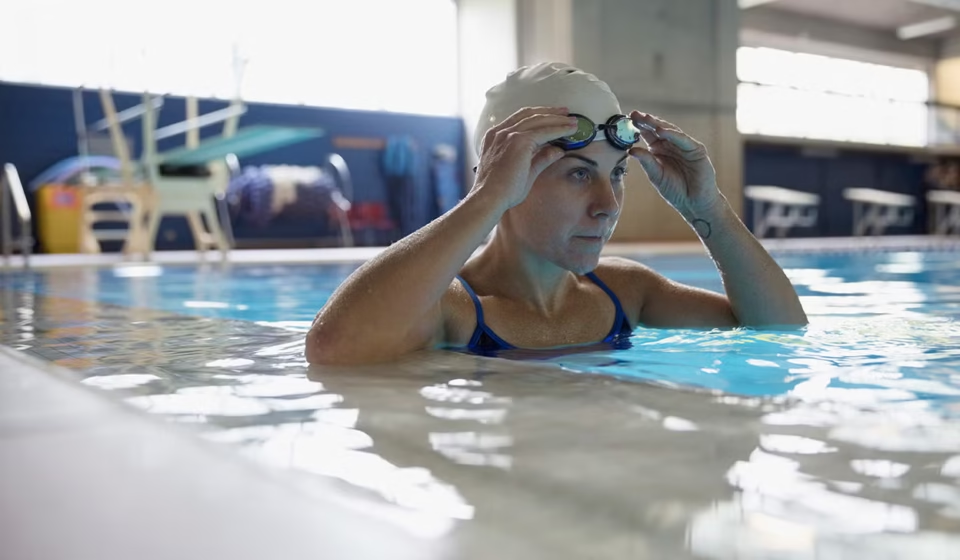
Swimming is one of the most effective fat loss exercises available — and one of the most underutilized. Most people think of it as a summer leisure activity or a rehabilitation exercise, not a serious fat loss tool.
That’s a mistake. Swimming burns more calories per hour than most gym exercises, builds muscle across the entire body simultaneously, has virtually zero injury risk, and provides a stress-reducing, cortisol-lowering effect that most land-based cardio can’t match. For the right person, it’s the single best exercise for fat loss available.

Here’s the complete guide to using swimming for weight loss effectively.
Why Swimming Is Exceptional for Fat Loss
High Calorie Burn
Swimming burns more calories than most people expect — particularly at higher intensities:
Approximate calorie burn per hour by stroke:
- Freestyle (moderate): 400–500 calories
- Freestyle (vigorous): 500–700 calories
- Breaststroke: 400–600 calories
- Butterfly: 600–800 calories (the most demanding stroke)
- Backstroke: 300–450 calories
- Water aerobics: 250–400 calories
For comparison:
- Walking (moderate): 200–300 calories/hour
- Cycling (moderate): 400–600 calories/hour
- Running (moderate): 450–600 calories/hour
- HIIT: 400–600 calories/hour
Swimming at moderate to vigorous intensity competes with running and HIIT for calorie burn — while being dramatically lower impact and accessible to people who can’t run due to joint issues.
Full Body Muscle Engagement
Every swimming stroke recruits muscles across the entire body simultaneously — upper body, core, and lower body all working together in each stroke cycle. This full-body muscular engagement produces genuine muscle-building stimulus alongside the cardiovascular benefit.
Over time, regular swimming builds lean muscle throughout the body — raising resting metabolic rate and improving body composition in ways that pure cardio doesn’t achieve.
The shoulders, back, core, and legs are particularly well-developed by swimming — producing the broad-shouldered, tapered physique associated with swimmers at all levels of the sport.
Low Impact — Accessible to Almost Everyone
Water supports approximately 90% of body weight — making swimming essentially impact-free. This makes it accessible and appropriate for:
- People with joint pain (knees, hips, ankles) who can’t run or do high-impact exercise
- Overweight individuals for whom impact exercise is painful or damaging
- Pregnant women (with appropriate precautions)
- Older adults with arthritis or reduced bone density
- People recovering from injury
- People with fibromyalgia or chronic pain conditions
For people in these categories, swimming may be the only form of vigorous exercise that’s comfortable — making it not just good for fat loss but essential.
Cortisol Reduction and Stress Management
Swimming has a distinctive psychological effect that most exercisers describe as uniquely calming — the combination of rhythmic movement, controlled breathing, water immersion, and sensory dampening produces a meditative state that significantly reduces cortisol.
This matters for fat loss. As covered in our guide to how to get rid of belly fat, chronically elevated cortisol is a primary driver of visceral fat accumulation and fat loss resistance. An exercise that burns significant calories while simultaneously reducing cortisol is particularly valuable.
The “Swimmer’s Appetite” Issue
There’s an important consideration that needs honest mention: swimming is notorious for stimulating appetite more than most exercise forms.
Research has found that swimming in cold water (below about 26°C/79°F) significantly increases appetite afterward — likely because the body seeks to restore thermal regulation. Many swimmers find themselves ravenously hungry after pool sessions, and overcompensate calorically.
This doesn’t eliminate swimming’s fat loss value — but it means dietary awareness is particularly important for swimmers. As covered in our article on why you’re always hungry, managing post-exercise hunger is essential for any calorie-burning exercise to produce fat loss.
Practical solutions: Eat a protein-rich meal or snack within 30 minutes of finishing a swim. Having protein ready immediately after prevents the excessive hunger compensation that undermines the caloric benefit of the session.
The Best Swimming Approaches for Weight Loss
Freestyle (Front Crawl) for General Fat Loss
Freestyle is the most efficient stroke for distance swimming and the best for sustained calorie burn. It’s also the most accessible stroke technically — most people can swim freestyle reasonably well without formal training.
For fat loss, freestyle intervals are particularly effective:
- Swim one length at hard effort
- Rest 20–30 seconds
- Repeat 15–20 times
This swim interval approach mimics HIIT on land — short bursts of high intensity followed by brief recovery, producing significant calorie burn and cardiovascular adaptation.
Breaststroke for Lower Intensity Sessions
Breaststroke is slower than freestyle but requires more force per stroke — particularly for the glutes, inner thighs, and chest. It’s the most accessible stroke for beginners and provides a solid moderate-intensity workout without technical difficulty.
Good for: recovery sessions, beginners, people who find freestyle tiring.
Butterfly for Maximum Intensity
Butterfly is the most calorically demanding stroke — burning 600–800 calories per hour — but also the most technically demanding. Most recreational swimmers can’t sustain butterfly for long periods.
If you can swim butterfly: even short butterfly intervals (one or two lengths) interspersed with freestyle rest lengths produce extraordinary calorie burn.
Water Aerobics for Low-Impact High Activity
Water aerobics classes use the water’s resistance for exercises that are essentially impossible to do with joint discomfort on land. For overweight, older, or joint-compromised individuals, water aerobics can provide 250–400 calories of calorie burn per session with minimal discomfort.
The social element of classes also improves adherence — one of the most important factors for long-term fat loss success.
How to Structure Swimming for Weight Loss
For complete beginners:
Start with 20–30 minute sessions focusing on continuous swimming at whatever pace is sustainable. Don’t worry about stroke technique initially — just keep moving.
Week 1–2: 20 minutes continuous, 3x per week Week 3–4: 30 minutes continuous, 3x per week Week 5–6: Begin adding intervals — alternate fast and easy lengths Week 7+: Build to 45–60 minute sessions with structured intervals
For intermediate swimmers:
A 45–60 minute structured session:
- 5 minute easy warm-up
- 20–30 minutes of interval work (fast lengths alternating with easy recovery lengths)
- 10 minutes of technique-focused slower swimming
- 5 minute easy cool-down
4 sessions per week produces meaningful fat loss when combined with dietary improvements.
Combining swimming with other exercise:
Swimming is excellent as the primary cardio modality alongside strength training on land. The combination of swimming for cardiovascular fat loss and strength training for muscle development and metabolism produces excellent body composition results.
As covered in our article on does cardio actually burn belly fat, the combination of cardio and strength training produces better fat loss and body composition outcomes than either alone.
Swimming Technique Tips for Better Fat Loss Results
You don’t need to be an elite swimmer to benefit — but a few technique improvements make sessions more effective and comfortable:
Breathing: The most common beginner mistake is holding breath or lifting the head too high to breathe. In freestyle, rotate to breathe every 2–3 strokes. Exhale continuously underwater to avoid the rush that causes head lifting.
Body position: A horizontal body position (head neutral, hips at surface level) dramatically reduces drag. Pressing the chest slightly down helps the hips rise to the surface.
Kick: A tight, quick kick from the hip (not the knee) is more efficient than a wide, slow kick. The kick should be a 6-beat pattern in competitive freestyle — but even a relaxed 2-beat kick helps.
Pacing: Most beginners start too fast and exhaust themselves in the first few lengths. A sustainable pace you can maintain continuously is more valuable for fat loss than going hard and stopping.
Consider lessons: Even one or two adult swimming lessons dramatically improves technique, which makes swimming more enjoyable and more effective for calorie burn.
Diet and Swimming for Fat Loss
The dietary strategies that maximize swimming’s fat loss benefit:
Prioritize protein throughout the day. Swimming builds muscle — protein provides the building blocks. As covered in our guide to how much protein you actually need per day, 0.7–1g per pound of bodyweight supports both the muscle-building and fat loss benefits of regular swimming.
Eat protein immediately after swimming. This is more important for swimmers than for most exercisers because of the post-swim appetite surge. A protein shake, Greek yogurt, or cottage cheese immediately after a session blunts the excessive hunger that can wipe out the caloric deficit from the swim.
Don’t significantly increase food intake. Many swimmers unconsciously eat far more than they burned in a session — eating “because they exercised.” Track food for a week or two to verify that the calorie deficit is actually being maintained.
Stay well hydrated. It sounds counterintuitive, but swimmers often underestimate fluid loss because they don’t feel sweaty in the pool. Drink adequately before and after sessions.
Swimming vs Other Cardio for Fat Loss
| Exercise | Calories/Hour | Impact | Full Body? | Cortisol | Accessibility |
|---|---|---|---|---|---|
| Swimming | 400–700 | None | Yes | Low | Pool required |
| Running | 450–600 | High | Partial | Moderate | Excellent |
| Cycling | 400–600 | Low | Partial | Low-moderate | Good |
| HIIT | 400–600 | High | Yes | High | Excellent |
| Walking | 200–300 | Low | Partial | Low | Excellent |
| Yoga | 170–350 | None | Yes | Very low | Excellent |
Swimming competes with the highest-calorie-burning land exercises while offering the lowest impact and excellent cortisol management. Its main limitation is accessibility — not everyone lives near a pool or can afford regular pool access.
Who Should Prioritize Swimming for Fat Loss
Ideal candidates:
- People with knee, hip, or ankle joint pain who can’t run
- Overweight individuals for whom impact exercise is uncomfortable
- People who already swim and enjoy it
- People looking for a low-stress exercise that doesn’t spike cortisol
- People with chronic pain conditions
- Older adults seeking vigorous exercise with minimal injury risk
Less ideal if:
- No convenient pool access
- Discomfort with water or swimming
- Need maximum calorie burn per unit of time and can do land-based HIIT
- Post-swim hunger management is very difficult
What to Expect: A Realistic Timeline
Weeks 1–4: Building swimming fitness. Calorie burn per session increasing as endurance improves. Scale may not move dramatically yet but cardiovascular fitness improving rapidly.
Weeks 4–8: Consistent fat loss if dietary deficit is maintained. Body composition changing — swimming is building muscle alongside burning fat, so scale movement may be slower than pure fat loss rate suggests. Clothes fitting differently.
Weeks 8–16: Significant body composition improvements. The full-body muscle development from swimming producing visible changes in shoulders, back, arms, and core. Combined with dietary approach producing clear fat loss.
For people combining swimming with good nutrition and adequate protein, results over 12 weeks are genuinely impressive — particularly for body composition rather than just scale weight.
The Bottom Line
Swimming is one of the most underrated fat loss tools available — high calorie burn, full body muscle development, zero impact, and genuine cortisol reduction in a single exercise form.
Its main practical considerations are pool access and post-swim hunger management. For people who have access and can manage their appetite after sessions, swimming competes with the best fat loss exercise options available.
For the complete dietary framework that makes swimming’s calorie burn translate into actual fat loss — particularly protein targets and dietary quality — our guide to how to get rid of belly fat covers everything that matters most alongside any exercise approach.
Do you swim for fitness or weight loss? Share your experience in the comments — including any tips for managing post-swim hunger, which is the most common challenge swimmers face.
Stop Wondering What to Eat This Week
Get my free 7-Day High-Protein Weight Loss Meal Plan delivered straight to your inbox — a simple week of satisfying, protein-focused meals designed to make healthy eating easier without complicated calorie tracking.
- 7 full days of breakfast, lunch, dinner & snacks
- One complete shopping list for the whole week
- A quick high-protein food cheat sheet
- Simple daily tips to help you stay on track
Free PDF • Delivered by email • Unsubscribe anytime
Check your inbox 💜
Your free 7-day high-protein meal plan is on its way.