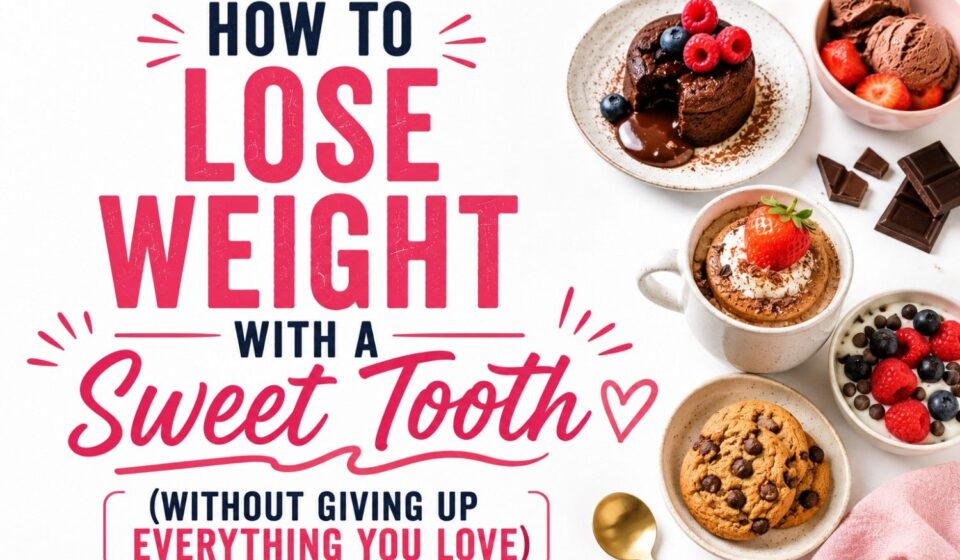
How to Lose Weight With a Sweet Tooth (Without Giving Up Everything You Love)

You don’t have to eliminate sugar to lose weight — you have to manage it smarter

“Just stop eating sugar.” Easy advice to give. Nearly impossible to sustain if sweets are a genuine part of how you enjoy food and life.
The good news: losing weight with a sweet tooth doesn’t require eliminating every sweet thing you enjoy. It requires understanding what’s actually driving the sweet cravings, making strategic swaps that satisfy without derailing progress, and building a dietary approach that accounts for the reality of who you are — not the ideal version of yourself who never wants dessert.
Why Sweet Cravings Are So Powerful
Sweet cravings aren’t a character flaw — they’re biology.
Dopamine response: Sugar triggers the brain’s reward system, releasing dopamine in ways that reinforce the behavior. The more frequently you eat sugar, the more your reward system calibrates to expect it — and the more uncomfortable its absence feels.
Blood sugar fluctuations: High-sugar foods cause rapid blood sugar spikes followed by crashes. The crash produces genuine physiological craving for more sugar to restore blood glucose — creating a cycle that feels irresistible because it partially is.
Habit and emotional association: For most people, sweet foods are deeply embedded in routines, celebrations, comfort, and reward. These associations are powerful regardless of physical hunger or blood sugar.
Palatability engineering: Processed sweet foods are specifically designed to override normal satiety signals — making them genuinely harder to stop eating than whole foods.
Understanding these drivers points directly to solutions that work with them rather than demanding willpower to overcome them.
Strategy 1: Stabilize Blood Sugar — Reduce the Craving Cycle
The most powerful dietary intervention for reducing sweet cravings is stabilizing blood sugar — breaking the spike-crash cycle that drives biological sugar demand.

How:
- Eat protein at every meal — protein slows glucose absorption and reduces post-meal blood sugar spikes
- Include fiber with every meal — fiber slows digestion and blunts blood sugar response
- Reduce refined carbohydrates alongside sugar — white bread, white rice, and processed cereals produce similar blood sugar patterns to sugar itself
- Don’t skip meals — arriving at meal times with very low blood sugar produces the most powerful sweet cravings
Within 1–2 weeks of consistently stabilized blood sugar, most people notice a significant reduction in the intensity of sweet cravings — not elimination, but reduction from overwhelming to manageable.
As covered in our guide to how much protein you actually need per day, adequate protein is the foundation of this blood sugar stabilization.
Strategy 2: Make Smart Swaps — Satisfy the Sweet Without the Damage
The goal isn’t to never eat anything sweet. It’s to satisfy the sweet craving at lower caloric and blood sugar cost.
The best sweet swaps:
Fresh fruit instead of candy or pastries: Fruit provides sweetness alongside fiber, water content, and micronutrients that slow absorption and improve satiety. A bowl of mixed berries satisfies a sweet craving at 60–80 calories with 4–6g fiber — versus 300+ calories for a pastry with minimal satiety.
Berries specifically — blueberries, strawberries, raspberries — are the lowest-sugar, highest-antioxidant fruit choices. A large bowl feels indulgent at minimal caloric cost.
Dark chocolate (70%+ cocoa) instead of milk chocolate: Dark chocolate provides genuine chocolate satisfaction at fewer calories per serving than milk chocolate, with:
- Less sugar per square
- More flavanols (which have real health benefits)
- Higher fat content that slows eating and improves satiety
20–30g (2–3 squares) of 70–85% dark chocolate is a genuinely satisfying sweet treat at 100–150 calories that fits into any reasonable daily target.
Greek yogurt with honey and berries instead of ice cream: 200g plain Greek yogurt + 1 teaspoon honey + berries = approximately 160 calories, 17g protein, genuine sweetness. Versus 300–400 calories of ice cream with essentially no protein and rapid satiety loss.
The protein in Greek yogurt extends the feeling of satisfaction significantly longer than ice cream — and the sweet combination is genuinely enjoyable.
Frozen banana “nice cream”: Blend frozen bananas until smooth — produces a creamy, ice cream-like texture at approximately 100 calories per banana, with zero added sugar and real fiber. Add cocoa powder for chocolate version. Genuinely good and satisfies ice cream cravings.
Medjool dates for candy cravings: Dates are extremely sweet — almost candy-like — and provide 1.6g fiber per date alongside the sweetness. 1–2 dates satisfies a sugar craving at 50–70 calories with natural fiber that slows absorption.
Protein-based desserts: Cottage cheese blended with cocoa powder and honey. Greek yogurt cheesecake (cottage cheese + cream cheese + lemon + sweetener, chilled). Protein mug cakes (protein powder + egg + banana, microwaved). These provide dessert satisfaction with 15–25g protein per serving — dramatically changing the macronutrient profile of “dessert.”
Strategy 3: Plan Your Sweets — Don’t Let Them Happen to You
The difference between sweets that derail fat loss and sweets that don’t is planning versus impulse.
Planned indulgence: You decide in advance that Saturday’s dinner will include dessert. The rest of the day’s eating accounts for this. The dessert is enjoyed without guilt because it was planned and fits the day’s total.
Impulse eating: You pass a bakery, the cookies look incredible, you buy three and eat them in the car. This wasn’t in the plan, wasn’t accounted for, produces guilt, and may trigger “I’ve already ruined today, might as well keep eating” thinking.
The solution: plan for sweet treats rather than trying to eliminate them through willpower and then eating them impulsively anyway.
The planned sweet treat approach:
- Decide in advance what and when your sweet treat will be for the week
- Account for it in your daily calorie target on that day
- Eat it mindfully — sitting down, without screens, savoring it
- Then move on without guilt
This approach satisfies the psychological need for sweets and social enjoyment while maintaining control over total weekly intake.
Strategy 4: Reduce the Sweetness Threshold Over Time
This is a slower strategy but one that produces lasting change: gradually reducing the sweetness of what you eat trains the palate to find less sweet things satisfying.
How it works:
- If you take 3 teaspoons of sugar in coffee, reduce to 2, then 1, then none — over weeks or months
- Replace sweetened yogurt with plain plus a small amount of honey, then less honey
- Choose 70% dark chocolate, then 80%, then 85%
- Swap sweetened cereals for oats with a small drizzle of honey
Over months, the threshold for what tastes “sweet enough” shifts. Foods that seemed not sweet enough initially taste satisfying. The cravings for very sweet things become less intense.
This isn’t about deprivation — it’s about recalibration. Most people who do this find that after several months, very sweet foods they used to crave actually taste too sweet.
Strategy 5: Address the Emotional Component
For many people with a sweet tooth, sugar isn’t just about taste — it’s about comfort, reward, stress relief, and emotional regulation.
If you find yourself reaching for sweets when stressed, bored, sad, or anxious — the sweet craving is functioning as an emotional coping mechanism. Addressing this requires building alternative emotional regulation tools alongside dietary management.
As covered in our article on how to lose weight with emotional eating, the goal isn’t to eliminate the emotional need — it’s to build alternative ways to meet it that don’t involve food.
Short-term alternatives for sweet-comfort moments:
- A cup of herbal tea (peppermint, liquorice root, or fruit teas have natural sweetness)
- A brief walk — changes the environment that’s triggering the craving
- A small portion of a genuinely satisfying sweet swap from the list above
Strategy 6: The 80/20 Approach to Sweets
Perfectionism about sugar elimination is the enemy of sustainable progress. If eliminating all sweets is what you’re attempting, the inevitable moment you eat something sweet becomes a failure — triggering the “might as well give up” response.
The 80/20 approach: 80% of the time, choose the lower-sugar, higher-protein options. 20% of the time, enjoy the real thing in reasonable portions.
A piece of birthday cake at a party is not a dietary failure. Ice cream on a summer evening is not the end of your progress. These moments, planned and enjoyed without guilt, are part of a sustainable long-term relationship with food.
The damage to fat loss from occasional planned treats is minimal. The damage from the guilt, restriction, and compensatory overeating cycle that perfectionism produces is significant.
What to Do When Cravings Hit Hard
When a sugar craving is intense and immediate:
- Drink a large glass of water first. Thirst and mild dehydration amplify cravings. 10 minutes after drinking, assess whether the craving is as intense.
- Wait 10 minutes before acting. Cravings peak and then subside. Most intense cravings reduce significantly within 10–15 minutes if not immediately acted upon.
- Have your go-to sweet swap ready. The planned response to cravings is more effective than deciding in the moment. Keep dark chocolate, berries, or Greek yogurt available as the default.
- If you eat the sweet, eat it slowly and mindfully. Eating quickly while distracted produces less satisfaction per calorie — you eat more before feeling satisfied. Eating one piece of chocolate slowly and consciously often satisfies as much as three pieces eaten mindlessly.
The Bottom Line
Losing weight with a sweet tooth is entirely possible — but it requires working with the sweet preference rather than against it.
The strategies that work:
- Stabilize blood sugar through protein, fiber, and reduced refined carbs — reduces craving intensity
- Make strategic swaps (dark chocolate, berries, Greek yogurt, frozen banana) — satisfies sweet cravings at lower caloric cost
- Plan sweet treats deliberately rather than eating impulsively
- Gradually reduce sweetness threshold over time
- Address the emotional component if sweets are stress or comfort eating
- Use the 80/20 approach — perfectionism produces worse outcomes than planned flexibility
A sweet tooth isn’t an obstacle to weight loss. It’s a preference to accommodate intelligently — and there are enough genuinely delicious lower-calorie sweet options that accommodation doesn’t require deprivation.
For the complete dietary framework that accommodates real food preferences alongside fat loss, our guide to how to get rid of belly fat covers everything in one place.
What’s your go-to sweet swap that actually satisfies — and did it take time to get used to it? Share in the comments.