
You don’t have to choose between a social life and fat loss — but alcohol does require a strategy

“Cut out alcohol completely.” It’s standard weight loss advice. It’s also advice that many people simply won’t follow — and that’s a legitimate position, not a character flaw.
Social drinking is part of how many people connect, celebrate, and enjoy life. Telling someone to eliminate it entirely as a prerequisite for weight loss is a recipe for either deprivation-driven failure or choosing between their social life and their health goals.
The good news: you don’t have to choose. You do have to be strategic. Here’s exactly how.
The Honest Case Against Alcohol for Weight Loss
Before the strategy, it’s worth being clear about what alcohol actually does — because understanding it makes the strategy make more sense.
Alcohol calories are real and significant:
- Beer: 150–350 calories per drink (light beer vs. craft IPA)
- Wine: 120–150 calories per glass
- Spirits: 65–100 calories per shot
- Cocktails: 150–500+ calories each
Three drinks on a Friday night: 400–1,000 calories — depending heavily on what you’re drinking.
Alcohol specifically promotes fat storage: When alcohol is in your system, your liver prioritizes metabolizing it over everything else — essentially pausing fat burning for the duration. Any food eaten while drinking is more likely to be stored as fat rather than used for energy.
Alcohol increases appetite — especially for calorie-dense food: Alcohol lowers inhibitions around food choices and stimulates appetite. The post-drinking pizza, the late-night snacking — these often add more calories than the drinks themselves.
Alcohol disrupts sleep: While alcohol helps you fall asleep faster, it dramatically disrupts sleep architecture — reducing deep sleep and REM sleep. As covered in our article on why sleep is the most underrated weight loss tool, poor sleep elevates hunger hormones and impairs fat loss regardless of dietary effort.
Alcohol reduces testosterone: Regular alcohol consumption lowers testosterone levels — impairing muscle maintenance and fat mobilization.
That’s the honest case. Now here’s how to work around it.
Strategy 1: Choose Lower-Calorie Options
The biggest single lever available: what you drink matters enormously.
Lowest calorie options:
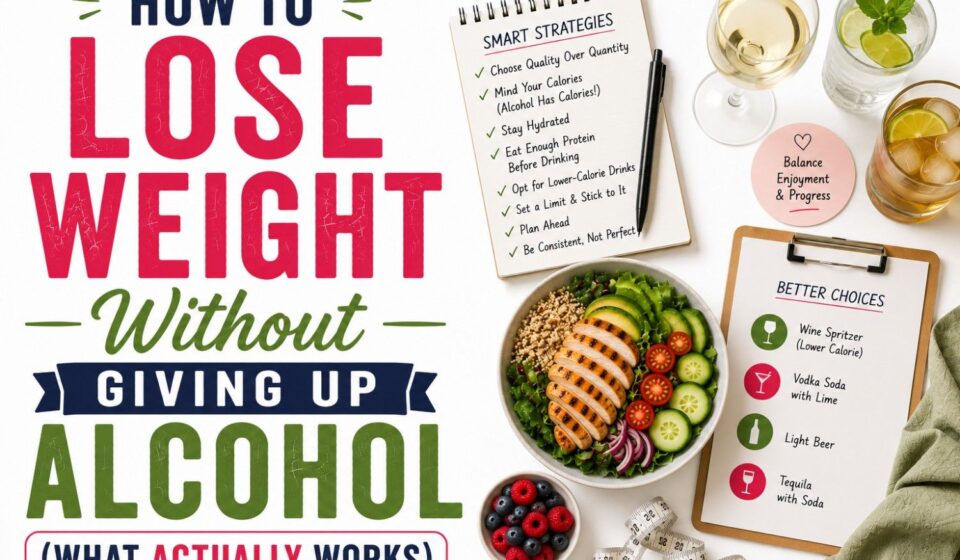
- Spirits with soda water and lime — vodka soda, gin and soda, tequila soda: 65–80 calories per drink. The lowest calorie way to drink alcohol socially.
- Dry wine (white or red) — 120–130 calories per standard glass. Significantly lower than sweet wines or rosé.
- Light beer — 95–110 calories vs. 200–350 for craft IPAs or stouts.
- Champagne/prosecco — 90–100 calories per glass, lower than most wines.
Highest calorie options to avoid:
- Cocktails with juice, simple syrup, or cream liqueurs — 200–500+ calories each
- Craft beers, stouts, IPAs — 200–350 calories
- Sweet wines and dessert wines
- Ciders — often 150–200 calories
- Premixed canned cocktails — often surprisingly high in sugar and calories
Simply switching from cocktails to spirits and soda can reduce alcohol calorie intake by 50–70% without reducing how much you drink.
Strategy 2: Set a Weekly Drink Budget
Rather than trying to eliminate drinking or drinking without awareness, set a specific weekly drink allowance — and stick to it.
How to set it:
- Decide how many drinks per week fits into your calorie budget
- For most people trying to lose weight: 3–7 drinks per week is manageable
- Distribute them across the week however works for your social life
- Count them and stop when the budget is reached
This transforms drinking from a variable that undermines fat loss into a planned component of it — the same way you’d budget for a planned treat.
Strategy 3: Account for Alcohol in Your Daily Calorie Budget
Alcohol has calories. Those calories count. The mistake most people make: drinking without accounting for the calories, which pushes daily intake significantly above the deficit target.
The solution: on days you’ll drink, reduce calorie intake from food to accommodate the alcohol calories.
Example:
- Daily calorie target: 1,700 calories
- Planning to have 2 vodka sodas: ~160 calories
- Food budget that day: 1,540 calories
- Result: still in deficit despite drinking
This requires planning — knowing you’ll drink that evening means eating lighter at lunch or dinner. It’s manageable and it works.
Strategy 4: Eat Before Drinking
This is one of the most practically impactful strategies:
Eat a protein-rich meal before drinking. This:
- Slows alcohol absorption — blood alcohol rises more slowly and peaks lower
- Reduces the appetite stimulation effect of alcohol on an empty stomach
- Significantly reduces the post-drinking hunger that drives late-night eating
- Maintains blood sugar stability that prevents the 2am food cravings
Arriving at any drinking occasion genuinely hungry is the fastest route to a 1,000+ calorie evening. A satisfying protein-rich meal beforehand prevents this reliably.
Strategy 5: Alternate With Water
This simple strategy reduces total alcohol consumption naturally — without requiring conscious restraint mid-evening:
One alcoholic drink → one full glass of water → next alcoholic drink
Benefits:
- Reduces total drinks consumed by 30–50% without feeling deprived
- Prevents dehydration that worsens next-day hunger and food choices
- Reduces the rapid drinking pace that produces higher consumption
- Significantly reduces hangover effects
Most people who adopt this habit find they naturally drink less and feel better — without it feeling like restriction.
Strategy 6: Manage the Day After
The day after drinking is often where significant dietary damage occurs — not from the alcohol itself:
The hangover hunger: Alcohol disrupts sleep and blood sugar regulation. The next day, many people wake up with intense cravings for calorie-dense, high-fat, high-carbohydrate comfort food. A greasy breakfast, fast food, excessive snacking — the “hangover food” day can easily add 500–1,000 extra calories beyond normal intake.
The “I already ruined it” mentality: Some people treat the morning after drinking as a reason to abandon the entire day’s dietary intentions — compounding the alcohol calories with unrestricted eating.
The strategy:
- Eat a protein-rich breakfast the morning after — this stabilizes blood sugar and reduces hangover cravings more effectively than carbohydrate-heavy comfort food
- Drink plenty of water throughout the day
- Return to normal eating — the alcohol calories happened, they’re done, move on without compensation or abandonment
- A walk in the morning helps restore normal appetite regulation
As covered in our article on how to get back on track after overeating, the return to normal at the next meal is the most important recovery behavior.
Strategy 7: Choose Your Drinking Occasions Deliberately
Rather than drinking habitually — a glass of wine most evenings, a beer while watching TV — reserve drinking for occasions where it genuinely adds to the experience.
A glass of wine at dinner with friends: genuinely adds to the occasion. A beer alone on the couch on a Tuesday: habit, not enjoyment.
Shifting from habitual drinking to intentional, occasion-based drinking reduces total weekly alcohol intake dramatically — often by 50% or more — without any feeling of sacrifice, because the occasions that actually matter still include drinking.
How Much Does Alcohol Actually Slow Fat Loss?
This depends entirely on how much you drink and how strategically:
Heavy drinking (10+ drinks per week, unmanaged): Can eliminate fat loss entirely — the calorie surplus, sleep disruption, and fat storage effects combine to work strongly against the deficit.
Moderate drinking (3–7 drinks per week, managed): Slows fat loss modestly — perhaps 20–30% compared to no alcohol — while remaining compatible with consistent progress.
Light strategic drinking (1–3 drinks per week, low calorie choices, planned): Minimal impact on fat loss — essentially noise in the weekly calorie picture.
The strategy matters as much as the quantity.
The Drinks Worth Avoiding Entirely
A few specific drinks are so high in calories or so disruptive that avoiding them entirely (even while drinking other things) produces significant improvement:
Sugary cocktails — margaritas, daiquiris, piña coladas, long island iced teas: 250–500+ calories each, high sugar spikes, often consumed multiple times in an evening.
Craft IPAs and stouts — 200–350 calories each, easy to drink 3–4 in an evening without noticing.
Shots followed by sugary mixers — the shot is 65 calories, the chaser is 150 calories. If you’re going to drink spirits, drink them with soda water.
What I’d Prioritize
If you want to lose weight while keeping alcohol in your life:
- Switch to spirits with soda water — the single highest-calorie-reduction change available
- Set a weekly drink budget — 3–7 drinks, planned
- Account for alcohol calories in your daily food budget on drinking days
- Eat a protein-rich meal before drinking — every time
- Alternate with water — naturally reduces consumption
- Manage the day after — protein breakfast, water, back to normal immediately
None of these require giving up your social life. They require being intentional about how you drink rather than letting it happen to you.
As covered in our complete guide to how to get rid of belly fat, alcohol’s direct effect on visceral fat storage makes it one of the highest-leverage lifestyle variables to manage — but management, not elimination, is a realistic and achievable goal.
Have you managed to lose weight while keeping alcohol in your life — and what strategies made it work? Share in the comments. This is one of the most practically useful conversations in weight loss.