
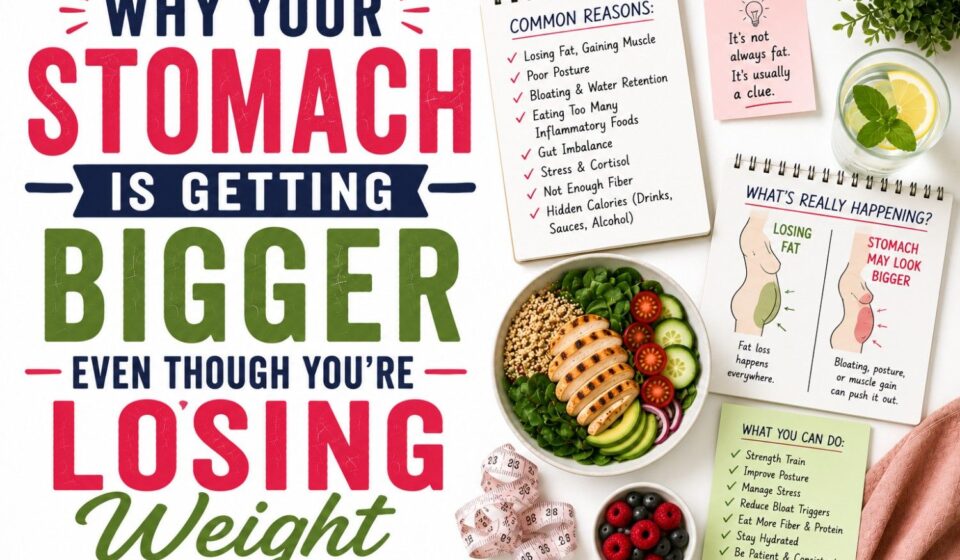

One of the most confusing weight loss experiences — here’s exactly what’s causing it

You step on the scale. The number is lower. But your stomach looks bigger — or at least, no smaller — than it did before you started. The rest of your body seems to be changing, but your belly just… isn’t.
This is one of the most common and most frustrating weight loss experiences. And it has specific, explainable causes — none of which mean the approach isn’t working.
First: Is It Actually Bigger, or Does It Just Look That Way?
Before exploring causes, it’s worth asking whether your stomach is actually larger or whether perception is playing a role.
The comparison trap: When you lose weight in your face, arms, and upper body first, these areas draw more attention — making the belly seem proportionally larger by contrast, even if it’s actually unchanged or slightly smaller.
Lighting and posture: How you stand, the lighting you’re in, and whether you’ve just eaten all dramatically affect how your stomach looks in the mirror. A photo taken from slightly below versus straight-on can produce completely different apparent stomach sizes.
Progress photo bias: Looking at yourself daily makes changes invisible — the gradual nature of change means you can’t see it accumulating. Monthly comparison photos under identical conditions are significantly more reliable than daily mirror assessment.
If you’re measuring and the tape measure shows your waist is the same size or slightly smaller — your stomach isn’t actually getting bigger, it just appears that way relative to other areas changing faster.
If It IS Actually Getting Bigger: The Real Causes
1. You’re Losing Fat Elsewhere First — Belly Fat Comes Last
This is the most common explanation — and the most frustrating one to hear.
Fat loss doesn’t happen evenly across the body. It follows a pattern largely determined by genetics, hormones, and the density of fat-mobilizing receptors in different fat stores.
For most people — particularly women — fat tends to come off first from the face, neck, and upper body, and last from the lower abdomen, hips, and thighs. These lower-body fat stores have higher concentrations of alpha-2 receptors that resist fat mobilization hormones.
The result: You can be genuinely losing fat and having your belly appear larger relative to other areas — not because belly fat is increasing, but because it’s the last to decrease while everywhere else is already changing.
This is biology, not failure. The belly fat will eventually respond — it’s just last in the queue.
As covered in our article on how to lose subcutaneous fat, the hormonally protected areas of fat storage respond to consistent overall fat loss — just on a longer timeline than other areas.
2. You Started Strength Training
If you recently added strength training to your routine, your abdominal muscles may actually be developing — and muscle takes up space.
More accurately: as abdominal muscles develop and the overlying fat hasn’t yet reduced enough to reveal them, the belly can temporarily look slightly more prominent. The muscles push outward slightly; the fat is still there on top.
This is a good sign — the definition will appear as fat continues to reduce. But it can be confusing in the short term.
3. Bloating Is Masking Fat Loss
Bloating can add 2–5 inches to abdominal circumference temporarily and make the belly look dramatically larger — independent of any fat changes.
Common bloating causes that may have increased when you changed your diet:
Increased fiber intake: If you dramatically increased vegetables, legumes, or whole grains when changing your diet, your gut bacteria are adapting to the increased fermentable material. This produces temporary increased gas and bloating that typically resolves over 2–4 weeks as gut bacteria adapt.
New foods introduction: Foods you weren’t eating before that are high in FODMAPs (onion, garlic, beans, certain fruits) can cause significant bloating in sensitive people.
Carbonated drinks: If you’ve been drinking more sparkling water as a substitute for other beverages, the carbonation adds gas to the digestive tract.
Eating faster: Changes in eating speed affect how much air is swallowed during meals.
As covered in our article on how to reduce bloating, addressing the specific bloating trigger often produces more dramatic visible abdominal improvement than weeks of fat loss.
4. Hormonal Fluid Retention in the Abdomen
For women, hormonal fluctuations throughout the menstrual cycle produce significant abdominal fluid retention — particularly in the week before menstruation.
If you started your weight loss effort at one point in your cycle and are now comparing to a different point, you may be comparing a low-retention week to a high-retention week — producing the appearance of abdominal growth despite genuine fat loss.
Abdominal fluid retention before menstruation can add 1–3 inches to waist measurement and significant visual fullness. This is entirely temporary and resolves at the start of menstruation.
Track and compare measurements at the same point in your cycle for accurate trend data.
5. Cortisol Is Specifically Storing Fat in Your Belly
Visceral fat cells have significantly more cortisol receptors than other fat cells. Chronic stress elevates cortisol — and that cortisol specifically directs fat to the abdominal area.
If your life stress has increased since starting your weight loss effort — or if the stress of dieting itself is elevating cortisol — visceral belly fat can be accumulating or maintaining even while subcutaneous fat elsewhere is reducing.
As covered in our article on does stress cause weight gain, cortisol-driven belly fat is a real, biological mechanism. Addressing cortisol through sleep, stress management, and daily walking directly targets this mechanism.
6. Your Diet Changes Are Producing Gas and Digestive Changes
Specific dietary changes common at the start of a weight loss effort can produce temporary abdominal distension:
Protein powder: Many protein powders contain lactose, artificial sweeteners (particularly sugar alcohols like sorbitol and xylitol), or other fermentable ingredients that cause significant gas and bloating in some people.
Artificial sweeteners: Common in diet foods, sugar-free products, and “healthy” snacks — many are poorly absorbed and fermented by gut bacteria, producing gas.
Dairy increase: If you’ve increased Greek yogurt, cottage cheese, or other dairy, and have some degree of lactose sensitivity, this could produce digestive distension.
Cruciferous vegetables: Broccoli, cauliflower, Brussels sprouts — very healthy but highly fermentable, particularly when eaten raw or in large amounts.
7. You’re Constipated
This sounds basic but is often overlooked: constipation produces genuine abdominal distension from accumulated digestive contents.
Common causes of constipation when starting a diet:
- Inadequate hydration (very common — increased protein needs more water to metabolize)
- Insufficient fiber
- Reduced food volume overall
- Changed eating schedule
A belly that’s larger due to constipation is not fat — it resolves with adequate hydration, fiber, and movement.
What to Do About It
If it’s regional fat loss pattern: Be patient. The belly is last — not never. Continue the approach and it will eventually respond. Track waist measurements monthly rather than daily.
If it’s bloating:
- Identify the trigger (new high-fiber foods, artificial sweeteners, dairy, carbonation)
- Eat more slowly — reduces air swallowing
- Reduce FODMAPs temporarily and reintroduce gradually
- Give new foods 3–4 weeks for gut adaptation before concluding they’re the problem
If it’s hormonal fluid retention: Track measurements at consistent cycle points. Add this context when interpreting apparent changes.
If it’s cortisol-driven: Active daily stress management — walking, breathing exercises, adequate sleep — directly reduces the cortisol-belly fat mechanism. This isn’t optional for people whose belly fat specifically seems resistant.
If it’s constipation: Increase water intake significantly (3+ liters per day), ensure adequate fiber, daily walking.
The Important Reassurance
A stomach that appears larger or unchanged despite weight loss elsewhere is one of the most common weight loss experiences — and it almost never means the approach isn’t working.
The most likely explanations are:
- Regional fat loss pattern (belly is last, not never)
- Bloating from dietary changes
- Hormonal fluid retention
- Comparison distortion as other areas change faster
Continue the approach. Track objectively. Be patient with the belly specifically.
As covered in our article on how to get rid of belly fat, visceral and abdominal fat does respond to consistent calorie deficit, adequate protein, reduced refined carbohydrates, and cortisol management — just on a longer timeline than most other fat stores.
Have you experienced this — losing weight elsewhere but your belly seeming unchanged or larger? Share in the comments — it’s far more common than people realize and the specific experience of others is genuinely helpful.