
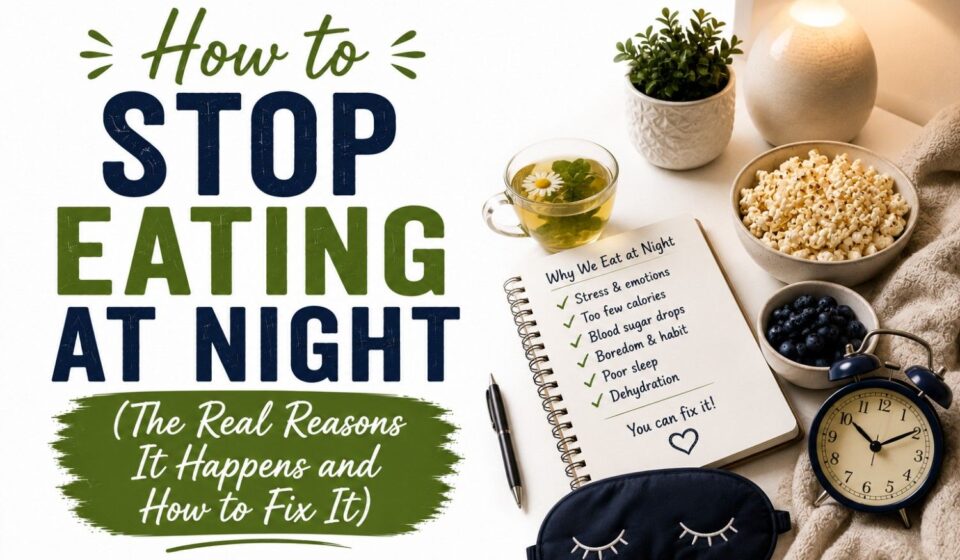

Night eating isn’t a willpower problem — here’s what’s actually driving it and the specific fixes that work

Night eating is one of the most common and most frustrating weight loss obstacles. You eat well all day, make good choices, stay on track — and then 9pm arrives and something shifts. The kitchen calls. The snacking starts. The day’s progress quietly unravels.
If this sounds familiar, you’re not alone — and more importantly, you’re not lacking willpower. Night eating is driven by specific physiological and psychological mechanisms that have nothing to do with self-control. Understanding them points directly to the fixes.
Why Night Eating Happens (The Real Reasons)
1. You’re Not Eating Enough During the Day
This is the most common cause — and the most fixable.
When calorie intake is too low during the day (from skipping breakfast, eating a light lunch, or restrictive daytime eating), the body accumulates a calorie debt that creates physiological hunger in the evening. This isn’t emotional eating or bad habits — it’s the body’s legitimate response to under-fueling.
People who eat too little during the day are significantly more likely to overeat at night. The evening hunger is real and biologically driven.
The fix: Eat more during the day — particularly protein at breakfast and lunch. As covered in our guide to how much protein you actually need per day, adequate protein at each meal suppresses hunger more effectively than any other macronutrient. A substantial protein-rich lunch makes 9pm hunger significantly less likely.
2. You’re Not Eating Enough Protein
Even when overall calories are adequate, low protein intake leaves hunger hormones elevated throughout the day — with the deficit compounding by evening.
Protein suppresses ghrelin (hunger hormone) more powerfully and more durably than carbohydrates or fat. People with low protein intake eat the same number of calories but feel significantly hungrier — particularly in the evening when ghrelin levels naturally rise.
The fix: Target 0.8–1g of protein per pound of bodyweight, distributed across meals. Specifically: a high-protein breakfast (30g+) produces measurably lower hunger throughout the day and into the evening.

3. Evening Is When You Finally Relax
Many people use food as the primary transition from work/stress mode to relaxation mode in the evening. The meal, the snack, the dessert — these are rituals that signal “the day is done, you can relax now.”
This association between eating and relaxation isn’t a character flaw — it’s a conditioned response that develops naturally. The problem is that it operates independently of actual hunger.
The fix: Create non-food evening transition rituals — a specific tea, a walk, a shower, changing into comfortable clothes, starting a book or show. The ritual function is what matters, not the food content. A cup of herbal tea can fulfill the same psychological transition role as an evening snack.
4. Boredom
Evening hours often have less structure and stimulation than the rest of the day — and boredom is one of the most reliable triggers for eating in the absence of hunger.
Boredom eating isn’t about food. It’s about stimulation — the mouth and hands have something to do. This is why people often report not even enjoying the food they eat when bored.
The fix: Identify the boredom directly and address it with engaging activities rather than eating. Reading, a phone call with a friend, a hobby, a puzzle, a walk — anything that provides genuine engagement. As covered in our article on how to stop emotional eating, the key is identifying the need (stimulation, connection, comfort) and meeting it directly rather than through food.
5. Stress and Cortisol
Evening cortisol spikes — from reviewing the day’s problems, worrying about tomorrow, or simply the accumulated stress of the day — drive evening hunger through multiple mechanisms:
- Cortisol directly stimulates appetite
- Stress specifically increases cravings for high-calorie, high-fat, high-sugar foods
- Stress depletes self-regulatory resources, making dietary choices harder
The fix: Active evening stress management — a short walk, breathing exercises, journaling, or anything that reduces cortisol before the evening eating window begins. As covered in our article on does stress cause weight gain, cortisol-driven eating is real and physiological — not just a mental weakness.
6. Poor Sleep — The Night Eating Cycle
Sleep deprivation and night eating have a bidirectional relationship:
- Poor sleep elevates ghrelin (hunger hormone) and suppresses leptin (fullness hormone) — directly driving evening and late-night hunger
- Eating late disrupts sleep quality — because digestion keeps the body metabolically active
- The resulting poor sleep drives more hunger the next day
If night eating is accompanied by poor sleep quality, addressing sleep is as important as addressing the eating. As covered in our article on why sleep is the most underrated weight loss tool, sleep deprivation’s appetite effects are immediate and significant.
Practical Strategies to Stop Eating at Night
1. Eat a Larger, Protein-Rich Dinner
The most counterintuitive fix: eat more at dinner, not less.
A substantial dinner with high protein (35–40g) and adequate fat produces satiety that extends 3–4 hours — eliminating the physiological hunger that drives most night eating.
People who eat small, unsatisfying dinners in an attempt to reduce calories often end up eating more total calories through subsequent night snacking than they would have from a larger, satisfying dinner.
2. Set a Kitchen Closing Time
A clear, consistent rule is more effective than ongoing willpower negotiation. “The kitchen closes at 8pm” is a decision made once — rather than a repeated decision every time a craving appears.
The first week is the hardest — after that, the body adapts and evening hunger decreases significantly. Like intermittent fasting, the hunger before the eating window closes is real initially and significantly reduces with adaptation.
Make it physical: Turn off the kitchen light, put away food, or do something that signals the kitchen is done for the day.
3. Create a Satisfying Evening Ritual That Includes a Small Planned Snack
For many people, complete elimination of evening eating is less sustainable than a planned, controlled evening snack.
A planned evening snack (150–200 calories, high protein or fat) at a set time is dramatically better than unplanned grazing that continues until bedtime. It satisfies the ritual need without the uncontrolled calorie accumulation.
Best evening snacks:
- Plain Greek yogurt with berries — high protein, satisfying
- A small handful of nuts — fat and protein produce lasting satiety
- Cottage cheese with a drizzle of honey — high protein, surprisingly filling
- A cup of bone broth — warm, savory, minimal calories
- 1–2 squares of dark chocolate — satisfies sweet cravings at minimal calories
4. Brush Your Teeth Earlier
This is a surprisingly effective behavioral intervention — brushing teeth creates a clear psychological end-of-eating signal and makes the thought of eating again genuinely unappealing (who wants to re-brush?).
Moving teeth brushing to immediately after dinner rather than immediately before bed is a simple environmental change that consistently reduces evening eating.
5. Drink Herbal Tea
Warm herbal tea in the evening serves multiple functions:
- Occupies the mouth and hands (addressing the behavioral component of evening eating)
- Provides warmth and comfort (fulfilling the emotional transition function)
- Chamomile specifically has mild anxiolytic effects that reduce evening stress
- Zero calories while providing genuine sensory satisfaction
Peppermint, chamomile, ginger, or any preferred herbal tea — a large mug at 8–9pm replaces mindless snacking for many people.
6. Remove Temptation From the Environment
The most effective dietary intervention is often environmental rather than willpower-based: if the food isn’t in the house, you can’t eat it at night.
Don’t keep highly palatable, easy-to-eat snack foods (chips, cookies, ice cream) accessible at home. If getting them requires leaving the house, most night eating impulses pass before action is taken.
As covered in our article on how to lose weight without feeling deprived, environmental design is more reliable than willpower — because it removes the decision entirely rather than requiring repeated good decisions under conditions of depleted self-regulation.
7. Identify Your Specific Trigger
Night eating has different primary drivers for different people — and the fix depends on the cause:
| Primary Trigger | Most Effective Fix |
|---|---|
| Under-eating during the day | Larger breakfast and lunch |
| Boredom | Engaging evening activity |
| Stress | Evening walk or breathing exercises |
| Habit/ritual | Non-food transition ritual (tea, shower) |
| Actual hunger | Larger dinner or planned snack |
| Poor sleep | Improve sleep; address sleep apnea |
Keeping a simple log for one week — noting what you ate at night, what time, and what you were doing or feeling beforehand — reveals your specific pattern and points to the most targeted fix.
8. Eat Breakfast — Even If You’re Not Hungry
Skipping breakfast is one of the most reliable predictors of night eating. The hunger accumulates throughout the day, peaking in the evening.
Eating a substantial breakfast — even if hunger isn’t present in the morning — resets the daily hunger pattern and significantly reduces evening hunger for most people.
This is particularly true for protein-rich breakfasts. As covered in our article on the best high protein breakfast ideas, starting the day with 30g+ protein produces the lowest hunger levels throughout the day.
Is Night Eating Actually a Problem? (The Honest Answer)
There’s a nuanced point worth making: night eating isn’t inherently worse for weight than eating the same calories earlier in the day — total daily calorie intake determines fat loss.
However, night eating is associated with weight gain in practice because:
- It’s typically additional to daytime eating (not a replacement)
- The foods chosen at night are usually highly palatable, calorie-dense snacks
- It’s often driven by emotional or habitual rather than physical hunger
- It can disrupt sleep quality, with downstream metabolic effects
If you eat a planned, portion-controlled evening snack within your daily calorie target — that’s not a problem. The issue is uncontrolled night eating that adds significant calories to an otherwise adequate daily intake.
When Night Eating Is a Clinical Condition
Night Eating Syndrome (NES) is a recognized eating disorder characterized by:
- Consuming 25%+ of daily calories after dinner
- Waking at night to eat (not just eating late before bed)
- Morning loss of appetite
- Mood disturbance
- Significant distress about the eating pattern
NES affects approximately 1–2% of the population and responds to specific treatment — cognitive behavioral therapy and sometimes medication. If your night eating involves waking from sleep to eat and causes significant distress, professional evaluation is warranted.
The Bottom Line
Night eating is driven by specific, identifiable causes — not weak willpower:
- Under-eating during the day (most common)
- Insufficient protein
- Evening relaxation ritual association
- Boredom
- Stress and cortisol
- Sleep deprivation
The most impactful fixes:
- Eat more protein during the day — particularly at breakfast
- Eat a larger, satisfying dinner
- Set a consistent kitchen closing time
- Replace evening eating with herbal tea or another non-food ritual
- Remove highly palatable snack foods from the home
- Identify your specific trigger and address it directly
For the complete behavioral framework for managing food choices and cravings during fat loss, our guide to how to get rid of belly fat covers everything in one place.
What’s your biggest night eating trigger — and what’s worked for you to manage it? Share in the comments.