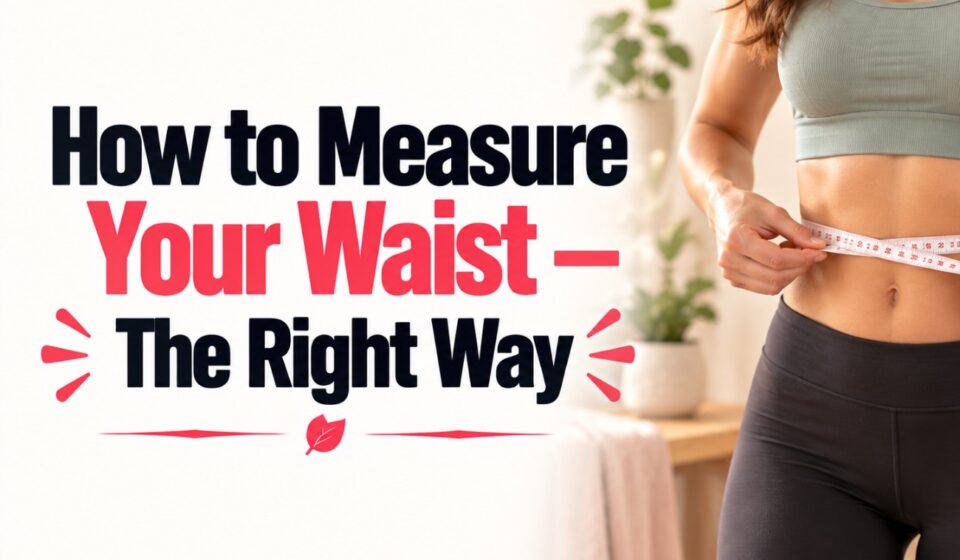

Why waist measurement matters more than scale weight — and exactly how to do it accurately

Waist circumference is one of the most clinically useful measurements you can take at home — more informative than scale weight alone for assessing metabolic health risk. But the measurement is only useful if it’s done correctly, and there’s surprising variation in how people actually do it.
Here’s the complete guide to measuring your waist accurately and understanding what the numbers mean.
Why Waist Measurement Matters
As covered in our complete guide to why your waist size matters — waist circumference is a more direct measure of visceral fat than scale weight or BMI.
Visceral fat — the fat stored around internal organs in the abdominal cavity — is metabolically active in ways that subcutaneous fat (the fat under the skin) isn’t. High visceral fat is associated with:
- Insulin resistance and type 2 diabetes risk
- Cardiovascular disease
- High blood pressure
- Metabolic syndrome
- Inflammatory conditions
Two people can have identical scale weight and BMI with dramatically different waist circumferences — and meaningfully different health risk profiles as a result.
The practical value:
Waist circumference tracks fat loss more accurately than scale weight during exercise programs — particularly when strength training is involved. Someone losing fat while gaining muscle may see minimal scale movement but meaningful waist reduction — the waist measurement tells the real story.
What You Need
- A flexible measuring tape — cloth or plastic, not a metal tape measure
- A mirror (optional but helpful for checking positioning)
- Bare skin or thin clothing — measuring over thick clothes introduces error
A cloth measuring tape is available at any fabric or sewing store, pharmacy, or online for minimal cost. Some pharmacies sell body measurement tapes specifically designed for this purpose with easier-to-read markings.
How to Find the Right Spot
The most common measurement error is measuring in the wrong location — either too high or too low.

The correct anatomical landmark:
The waist should be measured at the natural waist — the narrowest point of the torso, typically located approximately halfway between the bottom of the lowest rib and the top of the hip bone (iliac crest).
How to find it:
- Stand upright with feet together
- Place one hand on your lowest rib — feel for the bottom edge
- Place your other hand on the top of your hip bone — the bony prominence on the side of your pelvis
- The midpoint between these two landmarks is your natural waist
- For most people this is approximately at or slightly above the navel
Common location mistakes:
Too low — measuring at the navel: Many people measure at the belly button, which sits below the natural waist for most adults. This produces an inflated measurement that doesn’t correspond to standard health thresholds.
Too high — measuring at the narrowest visible point: Some people measure at the visually narrowest part of the torso when viewed from the front — which may be higher than the correct anatomical landmark.
Using belt line or trouser waist: Clothing waist sizes don’t correspond to the anatomical waist measurement used in health assessments.
Step-by-Step Measurement Technique
Step 1: Prepare correctly
- Stand upright on a flat surface
- Remove or lift clothing to access bare skin
- Feet together, weight evenly distributed
- Arms relaxed at sides
Step 2: Position the tape
- Wrap the measuring tape around your torso at the correct landmark (halfway between lowest rib and hip bone)
- The tape should be horizontal — parallel to the floor all the way around
- Check in a mirror if available to confirm the tape isn’t angled
Step 3: Check the tension
- The tape should be snug against the skin — not pulled tight enough to compress the tissue
- Not loose enough to create a gap between tape and skin
- You should be able to slide one finger under the tape but not two
Step 4: Breathe correctly
- Take a normal breath in
- Exhale normally
- Take the measurement at the end of a normal exhale — not after a forced exhale or while holding breath in
Step 5: Read the measurement
- Note where the tape meets the zero end
- Record to the nearest 0.5cm or 0.25 inch
- Note whether measuring in centimeters or inches — be consistent across measurements
Getting a Consistent Measurement
Single measurements vary — time of day, hydration, recent meals, and measurement technique all affect the number. For meaningful tracking:
Measure at the same time of day: Morning measurements before eating or drinking — and after using the bathroom — produce the most consistent results. Measurements taken later in the day are typically larger due to food intake, fluid, and digestive activity.
Measure in the same conditions: Same clothing (or no clothing), same posture, same breathing pattern. Consistency in conditions produces consistency in measurement.
Take 2-3 measurements and average: Remove the tape completely between each measurement, reposition, and re-measure. Average the results. This reduces individual measurement error.
Track trends, not single measurements: A single waist measurement tells you where you are. Measurements taken monthly under consistent conditions tell you whether your approach is working — which is far more valuable.
Waist-to-Height Ratio — A More Useful Calculation
Waist circumference alone is useful but doesn’t account for body size — a 90cm waist means something different on a 150cm person than on a 190cm person.
Waist-to-height ratio addresses this by dividing waist circumference by height (both in the same unit):
Waist-to-height ratio = waist circumference ÷ height
The general guideline: Keep your waist circumference to less than half your height — a waist-to-height ratio below 0.5.
This simple rule accounts for body size differences and predicts cardiovascular and metabolic risk more accurately than waist circumference alone across different populations.
Example: Someone 170cm tall with a 80cm waist: 80 ÷ 170 = 0.47 — below 0.5 ✅ Someone 170cm tall with a 90cm waist: 90 ÷ 170 = 0.53 — above 0.5 ⚠️
Health Thresholds — What the Numbers Mean
Standard health thresholds for waist circumference are based on large population studies linking measurements to metabolic risk:
For women:
- Below 80cm (31.5 inches): Lower risk
- 80-88cm (31.5-34.6 inches): Increased risk
- Above 88cm (34.6 inches): Substantially increased risk
For men:
- Below 94cm (37 inches): Lower risk
- 94-102cm (37-40 inches): Increased risk
- Above 102cm (40 inches): Substantially increased risk
Important context:
These thresholds are population-level risk indicators — not diagnostic criteria. Someone above the threshold isn’t automatically unhealthy, and someone below it isn’t automatically protected. They’re guidelines for understanding relative metabolic risk.
Ethnic variation:
Standard thresholds may underestimate risk for some populations — particularly South and East Asian populations, where metabolic complications occur at lower waist circumferences than in European populations. Lower thresholds are sometimes recommended for these groups.
What Waist Measurement Doesn’t Tell You
It doesn’t distinguish subcutaneous from visceral fat: Waist circumference reflects total abdominal fat — both the subcutaneous fat under the skin and the visceral fat around organs. High visceral fat is more metabolically harmful than high subcutaneous fat, but waist measurement can’t separate the two without imaging.
It doesn’t reflect overall health: Waist circumference is one useful metric among many. Metabolic health markers — blood pressure, blood sugar, cholesterol — provide additional and important information that waist measurement alone doesn’t capture.
It changes with posture and measurement technique: Even correctly performed measurements vary with posture, time of day, and technique. This is why consistent measurement conditions matter more than any single reading.
Waist Measurement vs. Other Body Composition Measures
vs. Scale weight: Scale weight reflects everything in the body — fat, muscle, bone, water, food in the digestive system. Waist measurement specifically reflects abdominal fat accumulation — more directly relevant to metabolic health risk than total weight.
vs. BMI: As covered in our guide to how to determine your ideal body weight — BMI doesn’t distinguish fat from muscle and doesn’t account for fat distribution. Waist circumference is a better predictor of metabolic risk than BMI for individuals.
vs. Body fat percentage: Body fat percentage (from DEXA scan or other methods) provides the most complete body composition picture. Waist measurement is less precise but free, requires no equipment, and is sufficient for tracking progress and assessing risk.
vs. Progress photos: Progress photos capture visual changes that measurements miss — posture, muscle definition, fat distribution changes. Both provide useful information that the other doesn’t.
How Often to Measure
For progress tracking during weight loss: Monthly measurements are sufficient — weekly measurements create too much noise from natural fluctuation to be informative. Monthly trends are meaningful; weekly fluctuations often aren’t.
As a health screening tool: Annual measurement — at the same time as other health screenings — provides useful longitudinal data without requiring frequent monitoring.
When not to measure: Immediately after large meals, late in the evening, during or immediately before menstruation (which affects water retention and bloating significantly), or after intensive exercise.
What Reduces Waist Circumference
As covered in our guide to why your waist size matters — targeted fat loss from specific areas isn’t possible, but certain approaches preferentially reduce abdominal and visceral fat:
Most effective for waist reduction:
- Dietary changes that reduce overall calorie intake — particularly refined carbohydrates and added sugar
- Regular aerobic exercise — as covered in our guide to aerobic exercise for weight loss — visceral fat is particularly responsive to aerobic training
- Running specifically — as covered in our guide to running for weight loss — consistently associated with visceral fat reduction
- Sleep improvement — poor sleep specifically promotes visceral fat accumulation
- Stress management — cortisol from chronic stress directly promotes abdominal fat storage as covered in our guide to do you really have high cortisol
Medical approaches: GLP-1 medications produce significant waist circumference reduction alongside total weight loss — addressing visceral fat accumulation through appetite regulation and metabolic improvement as covered in our guide to what are weight loss injections.
The Bottom Line
How to measure your waist correctly:
- Use a flexible measuring tape
- Find the correct landmark — halfway between lowest rib and top of hip bone
- Keep tape horizontal all the way around
- Snug but not tight — one finger underneath
- Measure at end of normal exhale
- Take 2-3 readings and average
- Measure at the same time of day under consistent conditions
- Track monthly trends rather than reacting to individual readings
What the numbers mean: Women above 88cm and men above 102cm are in the substantially increased metabolic risk category — worth discussing with a healthcare provider alongside other health markers.
The most useful calculation: Waist circumference divided by height — keep it below 0.5.
Waist circumference is a simple, free, highly informative health measurement that most people never take — or take incorrectly. Done right and tracked consistently, it tells you more about your metabolic health trajectory than the scale alone ever can.
Do you track waist circumference alongside scale weight — and have you found it more or less motivating than the number on the scale? Share in the comments.