How to Lose Hip Fat (Why It’s So Stubborn and What Actually Works)

Hips, love handles, and that frustrating outer thigh area — here’s the honest guide

Hip fat is one of the most commonly complained about and most stubbornly resistant fat deposits in the body — particularly for women. Many people find that their hips and outer thighs are among the last places to slim down, even after losing significant weight elsewhere.
This isn’t bad luck. It’s biology. And understanding the specific reasons hip fat is so resistant to loss — and the strategies that actually address it — is the difference between years of frustration and genuine progress.
Why Hip Fat Is So Stubborn
Hip fat stubbornness isn’t random — it has specific biological causes.
Estrogen and Lower Body Fat Storage
In women, estrogen actively directs fat storage to the hips, thighs, and buttocks. This is evolutionary — lower body subcutaneous fat provides an energy reserve for pregnancy and breastfeeding. Estrogen receptors in hip fat cells keep them in storage mode and resist the hormonal signals that would otherwise trigger fat release.
This is why women typically carry more lower body fat than men, and why this fat is the last to respond to fat loss efforts. It’s not stubbornness in a motivational sense — it’s a hormonal protection mechanism.
Alpha-2 Adrenergic Receptors
Hip and lower body fat cells have a higher proportion of alpha-2 adrenergic receptors compared to abdominal fat. These receptors respond to adrenaline by inhibiting fat breakdown — the opposite of the beta-2 receptors that promote fat release.
This receptor imbalance is one of the primary physiological reasons lower body fat is harder to mobilize than upper body or abdominal fat. The same hormonal signal that efficiently breaks down belly fat produces a much smaller response in hip fat.
The Order of Fat Loss
Fat loss doesn’t happen uniformly across the body. Most people lose fat in roughly the reverse order they gained it — with the most recently added fat coming off first and the oldest, most established fat deposits coming off last.
For many women, hip fat was the first to accumulate (often during puberty or early adulthood) and is therefore among the last to go. This isn’t a permanent barrier — it just means hip fat requires sustained overall fat loss before it begins responding visibly.

Subcutaneous vs. Visceral Fat
Hip fat is almost entirely subcutaneous — stored directly under the skin rather than around organs. Subcutaneous fat is metabolically less active than visceral fat and responds more slowly to lifestyle interventions. It’s also less dangerous from a health perspective than visceral abdominal fat, which is some consolation.
What Actually Reduces Hip Fat
1. Overall Fat Loss — The Non-Negotiable Foundation
There is no shortcut around this. Hip fat reduces through overall fat loss — a sustained calorie deficit that eventually draws on lower body fat stores after other areas have responded.
The strategies that drive overall fat loss are covered comprehensively throughout this blog. The complete framework is in our guide to how to get rid of belly fat — despite the belly-focused title, every principle applies body-wide, including to hip fat.
The key patience point: most people need to lose a meaningful amount of total body fat before hip fat begins responding visibly. For women starting at higher body fat percentages, this can mean losing 10–15 lbs overall before noticeable hip changes occur. This is normal — not a sign that the approach isn’t working.
2. High Protein to Preserve Muscle Shape
As hip fat reduces, the muscles underneath determine how the area looks. Well-developed glutes and hip abductors create the rounded, defined appearance that most people are aiming for. Underdeveloped muscles with reduced fat simply look flat.
High protein intake — 0.7–1g per pound of bodyweight daily — preserves and supports the muscle development that makes the hip and glute area look its best as fat reduces. As we cover in our guide to how much protein you actually need per day, protein is the most important dietary variable for body composition at any stage of fat loss.
3. Targeted Strength Training for Hips and Glutes
While you can’t spot-reduce hip fat, building the muscles in this area produces two meaningful benefits: it raises the metabolic demand of the area (contributing to overall fat loss), and it dramatically improves how the hip area looks as fat reduces.
The best exercises for hip and glute development:
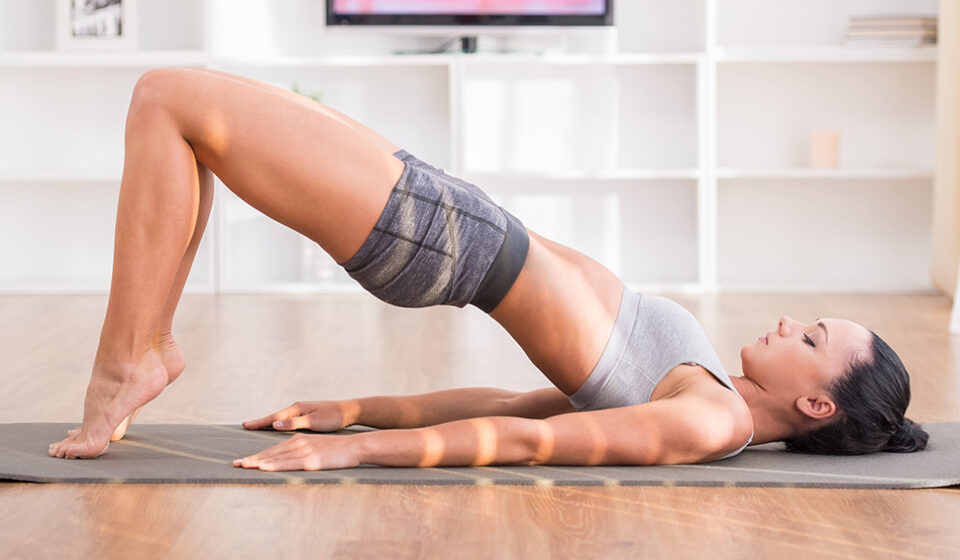
Hip Thrusts — the single most effective exercise for glute development. Sit with your upper back against a bench, feet flat on the floor, and drive your hips upward by squeezing your glutes. At the top, your body should form a straight line from knees to shoulders. The key is maximum glute contraction at the top of each rep. Can be performed with bodyweight, a resistance band across the hips, or a barbell.
Romanian Deadlifts — hinges at the hip with a flat back, creating a deep hamstring and glute stretch. One of the most effective exercises for the posterior chain. Perform with dumbbells, barbell, or resistance bands.
Squats (Regular and Sumo) — wide-stance sumo squats with toes pointed out at 45 degrees place more emphasis on the inner hip and adductor muscles than standard squats, complementing the posterior chain work of hip thrusts and deadlifts.
Lateral Band Walks — place a resistance band around your ankles and walk sideways in a half-squat position. This specifically targets the hip abductors (outer hip muscles) that give the hip area its rounded shape. One of the few exercises that directly targets the muscle group most responsible for “hip dips.”
Single-Leg Glute Bridges — perform a glute bridge on one leg at a time. More challenging than bilateral bridges and produces greater glute activation per rep.
Curtsy Lunges — step one foot diagonally behind the other (like a curtsy), lowering the back knee toward the floor. This movement pattern specifically targets the gluteus medius — the upper hip muscle that creates the rounded outer hip appearance.
Cable or Band Hip Abductions — standing hip abductions with a resistance band or cable machine target the gluteus medius and tensor fasciae latae — the muscles on the outer hip. These are among the most direct exercises for the outer hip area.
Perform these exercises 3 times per week, progressively increasing resistance over time. The hip and glute area responds well to muscle-building training — most people see meaningful shape improvements within 8–12 weeks of consistent training.
4. Reduce Estrogen-Driven Fat Retention Where Possible
Since estrogen actively drives hip fat retention, strategies that improve estrogen metabolism can make a modest difference to lower body fat loss resistance:
Maintain a healthy gut microbiome. The gut microbiome plays a role in estrogen metabolism — dysbiosis (imbalanced gut bacteria) impairs estrogen processing, potentially increasing circulating estrogen. Foods like Greek yogurt, kefir, kimchi, and sauerkraut support beneficial gut bacteria.
Eat cruciferous vegetables regularly. Broccoli, cauliflower, and Brussels sprouts contain compounds (DIM and indole-3-carbinol) that support healthy estrogen metabolism in the liver.
Reduce alcohol. Alcohol impairs liver function, which is the primary site of estrogen metabolism. Regular drinking increases circulating estrogen, which promotes lower body fat storage.
Manage body fat overall. Fat tissue itself produces estrogen — higher body fat means higher estrogen production, which reinforces lower body fat storage. This creates a cycle that overall fat loss gradually breaks.
5. Manage Cortisol and Stress
While cortisol primarily drives abdominal fat storage, chronically elevated cortisol also impairs the fat mobilization process throughout the body — including from hip fat stores.
Stress management, sleep optimization, and regular physical activity that doesn’t over-stress the body all contribute to lower baseline cortisol. For women with high-stress lifestyles, cortisol management often unlocks fat loss progress that has been stalled despite good diet and exercise.
As we cover in our article on how to stop stress eating, the cortisol-fat storage connection is one of the most underappreciated drivers of persistent fat retention.
6. Reduce Sodium and Fluid Retention
The hip and outer thigh area is particularly prone to fluid retention — especially in women — due to lymphatic drainage patterns and hormonal effects on fluid distribution.
Much of what appears as hip fat at certain times of the month, after salty meals, or during periods of high stress is actually fluid retention rather than actual fat. Reducing sodium, increasing water intake, and managing stress can reduce this fluid component quickly — sometimes producing visible changes in days.
As we cover in our articles on how to lose water weight fast and how to reduce bloating, addressing fluid retention is often the fastest route to visible improvement in problem areas.
What Doesn’t Work for Hip Fat
Spot reduction exercises — side leg raises, hip circles, and outer thigh exercises build the muscles in the area but don’t burn the fat overlying them. They’re valuable for muscle development but not for fat reduction.
Body wraps and compression garments — temporary fluid displacement, not fat reduction. Results reverse immediately upon removal.
Vibrating belts and massage devices — no evidence of fat reduction from mechanical stimulation in any robust research.
Extremely low calorie dieting — causes muscle loss alongside fat loss, producing the flat, undefined hip area that most people find worse than the original. Moderate deficit plus strength training is the correct approach.
The “Hip Dip” Question
Hip dips — the inward curve between the hip bone and the top of the thigh — are a normal anatomical feature determined primarily by the shape of your pelvis and the positioning of your femur. They’re not a fat issue — they’re a skeletal structure issue.
Hip dips are more visible in some people than others based on bone structure. They can be reduced visually by building the gluteus medius muscle (which fills in the dip area), but they cannot be eliminated entirely through fat loss or exercise because they’re fundamentally about skeletal architecture.
The lateral band walks and curtsy lunges mentioned above are the best exercises for building the gluteus medius and reducing the appearance of hip dips — but setting realistic expectations about what’s achievable based on your bone structure is important.
What to Expect and When
Weeks 1–4: Reduction in fluid retention and bloating from dietary changes. Possible 2–4 lbs on the scale, some visual improvement. Early muscle development from strength training beginning.
Weeks 4–8: Real fat loss beginning to occur. Scale moving. Clothes fitting differently. Hip muscles becoming more defined.
Weeks 8–16: Meaningful changes in hip shape and size with consistent effort. Fat loss plus muscle development producing visible improvement.
Months 4–6+: Lower body fat beginning to respond more significantly as overall body fat percentage decreases. For women, this is often when hip fat loss becomes most visible.
Hip fat takes longer to respond than abdominal or upper body fat — this is the biology discussed above, not a sign that the approach isn’t working. Tracking measurements and progress photos every 2 weeks provides more accurate progress tracking than the scale alone.
A Note on “Saddlebag” Fat
Saddlebag fat — the outer hip and upper outer thigh area — is one of the most resistant fat deposits in the entire body for women due to the concentration of estrogen receptors and alpha-2 receptors in this specific area.
People often find that saddlebag fat is essentially the last area to respond — changing only after significant overall fat loss has occurred elsewhere. This requires acceptance of a longer timeline and consistent execution of the strategies above over 6–12 months of sustained effort.
The combination of overall fat loss plus targeted hip and glute strength training (particularly lateral movements for the gluteus medius) produces the best results for this specific area — but patience is genuinely required.
The Bottom Line
Hip fat is among the most stubborn fat deposits in the body — particularly for women — due to estrogen receptor distribution, alpha-2 adrenergic receptor concentration, and the evolutionary protective function of lower body fat.
The strategies that work:
- Sustained overall fat loss through a moderate calorie deficit
- High protein intake to preserve and build muscle shape
- Targeted hip and glute strength training — hip thrusts, Romanian deadlifts, lateral band walks, curtsy lunges
- Reduced sodium to address fluid retention in the hip area
- Cortisol management and sleep optimization
- Patience with a longer timeline than abdominal fat
Hip fat responds to exactly the same approach that reduces fat everywhere — it just requires more time and consistent execution before the results become visible. Keep going — it does respond eventually.
Are hip and outer thighs your most stubborn area? Share in the comments — you’re in very good company, and the community has a lot of experience navigating this specific challenge.