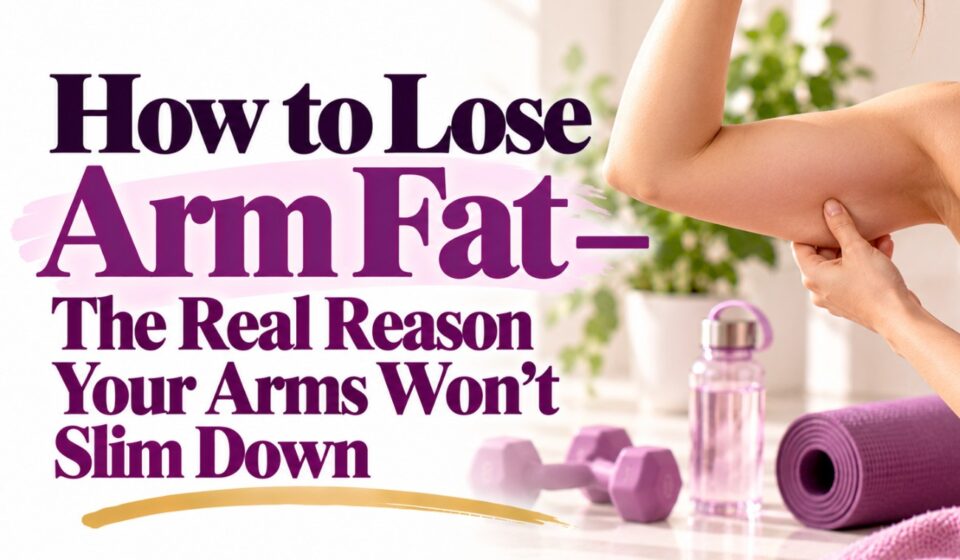

Flabby arms, bat wings, upper arm softness — here’s what actually drives arm fat loss and what wastes your time
Most people trying to lose arm fat are doing the wrong thing entirely — spending time on arm circles and tricep kickbacks while wondering why nothing changes. The reason nothing changes is that spot reduction doesn’t exist. But the solution to that isn’t just “do more cardio.” It’s more specific than that, and more actionable.
Here’s what actually works.

Why You Can’t Spot-Reduce Arm Fat
This needs to be said clearly because most arm fat content either skips it or buries it: no exercise specifically burns fat from your arms. Tricep dips, arm circles, resistance band pulls — these build the muscles in your arms, which matters enormously, but they do not preferentially burn the fat overlying those muscles.
Research has tested this directly. Studies that had participants perform hundreds of arm exercises over weeks found no preferential fat loss in the arms compared to control groups. Fat is mobilized from stores throughout the body based on overall energy balance and hormonal signals — not based on which muscles happen to be working.
As covered in our guide to can you target fat loss — the spot reduction myth is one of the most persistent in fitness, and arm fat is where people fall for it most often.
The good news: the strategies that actually reduce arm fat are the same strategies that improve your overall body composition everywhere. You’re not doing extra work for arms specifically — you’re doing the work that changes your body, and the arms change with it.
Why Arm Fat Is There in the First Place
Arm fat accumulates for the same reason fat accumulates anywhere: a sustained calorie surplus over time, combined with genetic predisposition to store fat in that area, hormonal factors, and age-related changes in body composition.
The genetics piece: Where your body stores fat and in what order it releases it is significantly genetic. Some people are predisposed to carry fat in the upper arms; others stay lean there even at higher overall body fat. This doesn’t make arm fat loss impossible — but it does mean some people need to reach a lower overall body fat percentage before arms respond visibly.
The age piece: The bat wing appearance becomes more pronounced with age — not just because fat increases, but because the triceps muscle underneath loses mass through age-related sarcopenia. As covered in our guide to what is skinny fat — losing muscle while maintaining fat produces a softer, less defined appearance even without gaining weight. This is why building the underlying muscle matters alongside losing the fat above it.
The hormonal piece: In women, declining estrogen levels during perimenopause and menopause cause fat redistribution — including increased accumulation in the upper arms. As covered in our guide to how to lose weight after menopause — hormonal changes in midlife affect where fat is stored and require specific strategies to address.
The Two Things That Actually Work — Together
Fat loss alone and muscle building alone each produce a partial result. The combination produces the one people are actually after.
Fat loss without upper body muscle development produces smaller arms that are still soft and undefined — often with loose skin where the fat was. As covered in our guide to how to tighten skin after weight loss — building muscle underneath is the most effective strategy for improving the appearance of looser skin, because it fills the space rather than leaving it empty.
Muscle building without sufficient fat loss builds definition that remains hidden under the fat layer — the arms get stronger and firmer to the touch but don’t look different in the mirror.
The combination — a moderate calorie deficit driving overall fat loss, alongside consistent upper body resistance training — is what produces genuinely toned arms. This is the same body recomposition approach covered in our guide to toned body without gym — muscle plus low enough body fat to see it.
“The reason arms are slow to respond isn’t that they’re particularly stubborn — it’s that most people are doing either the right thing (arm exercises) for the wrong reason (spot reduction), or the right reason (overall fat loss) without the thing that shapes the result (upper body muscle).”
Upper Body Training — The Exercises That Actually Shape Arms
The triceps — the muscle on the back of the upper arm — is responsible for most of what people think of as toned arms. It’s also the area most people neglect relative to biceps. Here are the most effective movements for arm definition, including bodyweight progressions for people training at home:
Tricep-focused movements:
Close-grip push-ups — hands closer than shoulder-width, index fingers nearly touching. This shifts emphasis to the triceps. Progress from incline (hands on a counter) → standard → decline (feet elevated). As covered in our guide to toned body without gym — close-grip push-ups are one of the most effective home tricep exercises available.
Tricep dips — hands on the edge of a chair or bench behind you, feet extended forward. Lower by bending elbows to 90 degrees, press back up. Control the descent rather than dropping.
Overhead tricep extension — hold a dumbbell, water bottle, or resistance band above your head with both hands. Lower behind your head by bending elbows, extend back up. This loads the tricep in its fully stretched position — producing excellent muscle development.
Tricep kickbacks — hinge forward with a flat back, upper arm parallel to the floor, extend the forearm back until the arm is fully straight. Squeeze at full extension. One of the most direct tricep isolation exercises.
For overall arm and shoulder definition:
Lateral raises — arms out to the sides to shoulder height, controlling the descent. Builds the medial deltoid that creates the rounded shoulder shape making arms look more defined overall.
Overhead press — press from shoulder height to full extension. One of the best compound movements for shoulders and arms. Dumbbells, resistance bands, or even loaded backpack works.
Bicep curls — the bicep contributes to the rounded arm appearance and overall definition. Worth including but secondary to tricep work for the bat wing concern specifically.
The minimal effective protocol:
3 sessions per week of upper body resistance training — 3-4 sets of 4-5 exercises from the list above, with progressive challenge over time. Consistent progression (more reps, slower tempo, heavier load) over 8-12 weeks produces meaningful arm muscle development.
A Complete Home Arm Workout (No Equipment)
For people without gym access — as covered in our guide to toned body without gym — bodyweight progressive training produces genuine results:
Warm-up (2 minutes):
Arm circles, shoulder rolls, 10 light push-ups
Circuit — repeat 3 times, 60 seconds rest between rounds:
- Close-grip push-ups: 10-15 reps
- Tricep dips off chair: 12-15 reps
- Overhead tricep extension (water bottle): 15 reps
- Lateral raises (water bottles or light dumbbells): 12 reps
- Bicep curls: 12 reps
Cool-down (2 minutes):
Tricep stretch (arm behind head), cross-body shoulder stretch
Progress by slowing tempo (3 seconds down, 1 second up), increasing resistance, or adding reps before moving to harder variations.
The Diet Side — Where Most of the Work Happens
Exercise shapes the arms. Diet drives the fat loss that reveals the shape. As covered in our guide to how to lose weight with a calorie deficit — a sustained moderate deficit is the fundamental mechanism of fat loss everywhere, including the arms.
Protein is the most important dietary variable for arm fat loss specifically — because protein simultaneously supports fat loss (through satiety and thermic effect) AND drives the muscle development that shapes the result. As covered in our guide to how much protein you actually need per day — 0.7-1g per pound of bodyweight is the target during a calorie deficit.
Sodium management reduces arm puffiness: The arms and hands retain fluid with high sodium intake — adding apparent size that isn’t fat. Reducing sodium to under 2,000mg daily for a week produces visible reduction in arm puffiness for many people. As covered in our guide to best electrolytes for weight loss — sodium-driven water retention is temporary and addressable.
As covered in our guide to best veggies for weight loss — building meals around high-volume, low-calorie vegetables creates the calorie deficit that drives arm fat reduction without requiring dramatic food restriction.
Loose Skin vs. Remaining Fat — How to Tell the Difference
After significant weight loss — what appears to be remaining arm fat is sometimes loose skin rather than fat. Distinguishing them:
More likely fat: You can pinch a thick, substantial layer between your fingers with significant resistance.
More likely loose skin: The skin is thin, pinches easily with minimal substance, and hangs loosely with little content when gathered.
As covered in our guide to how to tighten skin after weight loss — the most effective strategies for loose arm skin are building the triceps muscle underneath (fills the space), adequate protein (collagen building blocks), and time (skin remodeling takes 12-24 months). For significant skin excess after major weight loss — brachioplasty (surgical arm lift) is the only intervention that produces substantial resolution.
What to Expect — The Realistic Timeline
Weeks 1-4:
Early strength gains, slight reduction in fluid retention from dietary changes. Arms feeling firmer to the touch. Scale possibly moving. No dramatic visible change yet.
Weeks 4-8:
Visible muscle development beginning in the triceps and shoulders. Fat loss starting to show. Arms looking slightly more defined.
Weeks 8-16:
Meaningful change in arm shape for most people with consistent effort. The combination of reduced fat and increased muscle producing the toned appearance.
Months 4-6:
Significant improvement for people who have been consistent. Women often find arm fat responds before lower body fat — making it one of the more encouraging areas to track in the early stages of fat loss.
The arms respond to the right approach — the timeline just requires patience that most people don’t give it.
When to Consider Medical Support
For people who have been consistent with diet and upper body training for 3-6 months without meaningful results — particularly those with significant insulin resistance, hormonal imbalances, or metabolic syndrome — the underlying metabolic barrier may be limiting progress.
GLP-1 medications, as covered in our guide to what are weight loss injections — produce overall fat loss that naturally reduces arm fat alongside total body fat reduction.
Breeze Meds offers telehealth evaluations for people who have been struggling to lose fat despite consistent effort.
Check eligibility & pricing at Breeze Meds →Affiliate disclosure: We may earn a commission if you use this link. Breeze Meds provides telehealth weight-loss services. Prescription medication is only provided following an evaluation by a licensed healthcare professional and is not guaranteed.
The Bottom Line
Arm fat doesn’t respond to arm exercises in the way most people hope — but it does respond reliably to the combination of overall fat loss and upper body muscle development.
Three sessions per week of tricep and upper body training. A moderate calorie deficit with adequate protein. Daily movement — as covered in our guide to how many steps to lose weight — 8,000-10,000 steps provides meaningful calorie burn without muscle loss risk. Seven to nine hours of sleep. Consistency for 12 weeks before judging results.
The arms change when the approach is right. They just take longer than the internet suggests — and they need muscle built underneath, not just fat removed from above.
Which arm exercise do you find most effective — and how long did it take before you noticed visible changes? Share in the comments.
Stop Wondering What to Eat This Week
Get my free 7-Day High-Protein Weight Loss Meal Plan delivered straight to your inbox — a simple week of satisfying, protein-focused meals designed to make healthy eating easier without complicated calorie tracking.
- 7 full days of breakfast, lunch, dinner & snacks
- One complete shopping list for the whole week
- A quick high-protein food cheat sheet
- Simple daily tips to help you stay on track
Free PDF • Delivered by email • Unsubscribe anytime
Check your inbox 💜
Your free 7-day high-protein meal plan is on its way.